
Gyuto or Chef Knife
A versatile choice for chopping vegetables, mincing herbs, slicing fruit, and portioning boneless proteins.
Meal-prep knife guide
Choose the right Japanese-style knife for batch vegetables, herbs, fruit, boneless proteins, and the everyday cutting tasks behind a week of prepared meals.
The quick answer
For most home cooks, an approximately 8-inch Gyuto or Japanese-style chef knife is the best single meal-prep knife. It offers enough cutting length for larger vegetables and boneless proteins while remaining manageable for herbs, fruit, and everyday board work.
Choose a Santoku when you prefer a shorter, compact multipurpose blade. Add a Nakiri when vegetables dominate your prep. Choose a compact three-piece set when you regularly move between large, medium, and detailed cutting tasks.
A versatile choice for chopping vegetables, mincing herbs, slicing fruit, and portioning boneless proteins.
A shorter multipurpose knife for cooks who prefer agile handling or work on a smaller cutting board.
A chef knife, compact Santoku, and paring knife cover the core large, medium, and detailed meal-prep tasks.
Choose by your routine
Choose an 8-inch Gyuto or chef knife when your weekly routine combines vegetables, fruit, herbs, fish fillets, and boneless meat or poultry.
A Nakiri’s tall rectangular profile and comparatively straight edge suit repetitive chopping, push cutting, slicing, and dicing on the board.
A Santoku offers compact handling for vegetables, fruit, herbs, and carefully prepared boneless proteins.
A compact set lets you use a chef knife for larger work, a Santoku for quick board preparation, and a paring knife for peeling and trimming.
Knife-style comparison
| Feature | Gyuto / Chef Knife | Santoku | Nakiri |
|---|---|---|---|
| Primary role | Versatile all-purpose prep | Compact multipurpose prep | Dedicated vegetable prep |
| Typical profile | Longer blade with a curved belly | Shorter blade with a modest curve | Rectangular with a straighter edge |
| Common motion | Slicing, chopping, and gentle rocking | Push cutting, slicing, and light rocking | Chopping and push cutting |
| Pointed tip | Yes | Yes | Usually no |
| Best for | Mixed produce and boneless proteins | Compact daily preparation | High-volume vegetables and herbs |
| Important limitation | Longer blade needs more board space | Less reach for very large ingredients | Not a bone cleaver or full replacement for a chef knife |
Yakushi recommendations
Product images, localized prices, links, and availability are pulled directly from Shopify and update automatically.

An 8-inch, 192g Japanese-style chef knife with high-carbon stainless steel, a curved all-purpose profile, double-bevel edge, full tang, and Pakka wood handle.

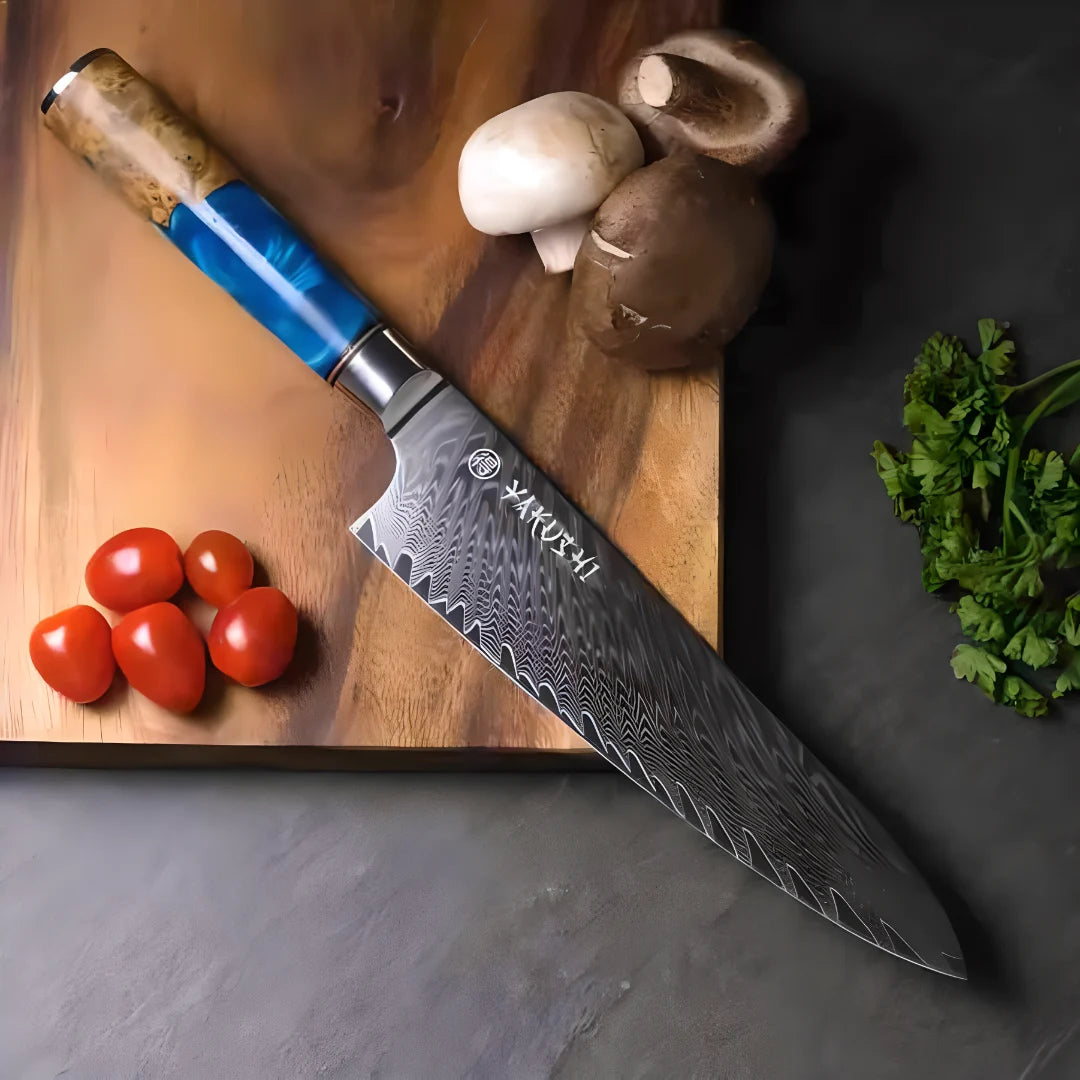
An 8-inch, 198g chef knife with a VG-10 stainless cutting core, 67-layer Damascus construction, double-bevel edge, full tang, and a wood-and-blue-resin handle.

Includes an 8-inch chef knife, 5-inch Santoku, and 3.5-inch paring knife with Damascus-clad carbon-steel blades, HRC 60+ hardness, double-bevel edges, and Pakka wood handles.
Buying criteria
The blade should be long enough for your common ingredients but comfortable on your board. An 8-inch chef knife is broadly useful, while shorter Santoku knives suit compact workspaces.
Choose a curved profile for gentle rocking and broad versatility. Choose a straighter profile when you prefer controlled chopping and forward push cuts.
Handle shape, blade weight, grip, knuckle clearance, and balance determine how controlled the knife feels through repeated cuts.
Stainless and stainless-clad blades generally simplify everyday care. Steel name alone does not determine performance; geometry, heat treatment, sharpening, and use also matter.
Double-bevel knives are approachable for most home cooks and can generally be used by either hand. Confirm the individual knife’s actual construction before purchasing or sharpening it.
Use wood or a suitable synthetic surface. Glass, stone, ceramic, and metal surfaces can accelerate edge damage and wear.
A practical setup
Begin with the blade that handles most of your vegetables, fruit, herbs, and boneless protein preparation.
Add a paring knife for peeling, trimming, scoring, berries, garlic, and other detailed work.
Add a Nakiri when vegetables dominate your routine or another specialty knife when a recurring task genuinely requires it.
Technique and care
Continue your research
Frequently asked questions
For most home cooks, an approximately 8-inch Gyuto or Japanese-style chef knife is the best single meal-prep knife. It offers useful reach for vegetables and boneless proteins while remaining manageable for herbs, fruit, and everyday board work.
Choose a Gyuto when you want more blade length, reach, and broad versatility. Choose a Santoku when you prefer a shorter, more compact multipurpose knife for smaller portions or workspaces.
One versatile chef knife can handle many core chopping, slicing, dicing, mincing, and boneless protein tasks. A paring knife, bread knife, or specialized blade may still be useful for work the chef knife is not designed to perform.
An 8-inch chef knife is broadly useful for home meal prep, but blade length should match your cutting board, hand size, workspace, ingredients, and preferred weight.
A Nakiri is a strong dedicated choice for vegetable-heavy prep because its tall rectangular blade and comparatively straight edge suit chopping, push cutting, slicing, and repetitive board work.
A suitable chef knife can portion boneless meat, poultry, cooked proteins, and fish fillets. Do not use a precision chef knife on bones, frozen food, or for twisting and high-impact chopping.
A double-bevel knife is generally the more approachable and versatile choice for home meal prep. Single-bevel knives are specialized tools that require technique and sharpening suited to their particular construction.
Use a wood or suitable synthetic cutting board, hand wash with mild soap, dry immediately, and store the blade safely. Avoid dishwashers, glass boards, bones, frozen food, prying, twisting, and scraping with the cutting edge.
Technical references
Knife-style and care references: Korin Gyuto guide, Korin Santoku guide, Shun Use & Care, and the current Yakushi product specifications.