
Rinse promptly
Do not leave food residue drying on the blade, particularly after cutting acidic or salty ingredients. Move the knife safely away from the preparation area once you finish using it.
Cleaning, storage and edge care
Learn the simple habits that protect a Japanese knife’s edge, blade, finish and handle—without relying on rigid schedules or one-size-fits-all sharpening advice.
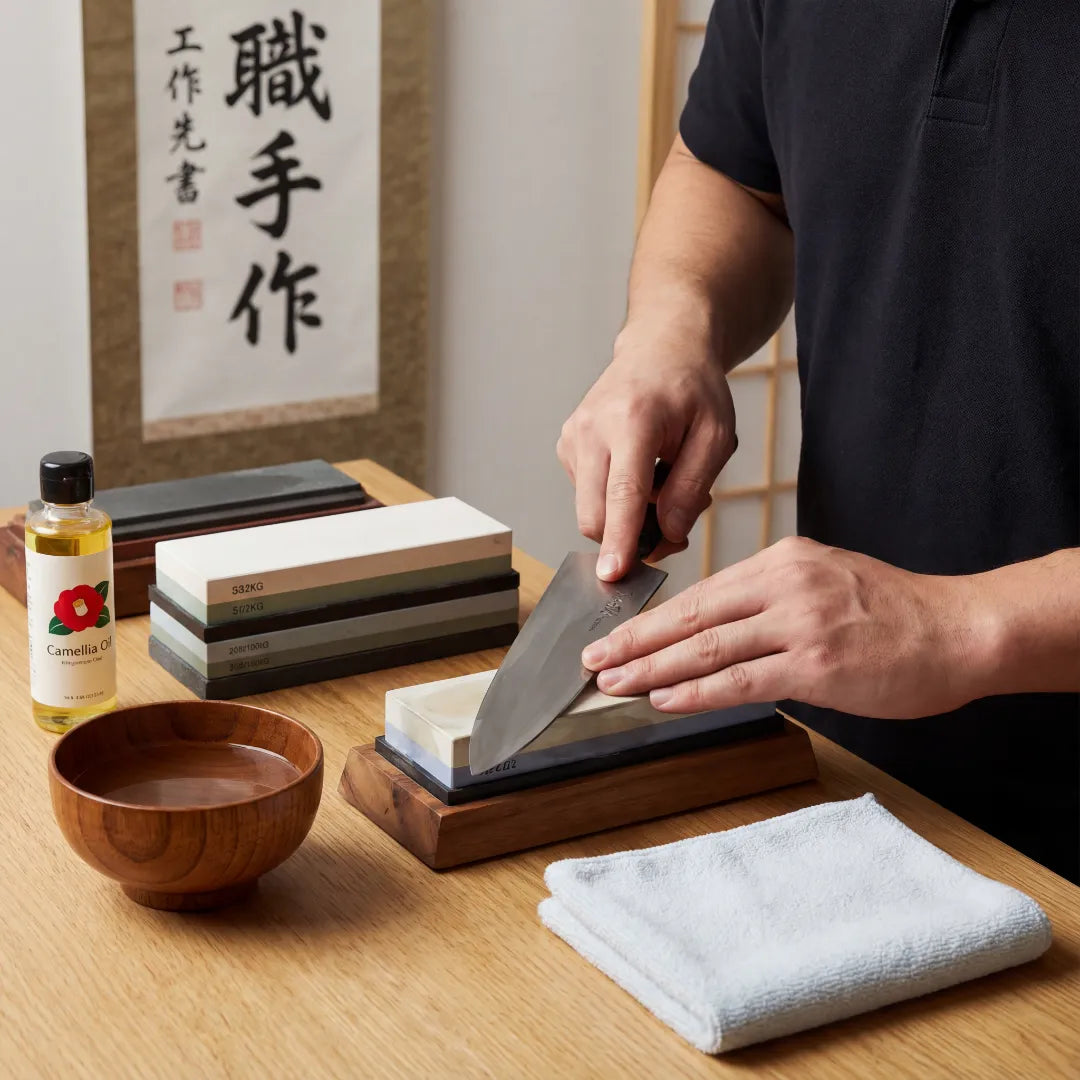
The essential routine
Use the knife only for an appropriate cutting task, hand-wash it promptly, dry the blade and handle completely, and store it where the edge cannot contact other utensils.
Use a wood or suitable plastic cutting board and sharpen the knife when cutting performance declines—not merely because a fixed number of weeks has passed.
After every use
These four habits do more to prevent corrosion, accidental damage and premature dulling than an elaborate maintenance schedule.
Do not leave food residue drying on the blade, particularly after cutting acidic or salty ingredients. Move the knife safely away from the preparation area once you finish using it.
Use warm water, mild dish soap and a soft sponge or cloth. Keep the edge facing away from your hand and never leave a knife concealed beneath water in a sink.
Towel-dry the blade, spine, handle and the junction between them. Pay extra attention to hammered or textured areas where droplets can remain.
Place the dry knife in a suitable block, sheath, in-drawer tray, knife case or secure magnetic holder. Never toss it loose among metal utensils.
Dishwasher heat, prolonged moisture, detergent and contact with other objects can damage the edge, blade finish and handle. Even a knife described as stainless is better protected by prompt hand-washing and drying.
Prevent chips and corrosion
Protect the edge while cutting
Every cut ends against the board. A suitable surface yields slightly beneath the edge instead of acting like a hard countertop.
Let the edge cut with a smooth push, pull or rocking motion suited to the blade profile. Avoid forceful impacts and lateral pressure. If a knife becomes stuck in dense food, lift it out carefully rather than twisting the blade sideways.
Repeatedly dragging the sharpened edge sideways across a board can degrade the apex. Turn the knife over and use its spine, or use a bench scraper, when moving chopped ingredients.
Know the blade material
“Stainless” means corrosion-resistant, not corrosion-proof. Reactive carbon steel needs greater attention, but both benefit from immediate cleaning and thorough drying.
Stainless steels are generally more forgiving, but prolonged moisture exposure can still cause staining, corrosion or pitting.
Follow the knife maker’s instructions before applying oil. If used, apply only a thin film to a clean, dry blade and wipe away excess before the knife returns to food preparation.
Reactive carbon steel can develop blue, grey or dark coloration known as patina. This is different from powdery orange-brown rust or pitting. If you are unsure what you see—or the blade has a special etched, Kurouchi or Kasumi finish—ask an experienced knife professional before using abrasives.
Maintain the cutting edge
There is no universal sharpening interval or angle for every Japanese knife. Use your knife’s performance and the manufacturer’s guidance to choose the right method.
Sharpening forms a new cutting apex using an abrasive stone or professional equipment. It is appropriate when the knife no longer slices cleanly after ordinary touch-up care.
A honing rod can realign or lightly abrade an edge, depending on the rod. Some thin, hard Japanese edges should not be maintained on a conventional grooved steel. Follow the knife maker’s recommendation.
Stropping can refine or deburr an already established edge using very light pressure. It does not replace sharpening when the edge is genuinely dull or damaged.
| What you notice | Likely next step | Important caution |
|---|---|---|
| The knife still cuts but has lost some refinement | Consider an approved strop, fine stone or appropriate honing method | Use light pressure and follow the specified edge angle |
| The blade slips on tomato skin or crushes rather than slices | Sharpen the knife or use a qualified sharpening service | Do not compensate by applying excessive force |
| The edge has visible chips | Use a lower-grit repair process or professional service | A fine finishing stone is not designed for major chip removal |
| A single-bevel knife needs correction | Use the correct single-bevel technique or professional service | Sharpening it like a standard double-bevel knife can alter its geometry |
This is a fine-grit stone intended for refining and polishing an already established edge. A severely dull or chipped knife normally requires a coarser stone or professional repair before progressing to 3000 and 8000 grit.
Safe between uses
Use slots that comfortably fit the blade without forcing the edge against a hard surface. Keep the holder clean and store only completely dry knives.
Choose a secure rack with a blade-friendly contact surface. Attach and remove the knife in a controlled motion so the edge does not strike the rack.
A correctly sized sheath protects a knife in a drawer or during transport. Never cover a damp blade, and do not rely on a loose guard that can slide off.
Do not overlook the handle
Handle materials vary. Natural unfinished wood, stabilized wood, resin composites and synthetic handles do not all need the same treatment.
Food-safe mineral oil or a suitable wood-care product may help an unfinished natural-wood handle. Do not assume every handle should be oiled: stabilized wood, sealed wood, resin and composite handles may need no oil at all. Follow the product instructions for your knife.
Troubleshooting
| Problem | Immediate action | When to seek professional help |
|---|---|---|
| Light surface discoloration | Clean and dry the blade; determine whether it is patina or rust | If you cannot identify it or the knife has a specialized finish |
| Orange-brown rust | Stop using the knife on food until the rust is safely removed | For pitting, widespread corrosion or uncertainty about refinishing |
| Small edge chip | Do not keep cutting hard ingredients or attempt to bend the edge back | If you lack the correct coarse stone and repair technique |
| Loose or cracked handle | Stop using the knife until the handle is secure | For movement, cracking, gaps or moisture intrusion |
| Severely dull edge | Use a suitable sharpening progression rather than greater cutting force | For single-bevel knives or when the original geometry is uncertain |
Yakushi care tools
These current products support edge refinement, protected storage and an appropriate cutting surface. Prices and availability update automatically from Shopify.

A fine dual-sided water stone for refining, smoothing and polishing an established kitchen-knife edge.

Countertop storage with eight individual slots for compatible kitchen knives.

A substantial wood preparation surface for everyday chopping, slicing and serving.
Simple maintenance plan
Inspect and maintain the knife according to its condition and use rather than following arbitrary weekly or monthly sharpening rules.
| When | What to do | Why |
|---|---|---|
| After every use | Hand-wash, dry and store the knife safely | Limits corrosion, handle damage and accidental edge contact |
| During extended prep | Wipe reactive blades between wet, acidic or salty ingredients | Reduces prolonged exposure on carbon steel |
| When cutting declines | Test the edge and use an appropriate touch-up or sharpening method | Restores performance without unnecessary steel removal |
| Before extended storage | Clean, dry and inspect; protect reactive steel if recommended | Prevents unnoticed moisture or corrosion during storage |
| Whenever damage appears | Stop using the knife and assess repair requirements | Prevents a chip, loose handle or rust spot from worsening |
Continue learning
Frequently asked questions
No. Hand-washing is the safer method. Dishwasher heat, detergents, moisture and contact with other objects can damage the edge, finish and handle.
Use warm water, mild dish soap and a soft sponge or cloth. Keep the edge facing safely away from your hand, rinse thoroughly and towel-dry the blade and handle immediately. Do not soak the knife or leave it hidden in a sink.
Sharpen according to performance rather than a universal calendar. If the knife slips on food, crushes ingredients or requires more pressure than normal, inspect the edge and sharpen it using the correct method and angle for that knife.
It depends on the knife and the honing tool. A conventional grooved steel may be unsuitable for some thin, hard Japanese edges. Follow the manufacturer’s instructions or use an approved ceramic rod, strop, fine stone or professional service.
Use a well-maintained wood board or an appropriate food-safe plastic board that yields slightly beneath the edge. Avoid glass, ceramic, granite, marble and metal cutting surfaces.
Patina commonly appears as blue, grey or dark coloration on reactive carbon steel. Active rust is generally orange-brown and may become powdery or create pitting. If you are unsure, stop using the knife on food and consult an experienced knife professional.
Reactive carbon-steel blades may benefit from a very thin layer of food-safe blade oil during extended storage or humid conditions. Many stainless blades do not require routine oiling. Follow the instructions for the specific steel and remove excess oil before use.
Store the clean, completely dry knife in a properly sized block, sheath, in-drawer tray, knife case or secure magnetic holder. The edge should not contact other knives or utensils, and the storage location should be inaccessible to children.
Small habits, better protection
Prompt washing, thorough drying, a suitable board and protected storage provide the foundation. Sharpen only with a method appropriate for your blade.