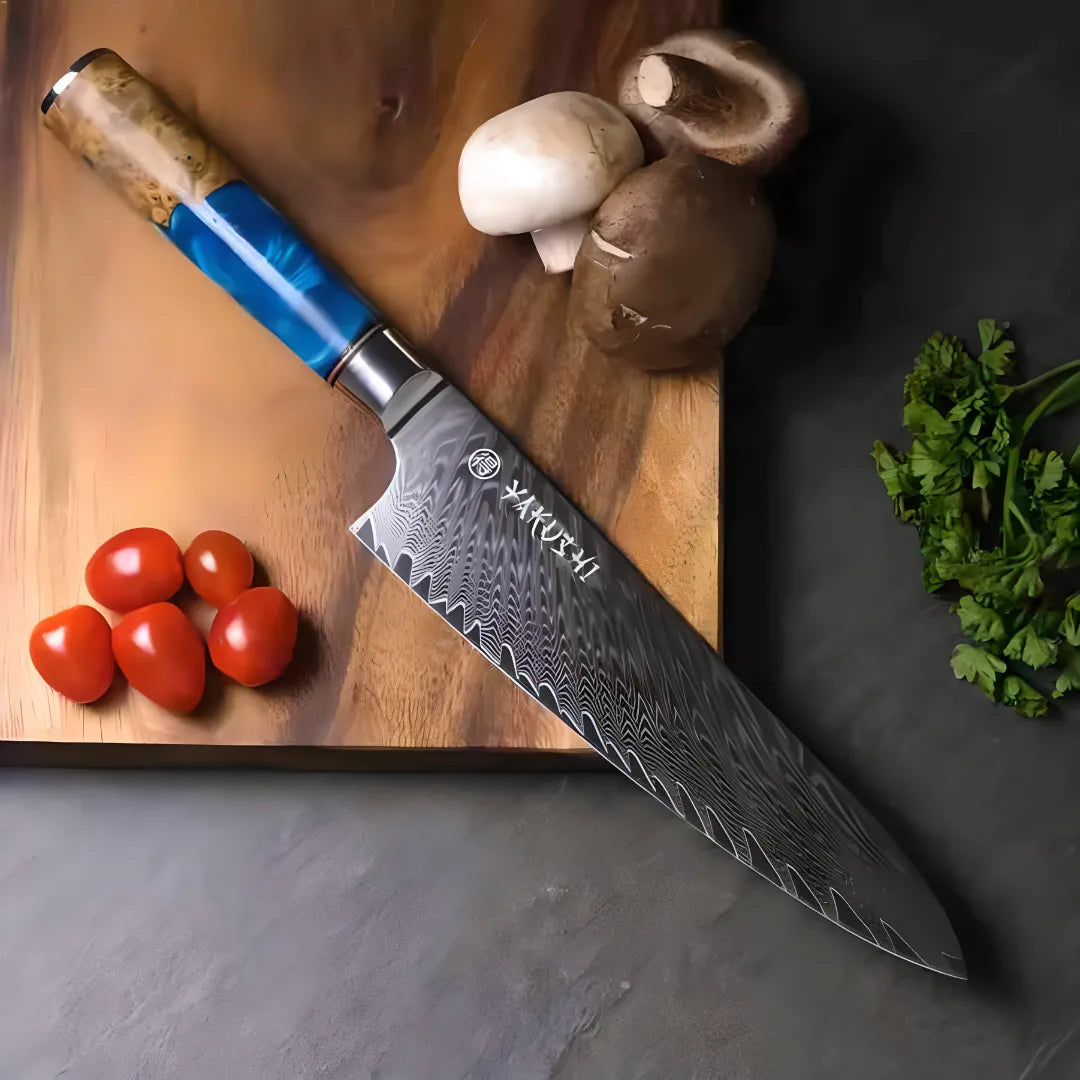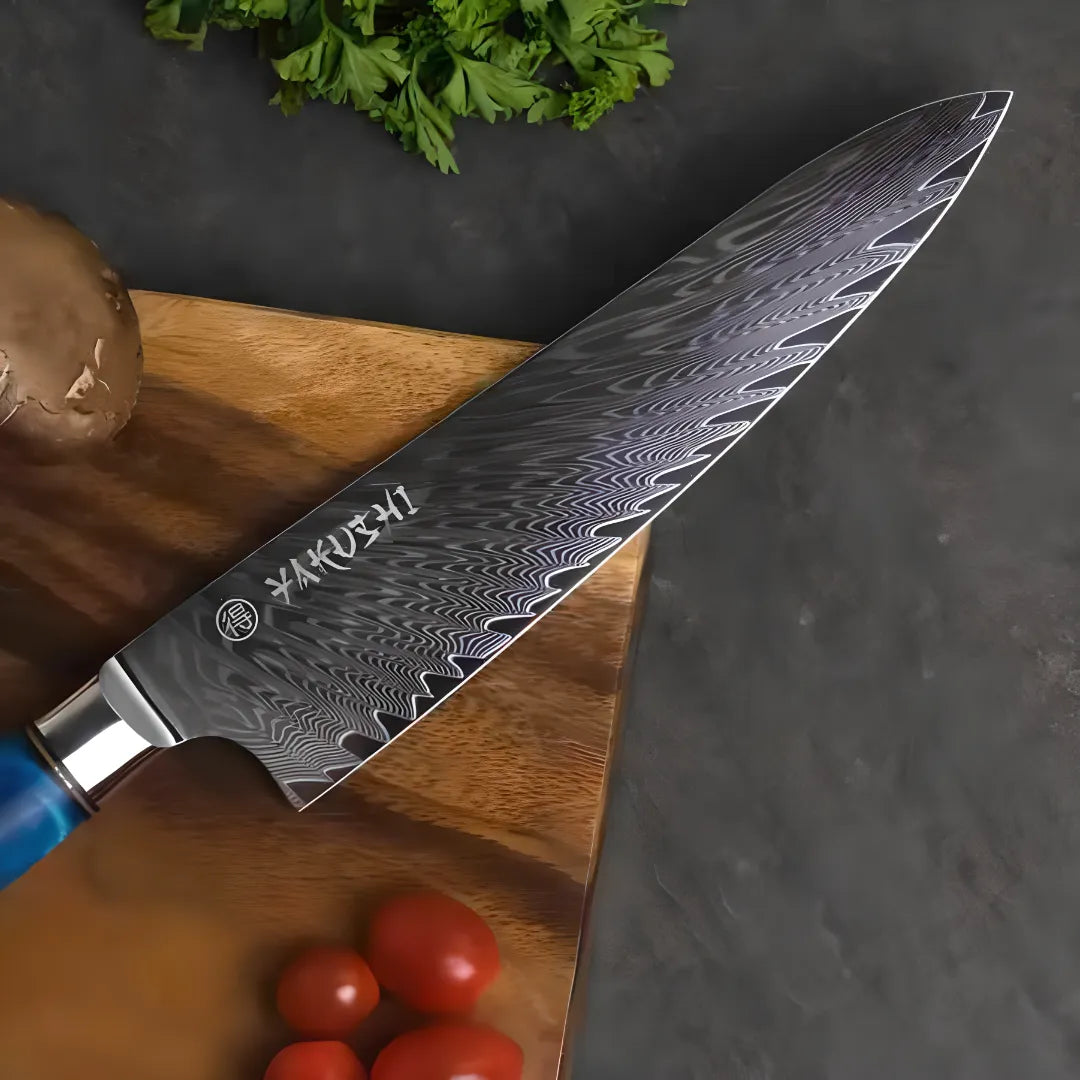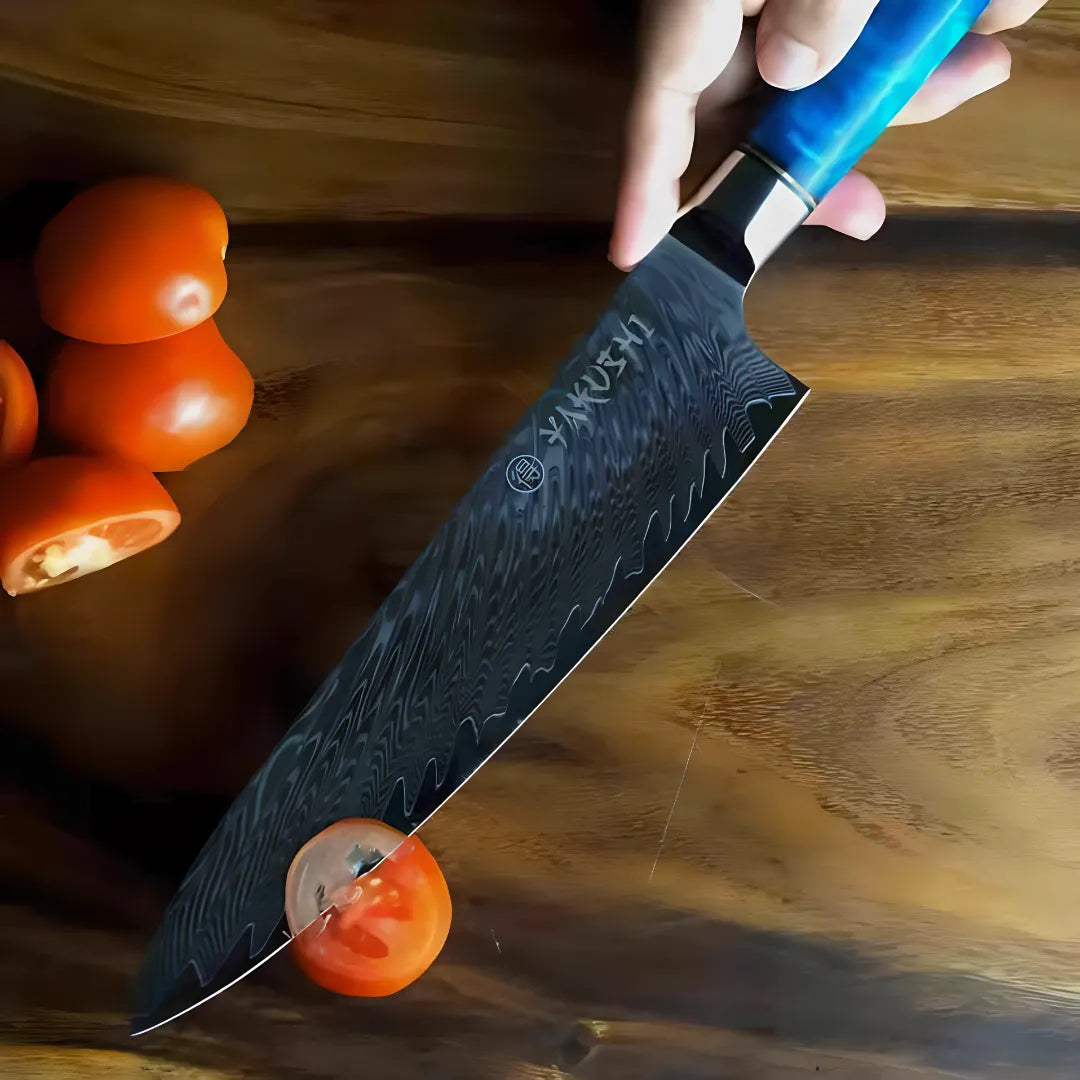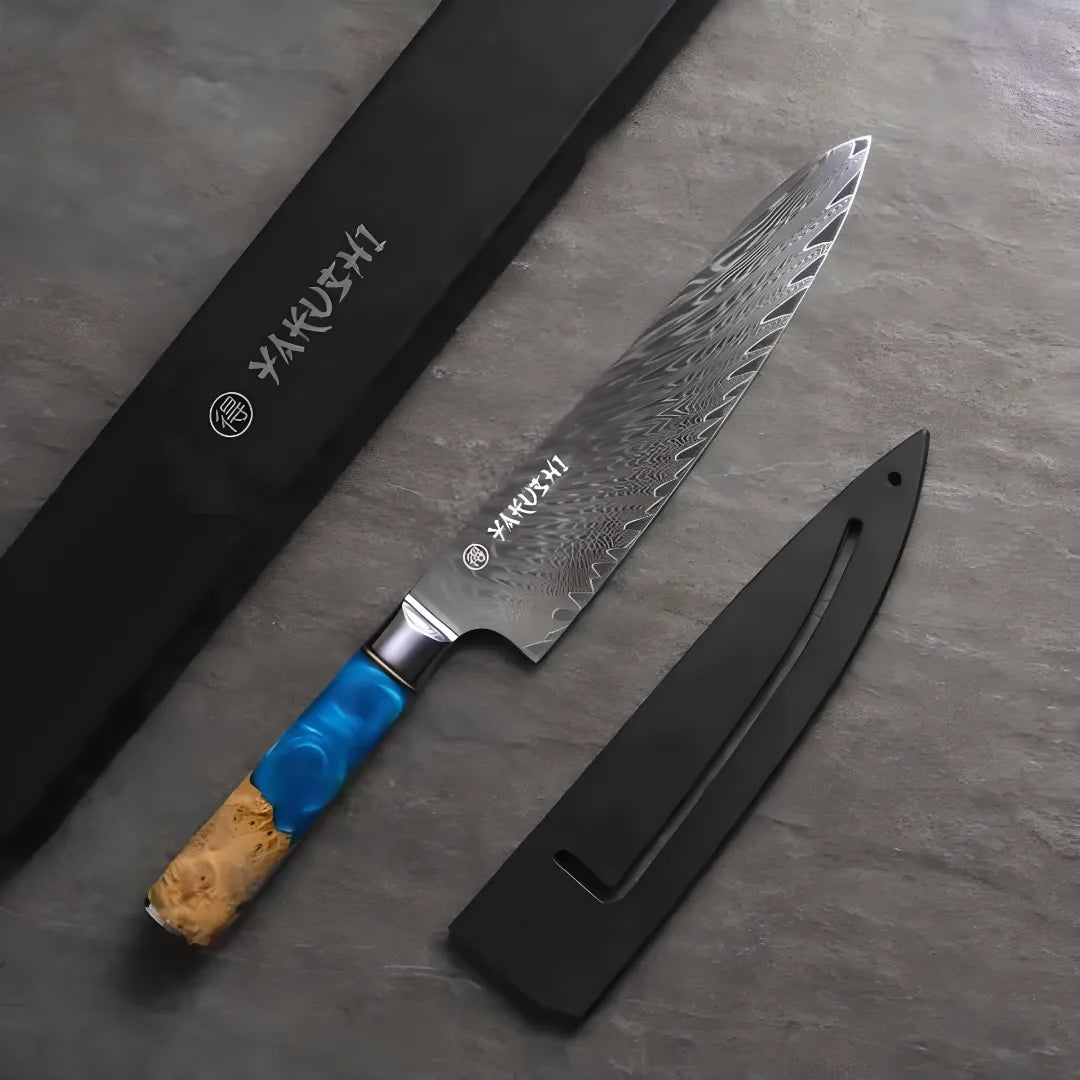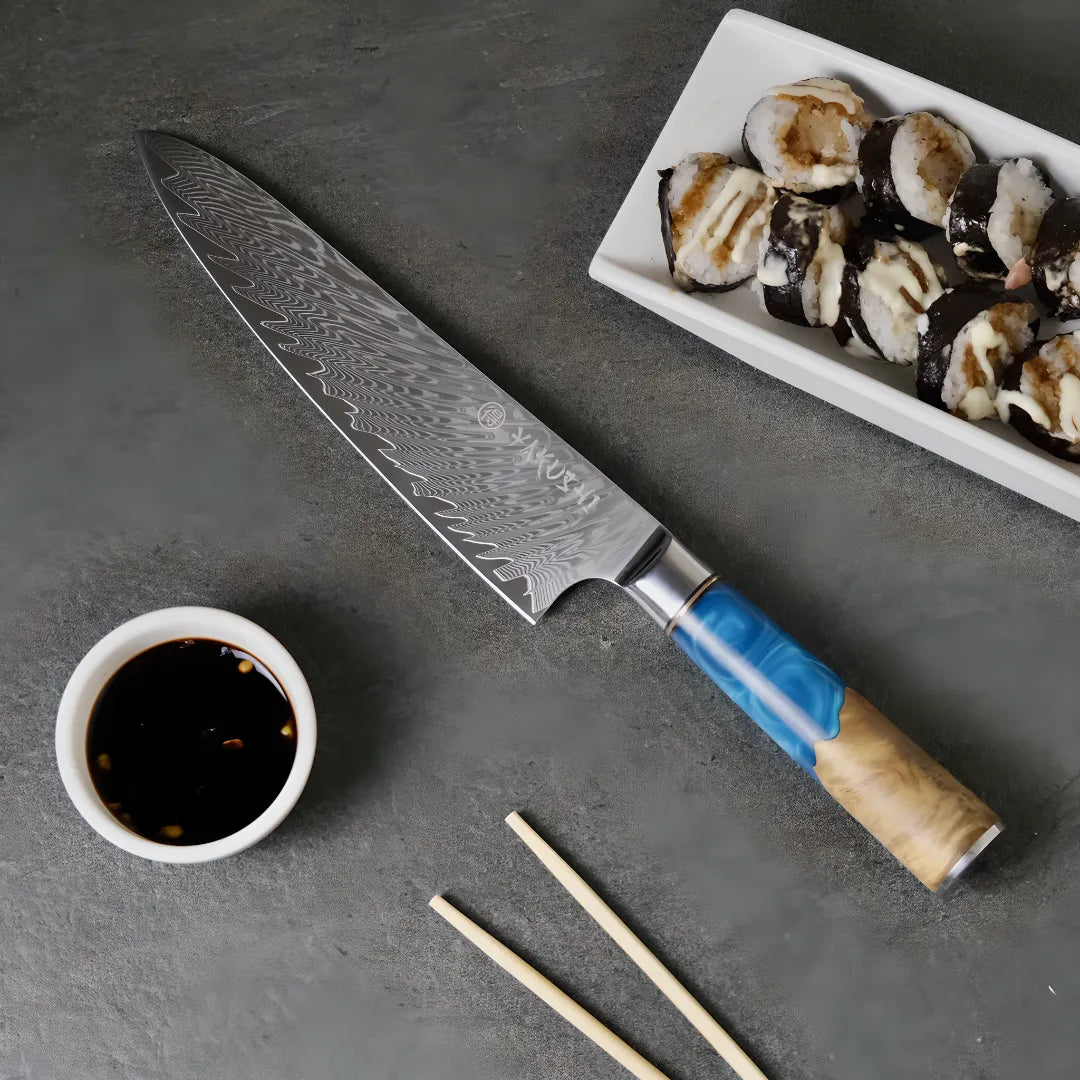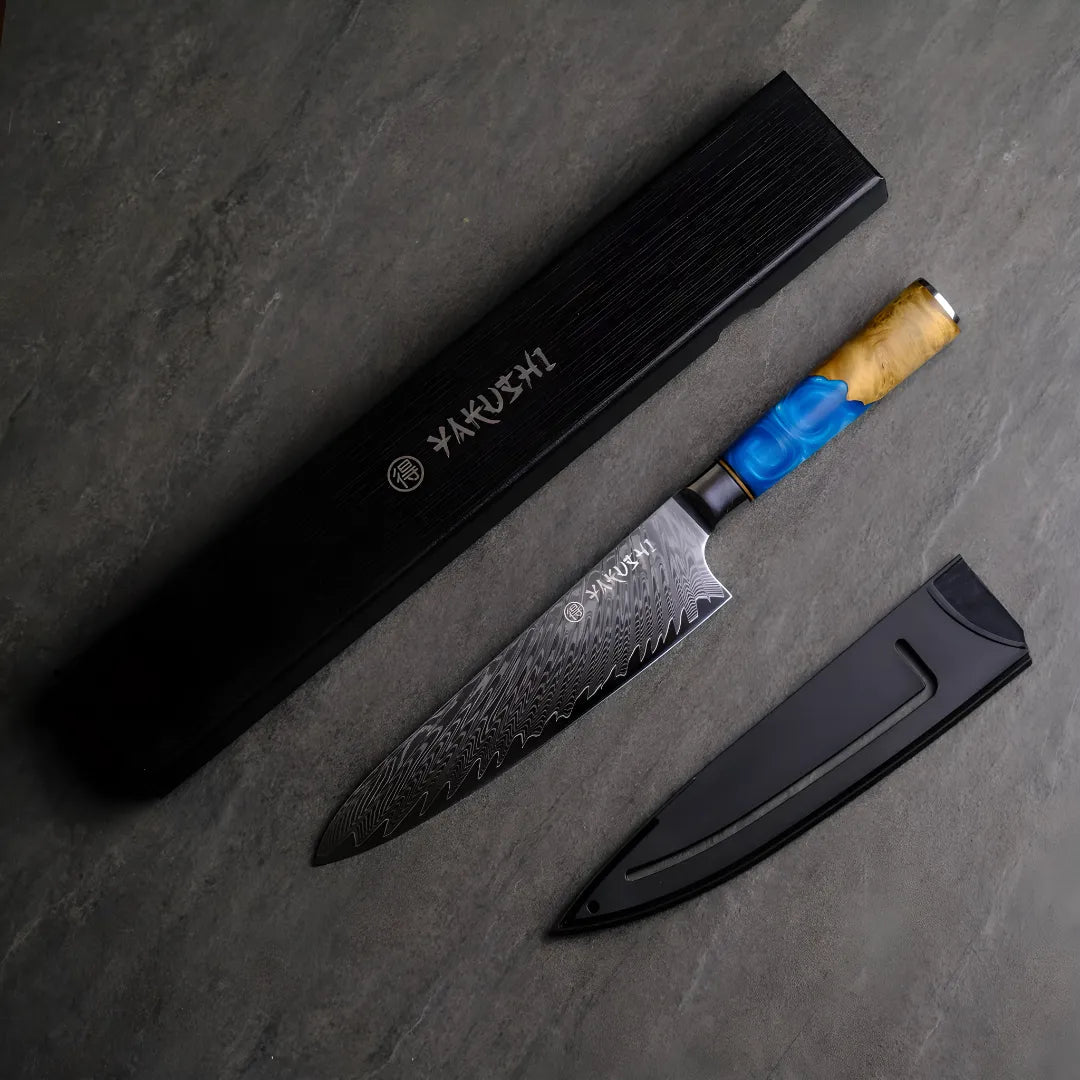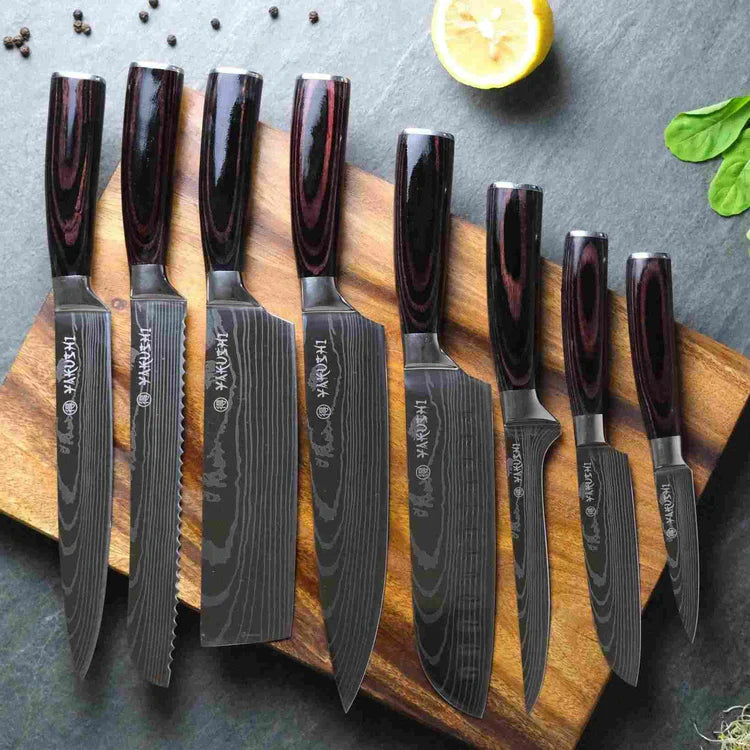
A Damascus steel chef knife is a high-performance kitchen tool featuring a blade constructed from multiple layers of steel forge-welded together. This layering process surrounds a hard inner cutting core with flexible outer cladding, resulting in exceptional edge retention and a distinct, wavy surface pattern reminiscent of flowing water.

A classy handcrafted
chef's knife, will impress
anyone.
Whether you're inviting guests over or just cooking for yourself, the Yakushi™ Damascus Chef Knife will make a lasting impression on yourself, your guest and your kitchen. Handcrafted with premium and durable materials, and equipped with a very elegant handle, these knives are for chefs and home-cooks alike.
You will undoubtedly take your cooking to the next level with the Yakushi Damascus Chef Knife!

Don't sacrifice comfort for good looks.
It's possible to have both.
The Yakushi™ Damascus Chef Knife offers perfect balance between the handle and blade. This balance is crucial to alleviate some weight of your hands and wrists, allowing you to continue with your cooking sessions without fatiguing. Let the knife do the work.

That's enough showboating, it's time to
Meet The Chef's Knife.

8" Japanese Damascus Steel Chef Knife | Authentic Forged VG-10 Super Steel
Professional Precision for the Serious Home Cook
Most kitchen knives force you to choose between visual art and pure cutting performance. The Yakushi™ Japanese Damascus Knife delivers both. Handcrafted by master artisans using centuries-old bladesmithing traditions, this 8-inch Damascus steel chef knife transforms your daily meal prep from a chore into a seamless, tactile experience.
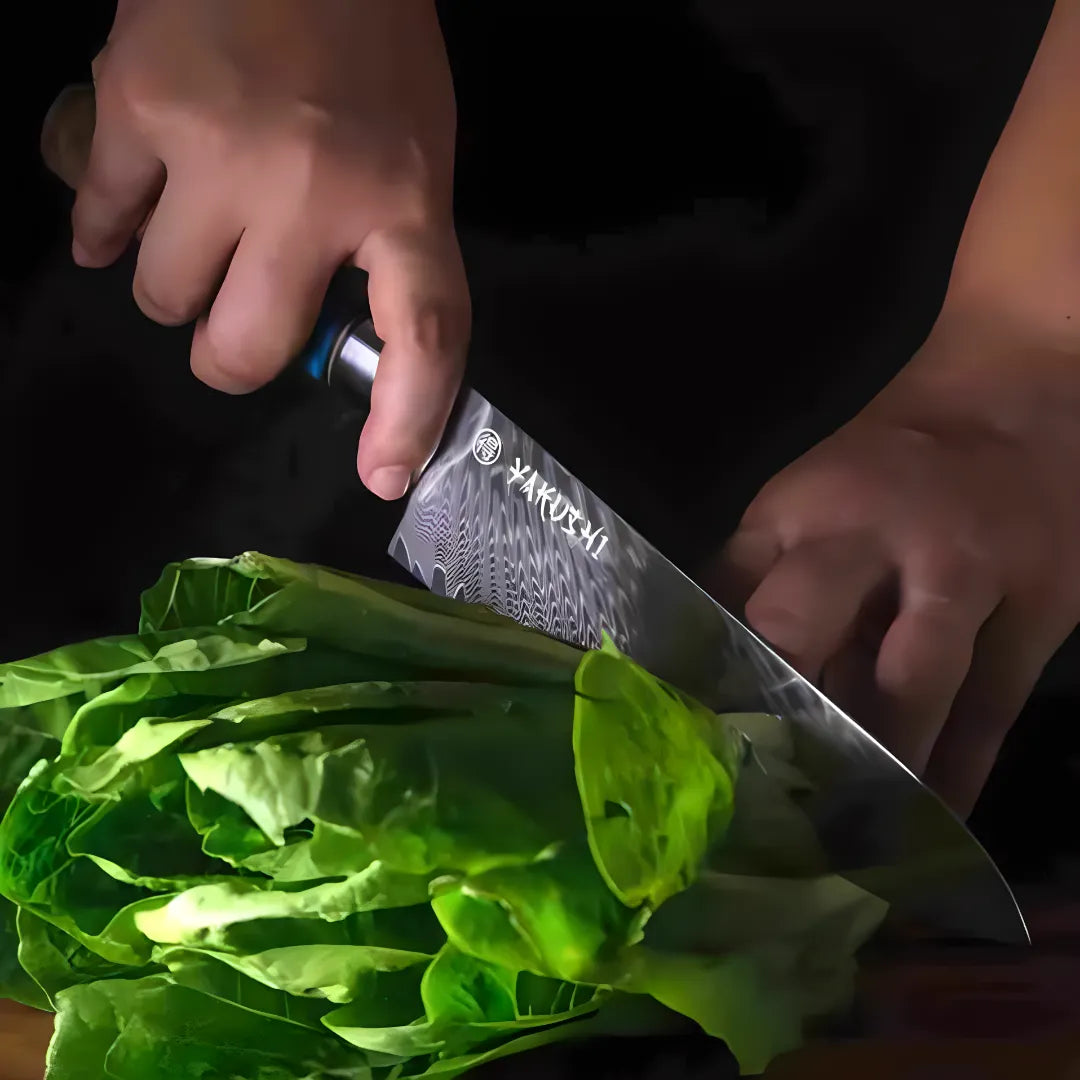
Whether you are dicing fibrous root vegetables, slicing delicate raw proteins, or mincing fresh herbs, this versatile Damascus kitchen knife lets the blade do the work—gliding through ingredients with zero drag or wedging.
Is This Real Damascus Steel?
This knife has a Damascus-style patterned finish over a Japanese steel blade. It is designed for sharpness, edge retention, and visual appeal, but it should not be confused with hand-forged artisan Damascus blades from individual Japanese blacksmiths.
The Technical Specs: Engineered for Edge Retention
Attribute
Specification
Performance Advantage
Core Material
Japanese VG-10 Super Steel
High carbon content (~1.0%) ensures maximum edge hardness and retention.
Cladding Layer
67-Layer Forged Damascus Steel
Protects the inner core from corrosion and dampens hand vibration.
Hardness Rating
60-62 HRC (Rockwell Scale)
Significantly outperforms softer Western knives (56-58 HRC) for long-term sharpness.
Edge Angle
Razor-Sharp 15° Double-Bevel
Ultra-thin geometry yields effortless, surgical precision slices with every motion.
Weight & Balance
198 Grams (Balanced at the Bolster)
Minimizes wrist fatigue during extended, heavy volume prep sessions.
What Makes This a Damascus Steel Chef Knife?
Historically, Damascus steel was famous for its wavy, water-like patterns and legendary strength. Today, our Damascus steel chef knife achieves this through a premium process called pattern-welding.
We take a high-carbon cutting core and forge-weld 66 layers of alternating premium stainless steel alloys over it (33 layers per side). The blade is then meticulously acid-etched. Because different steel alloys react differently to the acid, the stunning, high-contrast flowing wave pattern is revealed. Every single pattern is entirely unique to that specific blade—it is structural, not laser-printed on the surface.
Who This Damascus Chef Knife Is Best For?
This high-performance kitchen tool is engineered for:
- Passionate Home Cooks: Enthusiasts who want to elevate their culinary skills, speed up prep time, and appreciate the tactile joy of effortless cutting.
- Culinary Professionals: Line cooks and chefs looking for a striking, reliable daily driver that maintains a razor edge through long, demanding kitchen shifts.
- Aesthetic Collectors: Anyone who believes kitchen tools should be as beautiful as they are functional. It makes a stunning centerpiece for open-concept kitchens.
Damascus Steel vs. Regular Stainless Steel Chef Knives
Traditional Western stainless steel knives (often made of softer steels like X50CrMoV15) are durable but dull quickly. Here is how they compare to Yakushi Damascus:
Feature
Regular Stainless Steel
Yakushi Damascus (VG-10)
Hardness (Rockwell)
Soft (55-56 HRC)
Hard (60-62 HRC)
Edge Retention
Low (Needs frequent honing/sharpening)
Exceptional (Holds an edge for months)
Blade Geometry
Thick, heavy profile
Thin, lightweight, laser-precise
Visual Appeal
Monolithic, plain gray
Unique, layered flowing-wave artwork
Japanese Damascus Chef Knife vs. Western Chef Knife
The differences between a traditional Western (German/French) knife and a Japanese Damascus knife dictate how they perform on the cutting board:
- The Edge Angle: Western knives are typically sharpened to a thick 20-degree angle on each side to withstand abuse. Our Japanese Damascus knife features an ultra-thin 15-degree double-bevel edge, allowing for surgical precision and drastically cleaner cuts.
- The Profile: Western knives have a heavy, curved belly meant for continuous rocking motions. Our knife favors a flatter, lighter Japanese profile optimized for precise push-cutting, dicing, and clean chopping.
VG-10 Core Steel: Why It Matters
The secret to our knife’s performance lies at its center. While the outer 66 layers provide flexibility and stunning aesthetics, the actual cutting edge is made of Japanese VG-10 Super Steel.
The Chemistry of Sharpness: VG-10 is a gold-standard alloy enriched with Carbon (for extreme hardness), Chromium (for rust resistance), Cobalt (for structural strength), and Vanadium (for incredible wear resistance).
This composition allows the steel to be hardened to 60-62 HRC, meaning it can be ground to an incredibly fine edge that won't roll, fold, or dull easily under heavy use.
What You Can Cut With This Knife
This 8-inch chef knife is the ultimate kitchen workhorse. It is perfectly optimized for:
- Proteins: Slicing raw or cooked boneless meats, trimming brisket, dicing chicken, and precision-slicing delicate seafood or sushi.
- Vegetables: Effortlessly dicing onions, julienning bell peppers, mincing garlic, and slicing hard root vegetables like sweet potatoes without wedging.
- Herbs: Chiffonading basil or chopping cilantro cleanly without bruising the leaves (which causes bitter browning).
What NOT to Cut With a Damascus Chef Knife
- Frozen foods or solid blocks of ice.
- Animal bones (chicken carcasses, beef bones, pork ribs).
- Hard shells (coconuts, squash stems, or hard seafood shells).
- Hard surfaces: Never cut on glass, ceramic, stone, or stainless steel countertops. Stick strictly to wood, bamboo, or high-quality plastic cutting boards.
How to Care for a Damascus Steel Chef Knife
Premium maintenance guarantees a lifetime of peak performance. Follow these simple rules:
- Hand Wash Only: Wash with warm water and mild dish soap immediately after use. Never put it in the dishwasher, as the heat and chemicals will ruin the edge and handle.
- Dry Immediately: Wipe the blade completely dry with a clean towel before storing it. Do not let it air dry in a dish rack.
- Proper Storage: Store the blade in a wooden knife block, on a magnetic knife strip, or in a protective sheath. Never drop it loose into a utensil drawer where other metals can nick the edge.
Is a Damascus Chef Knife Worth It?
Absolutely. While the initial investment is higher than a mass-manufactured supermarket knife, a premium Damascus chef knife pays for itself over a lifetime of use. You aren't just buying a blade; you are investing in a tool that retains its value, prevents hand fatigue through superior balance, minimizes food prep time, and serves as a piece of functional art you will be proud to use every single day.
Why Passionate Cooks Choose the Yakushi Damascus Chef Knife
Authentic 67-Layer Pattern-Welded Forging
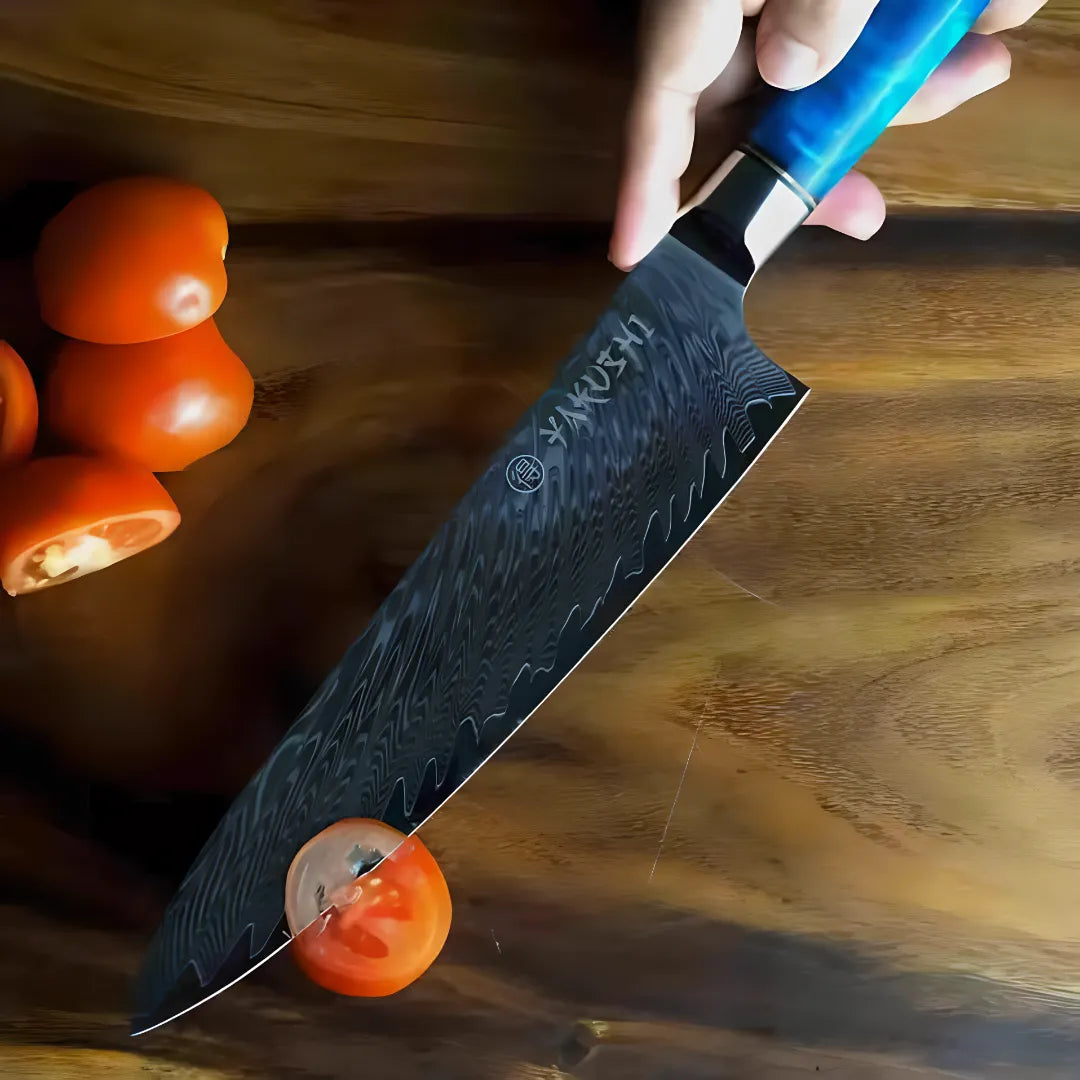
Unlike mass-produced, laser-etched imitations, the swirling wave pattern on every single Yakushi Japanese Damascus kitchen knife is entirely unique. It is the physical result of high-carbon steel alloys being repeatedly folded and forge-welded together. This multi-layered construction creates functional micro-serrations along the 15-degree edge, enabling the blade to bite cleanly into slick ingredients like tomato skins without bruising them.
Ergonomic Balance & Seamless Control
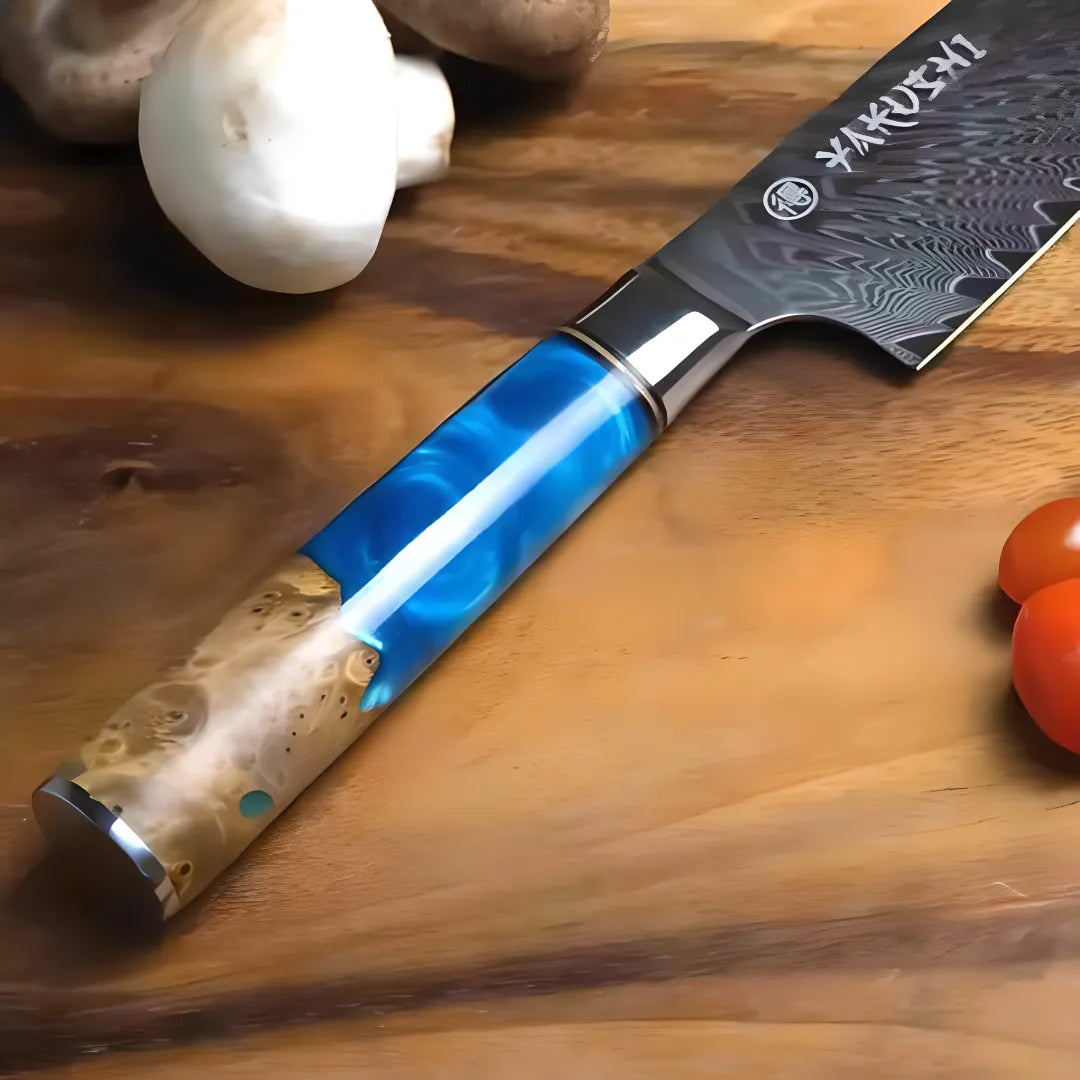
A premium Damascus cooking knife is only as good as its handling. The contoured handle features a premium blend of stabilized natural wood and deep blue liquid resin. Ergonomically shaped to fill the palm, it provides a confident, non-slip grip under wet conditions. The precise balance point rests directly at the bolster, giving you absolute authority over both rocking motions and straight push-cuts.
Check Out The Live Unboxing
They say a picture says a thousand words. We think a video says even more. Dive into the unboxing of the best-selling Yakushi Knives and experience the extreme sharpness and robustness of our Damascus Steel Chef Knife.
Don't Just Take Our Word For It.
Cooks Around The World Have Spoken.
Got any home cook friends?
Save up to up to 75$ on your gifts.
Buy 2 Damascus Chef Knives = Save $15 per knife - $30 in total.
Buy 3 Damascus Chef Knives = Save $25 per knife - $75 in total.

Still unsure?
We tried answering most questions below.
What is a Damascus steel chef knife?
What is the blade material of the Damascus steel chef knife?
The blade of the Damascus steel chef knife is made up of 67 Layer Damascus Japanese Damascus Steel. This material is known for its excellent edge retention capacities, resulting in sharp edges for longer.
What is the blade length of the Damascus steel chef's knife?
The length of the Damascus steel chef knife is 8 inches / 20.32.
Is Damascus steel better than stainless steel?
Damascus steel is not a single type of metal; it is a construction method. A Damascus blade utilizing a premium core like VG-10 outperforms traditional Western stainless steel knives by offering vastly superior edge retention, a thinner and sharper cutting geometry, and a unique aesthetic, while still maintaining excellent stain and rust resistance.
Can it cut meat?
Can it cut meat?
Can it cut bones?
No. This knife is engineered for precision slicing, not high-impact hacking. Attempting to cut through poultry bones, beef bones, frozen foods, or dense rinds can cause the hard, rigid VG-10 edge to micro-chip. For bones, use a dedicated, heavy-duty meat cleaver.
Is the knife dishwasher safe?
It is recommended not to wash the Damascus steel chef knife with the dishwasher as it can damage the blade and the handle. It can cause the blades to rust, corrode or discolor.
Is this a Japanese Damascus knife?
Yes. This knife follows classic Japanese bladesmithing traditions. It features an authentic Japanese VG-10 super-steel core, a hard 60–62 HRC rating, a lightweight profile, and a razor-sharp 15-degree double-bevel cutting edge tailored for precision work.
Can left-handed cooks use it?
Absolutely. Because the blade features an even 50/50 double bevel and a symmetrical, ergonomically contoured handle, it functions perfectly for both right-handed and left-handed chefs.
What is the handle material of the Damascus steel chef knife?
The handle material of the Damascus steel chef knife is made up of solidified wood and blue resin. It makes the knife appear aesthetically pleasing as well as highly durable. Solidified wood and blue resin is a stable material that ensures the handle of the knives is less likely to break or bend.
What is the core steel?
The core steel—the central layer that forms the actual cutting edge—is authentic Japanese VG-10 Super Steel. The outer 66 layers of the Damascus cladding act as a protective, flexible shield for this ultra-hard core.
What is VG-10 steel?
VG-10 is a premium, high-carbon Japanese stainless steel alloy produced by Takefu Special Steel. It is specially enriched with carbon, chromium, cobalt, and vanadium, allowing it to reach a Rockwell hardness of 60–62 HRC for incredible sharpness without becoming excessively brittle.
What is the blade angle?
The blade features an ultra-thin 15-degree cutting angle on each side. This acute geometry allows the knife to slice through dense or delicate foods effortlessly with minimal cell damage, vastly outperforming thicker 20-degree Western blades.
How do you sharpen a Damascus chef knife?
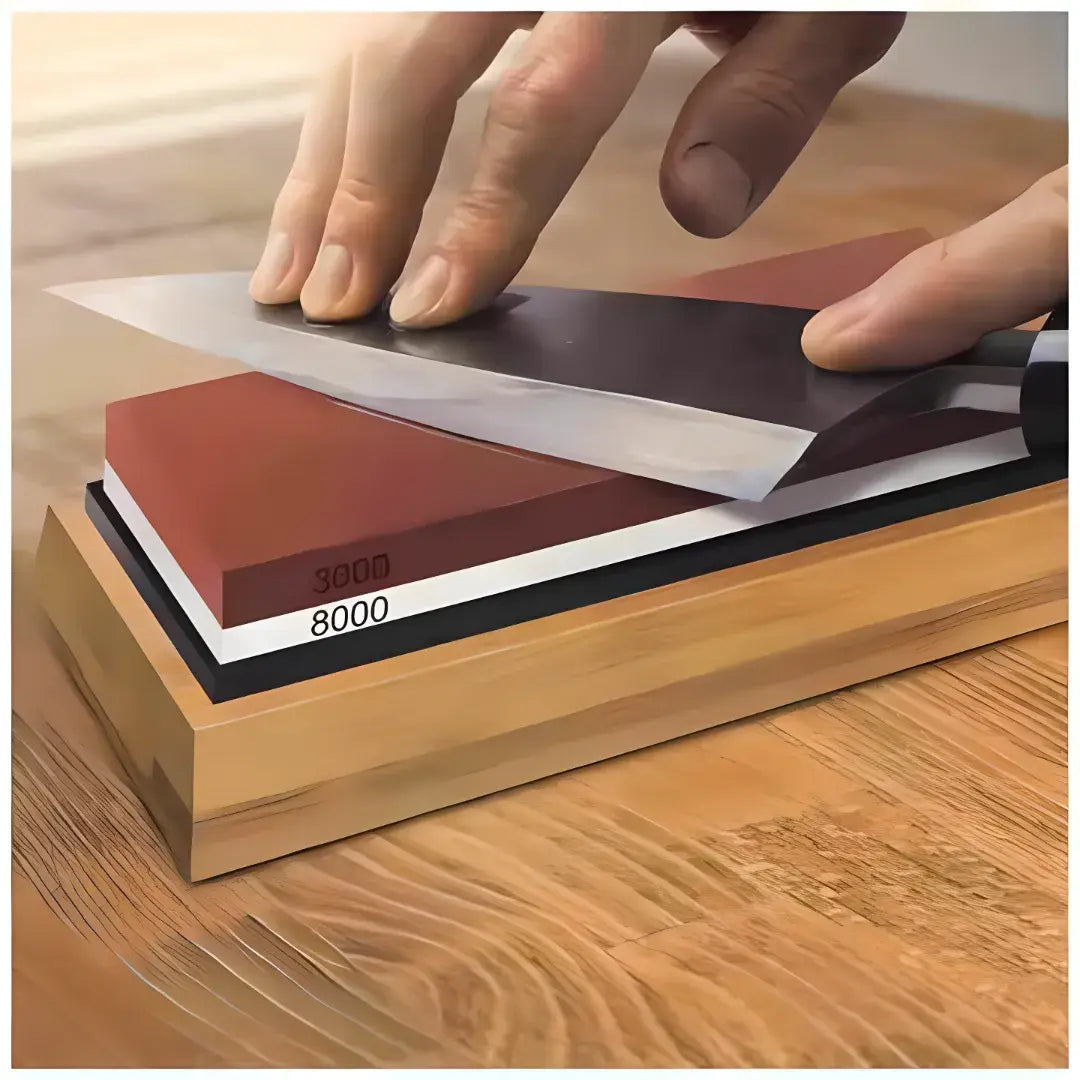
To maintain the precise 15-degree angle, sharpen the blade using a synthetic whetstone (such as a 1000/6000 dual-grit stone). Never use automated electric sharpeners or pull-through desktop gadgets, as they rip away excessive steel and destroy the delicate Damascus profile.
How do you prevent rust?
While VG-10 is a highly stain-resistant stainless steel alloy, you should wash the knife with warm soap and water immediately after prep, then dry it completely with a towel before storing. Do not let it sit wet in a sink or air-dry in a dish rack.
Is the Yakushi Damascus Chef Knife double bevel?
Yes. It features a symmetrical 50/50 double-bevel edge, meaning it is ground evenly at a 15-degree angle on both the left and right sides of the blade.
What is the warranty for the Damascus steel chef's knife?
Our Damascus steel knives are able to last for the longest time that you can imagine but more for your assurance we offer three months warranty and 15 days test return.
How do I maintain and care for a Damascus steel knife?
To preserve the premium VG-10 core and the intricate layered pattern, always wash your knife by hand with warm water and mild dish soap immediately after use. Dry it fully with a soft cloth before storing. Never place high-end Damascus steel knives in a dishwasher, as the high heat and harsh detergents will dull the edge and degrade the handle material.
How often does a VG-10 Damascus cooking knife need sharpening?
Thanks to the exceptional 60-62 HRC hardness of Japanese VG-10 steel, this knife retains its razor-sharp edge significantly longer than traditional stainless steel cutlery. For standard home kitchen use, you will only need to refine the edge on a high-grit whetstone (such as a 3000/8000 grit stone) every few months. Regular light honing on a ceramic rod will keep the micro-edge aligned between prep sessions.
Is the Damascus pattern real or laser-etched?
Every Yakushi blade features authentic, pattern-welded Damascus steel. The signature rippling design runs entirely through the structural composition of the blade—from the spine down to the cutting core—and is brought to life via a meticulous traditional acid-etching process that darkens alternating layers of steel.