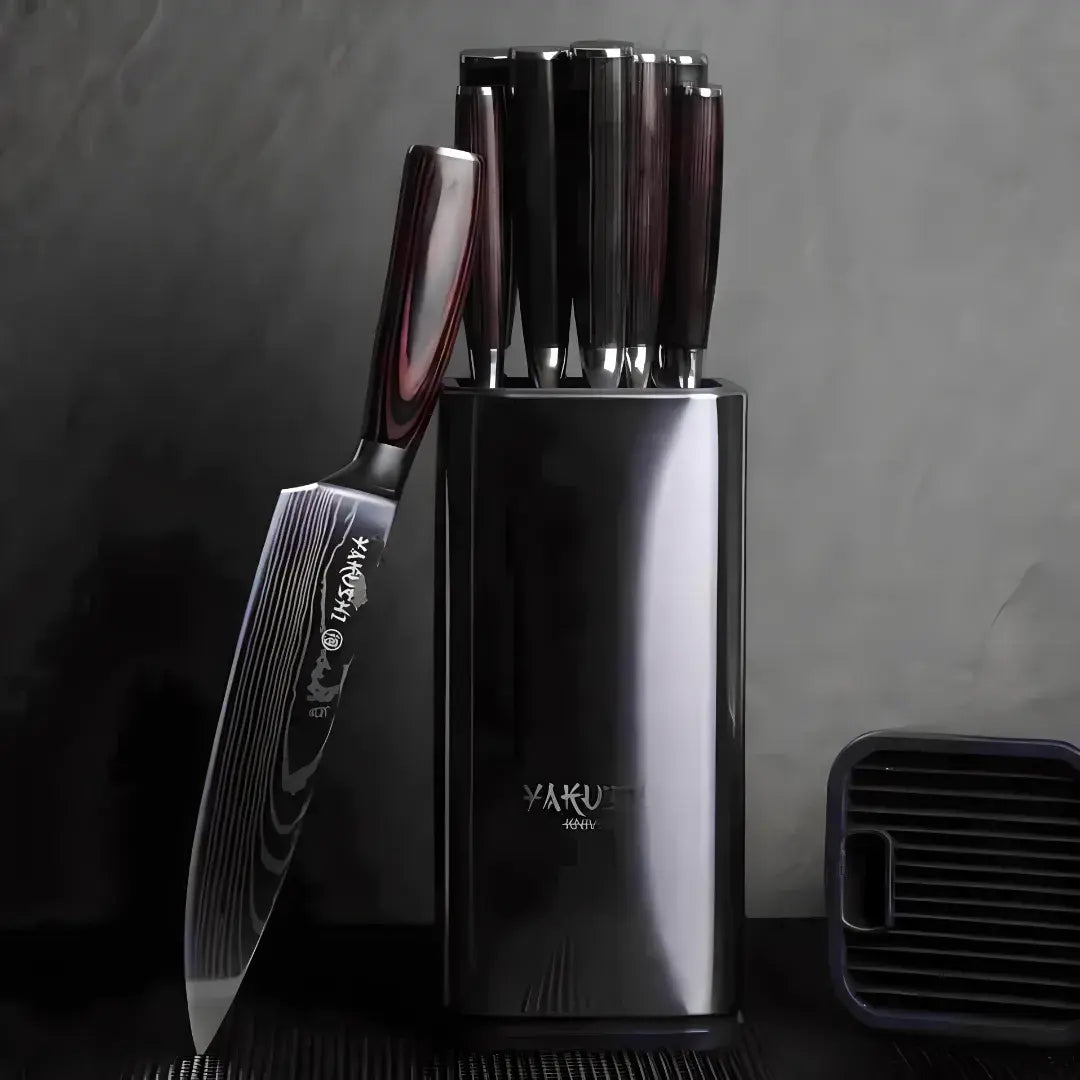
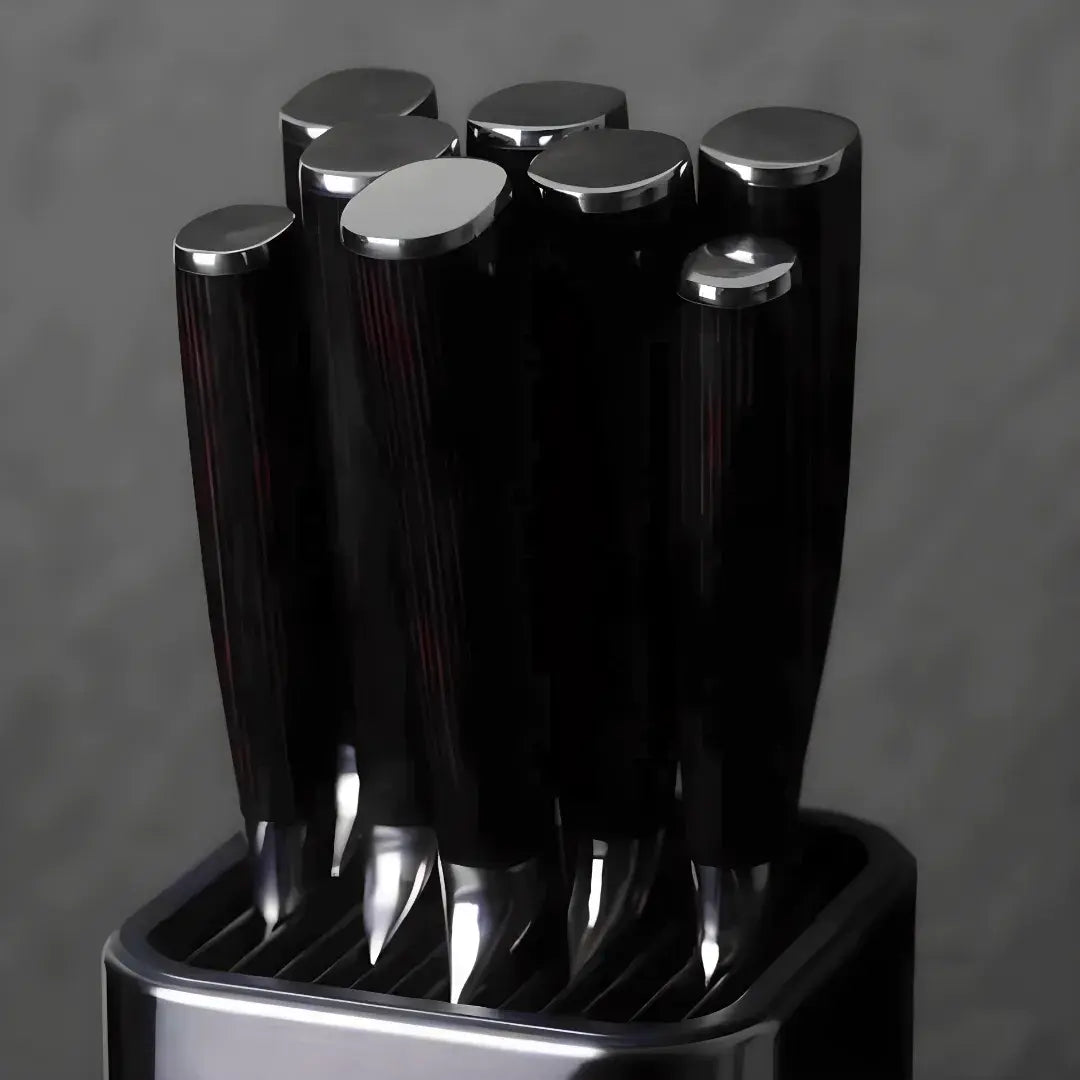
Keep your kitchen knives safe, organized, and easy to reach with a dedicated knife holder for your countertop. A good knife holder helps protect blade edges, reduces drawer clutter, and keeps your most-used chef knives, utility knives, paring knives, and kitchen scissors within reach. The Yakushi Premium Knife Holder is built with a stainless steel body, protective internal slots, a stable base, and drainage to help store up to 8 daily-use knives safely.
Our current knife holder collection features the Yakushi Premium Knife Holder, a compact stainless steel countertop holder designed for safe, accessible storage of up to 8 daily-use kitchen knives.
- Holds Up to 8 Knives
- Stainless Steel Body
- Protective Internal Slots
- Stable Heavy Base
- Drainage Hole for Moisture Control
- Compact 10 × 10 cm Footprint
Filters
1 product
How to Choose the Best Knife Holder for Your Kitchen
Selecting the ideal knife holder requires a balance of spatial ergonomics, material safety, and kitchen workflow efficiency. For professional chefs and home culinary enthusiasts alike, a knife holder is not just an organizational accessory; it is a critical instrument for blade preservation and kitchen hygiene. When evaluating your options, the primary factors to analyze are footprint stability, material non-porosity, and slot adaptability.
An exceptional storage system must accommodate various blade geometries—from a wide-bellied Gyuto or heavy Cleaver to a delicate, narrow Petty knife—without causing contact friction against the cutting edges. Furthermore, footprint stability prevents tipping accidents during rapid-paced prep work, making weighted bases a structural necessity.
For modern kitchens where food safety is paramount, material composition is the ultimate deciding factor. While traditional options have relied on organic fibers, contemporary culinary spaces heavily prioritize non-porous materials that resist moisture retention. The choice of storage also impacts your daily kitchen ergonomics. A well-designed kitchen layout places your primary cutting tools within an effortless arm's reach of your main cutting board station, meaning your storage solution must fit cleanly under standard upper cabinetry clearances (typically 18 inches) while still allowing vertical clearance to draw a full-length 10-inch chef’s knife safely.
Why Hygienic Knife Blocks Matter for Premium Cutlery
Where you store your kitchen tools is just as important as how you clean them. Traditional wooden knife blocks are notorious for a hidden kitchen hazard: moisture retention. Deep, dark, unexposed wooden slots trap humidity after washing, creating an ideal breeding ground for bacteria, yeast, and mold.
For high-performance cutlery—especially high-carbon Japanese steels like VG-10 or Blue Paper Steel—trapped moisture causes a secondary issue: microscopic corrosion and pitting. Keeping a premium blade in a damp environment actively degrades the structural integrity of your cutting apex, leading to premature dulling or rust spots.
A premium stainless steel knife holder eliminates this vulnerability completely:
- Superior Air Circulation: Engineered with ventilation paths that allow residual ambient moisture to evaporate rapidly.
- Sterile Material Matrix: Non-porous stainless steel exterior resists bacterial growth and odors.
- Removable, Washable Inserts: Unlike wooden blocks that can never truly be cleaned inside, modern food-safe inserts can be easily removed, thoroughly rinsed, and completely sanitized.
Countertop Knife Holder vs Knife Block vs Magnetic Knife Holder
The debate between a standalone countertop knife holder, a traditional wooden knife block, and a wall-mounted magnetic knife strip hinges on safety, sanitation, and blade access.
- Traditional Wooden Knife Blocks: Traditional wooden blocks feature deep, enclosed structural slots. While visually classic, wood is inherently porous and susceptible to ambient kitchen humidity. Over time, inserting a blade that is not 100% dry can trap moisture inside dark, unventilated slots, creating micro-environments where bacteria and mold can thrive out of sight. Furthermore, blind slots force the knife edge to drag against raw wood every time the tool is drawn or sheathed, leading to accelerated microscopic edge alignment degradation.
- Magnetic Knife Holders: Wall-mounted magnetic strips offer excellent sanitation because the open-air design eliminates enclosed spaces. However, they introduce physical risks to high-end cutlery. If a knife is twisted incorrectly off a powerful neodymium magnet, the hard metal surface can torque the delicate edge, leading to micro-chipping along the bevel—especially in high-carbon Japanese steels hardened to 60+ HRC (Rockwell Hardness Scale). Additionally, exposed blades pose an open safety risk in busy or family households.
- Modern Countertop Stainless Steel Knife Holders: This configuration represents the evolutionary middle ground, maximizing the benefits of both worlds while engineering out the flaws. Utilizing an open-chassis design or removable inner matrices made of food-grade, corrosion-resistant metals or polymers allows for complete airflow. This prevents moisture stagnation while physically shielding the sharp edges within a secure, weighted enclosure that sits safely on the counter surface, completely avoiding edge-to-magnet friction.
Why Proper Knife Storage Protects Blade Sharpness
A premium kitchen knife achieves its cutting performance through a precisely honed apex, which can be as thin as a few microns. When knives are stored loosely in a kitchen utility drawer, they are subjected to "blade-on-blade" contact friction every time the drawer is opened or closed. This casual impact against other metal tools forces the refined apex to roll, dull, or catastrophic chip, completely undoing the benefits of meticulous whetstone sharpening.
Proper knife storage guarantees that each blade remains completely isolated. By securing the knife firmly by its handle or spine, an optimized holder ensures that the razor-sharp cutting edge never bears the physical weight of the tool itself.
When a blade rests flat on its face or is suspended freely without touching neighboring metals, the micro-structure of the steel carbide remains perfectly intact. Protecting this edge integrity not only prolongs the lifespan of your cutlery investment but also dramatically reduces the frequency of aggressive abrasive sharpening, preserving the blade's profile and steel thickness over years of daily kitchen prep.
Preventing Blade Friction and Scratching
A high-end kitchen knife is a work of art, featuring intricate Damascus cladding, hand-hammered Tsuchime finishes, or highly polished mirror bevels. Sliding these delicate surfaces against harsh, rigid materials can leave permanent, unsightly scratches across the face of the blade.
Worse yet, if a knife storage system forces the delicate cutting edge (the apex) to scrape hard against wood or metal walls every time it is put away, the knife will dull without ever touching a cutting board.
To preserve both the edge geometry and the aesthetic finish of your collection, our 8-Slot Stainless Steel Knife Holder features specialized internal guards:
- Zero Metal-on-Metal Contact: The internal guiding matrix is constructed from smooth, resilient, food-safe polymers that cushion the blade rather than resist it.
- Apex Protection: The parallel slots hold the knives securely by the spine and the face, preventing the ultra-thin 15-degree cutting edge from bearing the weight of the tool or dragging against abrasive surfaces.
- Anti-Friction Glide: Low-friction slot entries ensure smooth, effortless retrieval and storage, preserving your knife's surgical sharpness over thousands of kitchen cycles.
Why the Yakushi Premium Knife Holder Works for Daily Kitchen Prep
Engineered to fulfill the rigid standards of professional culinary workflows, the Yakushi Premium Knife Holder combines high-density structural stability with architectural sanitation. Constructed from premium, food-grade stainless steel, this holder features a fingerprint-resistant matte finish that withstands the high-moisture, high-acid environment of active prep stations.
Unlike traditional wooden blocks that impose rigid width limitations, the Yakushi architecture features an optimized parallel slot layout. This intentional configuration prevents lateral blade movement while accommodating various blade profiles seamlessly. Whether you are storing a wide-profile Santoku, a thick-spined Nakiri vegetable cleaver, or an ultra-long slicing Sujihiki, the internal guide system keeps the blades vertical and separated.
The heavy, non-slip weighted base lowers the overall center of gravity, ensuring that even when fully loaded with heavy-handled knives, the block remains anchored during rapid, single-handed tool retrieval.
Universal Parallel Slotted Design vs. Traditional Component Slots
| Feature | Traditional Wooden Blocks | Universal Parallel Slotted Design |
|---|---|---|
| Slot Configuration | Rigid, pre-determined sizes | Adaptive, linear parallel slots |
| Blade Capacity | Limited to matching tool shapes | Fits any blade shape up to maximum capacity |
| Collection Freedom | If you buy a new knife, it might not fit | Rearrange your layout instantly as your collection grows |
| Hygiene Access | Sealed, permanent dark zones | Open, accessible, and easily sanitized |
How Many Knives Should a Knife Holder Hold?
An efficient kitchen does not require dozens of redundant blades; it requires a highly curated rotation of essential culinary tools. A premium knife holder should comfortably hold between 6 to 9 primary tools to cover 99% of all processing tasks without causing counter overcrowding.
Overcrowding a storage system causes handles to bunch together, making it difficult to safely grip a single knife without bumping or scratching adjacent tools. An optimized 8-slot allocation provides dedicated space for a foundational kitchen lineup:
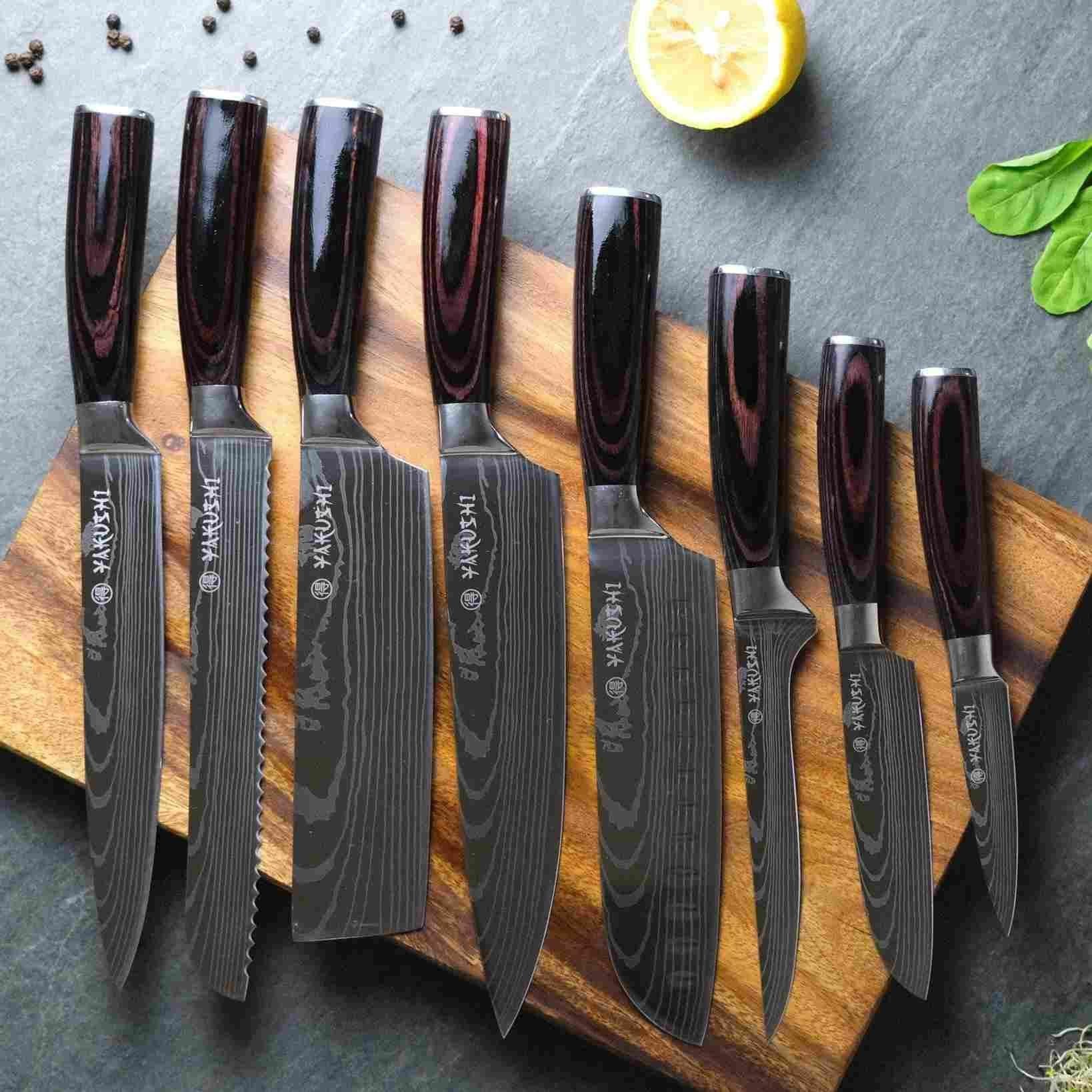
- A primary 8 to 10-inch Chef's Knife (Gyuto) for heavy-duty volume slicing
- A 7-inch Santoku or Nakiri for precision vegetable prep
- A dedicated Utility Knife for intermediate detail work
- A long, serrated Bread Knife for crusts and delicate pastries
- A flexible Boning or Fillet Knife for protein fabrication
- A nimble 3 to 4-inch Paring Knife for delicate coring and peeling
- A Honing Steel or ceramic alignment rod to maintain the apex daily
By limiting the capacity to a targeted, high-utility selection, the holder maintains a compact footprint while ensuring each tool remains highly accessible.
How to Clean and Maintain a Knife Holder
To ensure your kitchen sanitation remains flawless, your knife storage system must be cleaned regularly. Traditional wooden blocks are nearly impossible to clean internally once contaminated, but a stainless steel or modular countertop holder turns maintenance into a simple, routine task.
1.Completely Depopulate the Holder:Safety First.
Remove all cutlery from the slots and place them safely flat on a clean side towel. Never attempt to clean or wipe down a holder while blades are still housed inside.
2.Remove the Top Cap or Inner Matrix:Disassembly.
If your holder features a modular design, detach the top slot guide or slide out the internal parallel rods from the stainless steel exterior shell.
3.Wash with Warm, Soap-Infused Water:Sanitization.
Using a non-abrasive microfiber cloth or a soft-bristled nylon bottle brush, clean the interior walls and individual slots using warm water and a mild, grease-cutting dish soap. Avoid harsh bleach or steel wool pads, which can scratch the protective chromium oxide layer of stainless steel.
4.Air Dry Completely Inverted:Evaporation.
Shake off excess water droplets and place the components upside down on a clean, dry dish rack in a well-ventilated area.
Ensure the interior channels are 100% dry before reassembling or inserting knives to prevent trapped moisture from causing spotting or surface oxidation on your blade steel.
Knife Holder Comparison
| Storage Type | Best For | Weakness |
|---|---|---|
| Countertop knife holder | Easy access, no wall installation, daily home use | Takes some counter space |
| Magnetic knife holder | Space-saving, visible blade display | Requires wall space or careful installation |
| Knife block | Traditional kitchens, larger sets | Can trap moisture if not cleaned |
| In-drawer knife organizer | Minimalist kitchens, child safety | Requires drawer space |
| Knife roll | Travel, chefs, storage | Not ideal for daily countertop access |
Knife Holder FAQs:
Storage, Cleaning, Capacity & Care
What is the best type of knife holder for kitchen knives?
A countertop knife holder is best for cooks who want quick access without installing a wall-mounted magnetic strip. Magnetic holders save wall or counter space, while in-drawer organizers are best for minimalist kitchens.
How many knives can the Yakushi Premium Knife Holder hold?
The Yakushi Premium Knife Holder holds up to 8 knives. The product uses individual slots to keep knives separated and easier to access.
Is a knife holder better than storing knives in a drawer?
Yes, a knife holder is usually better than loose drawer storage because it keeps blades separated and reduces edge damage, clutter, and accidental contact. Proper knife storage is commonly recommended to protect sharpness and improve safety.
Does this knife holder protect the blade edge?
Yes. The Yakushi Premium Knife Holder uses food-safe plastic slots designed to separate and protect the knives from damage.
Is this a countertop knife holder?
Yes. The Yakushi Premium Knife Holder is a compact countertop knife holder measuring 9 inch (23 cm) tall and 4 inch (10 cm) wide by 4 inches (10 cm) long.
Is this knife holder good for Japanese knives?
Yes, it is suitable for daily-use kitchen knives, including Japanese-style chef knives, santoku knives, nakiri knives, utility knives, and similar blades, provided they fit safely in the slots.
How do you clean a knife holder?
Remove all knives, wipe the holder with a soft damp cloth, use mild detergent when needed, rinse, dry thoroughly, and only return clean, dry knives. Your current product page already gives similar care guidance.
Can wet knives be stored in a knife holder?
No. Knives should be washed and dried before storage. Moisture can contribute to rust, mold, and hygiene issues. Your product page correctly emphasizes keeping the holder dry and using the drainage feature to manage moisture.