
First-knife buying guide
Best Japanese Knife for Beginners
For most beginners, the best first Japanese-style knife is a versatile, double-bevel chef knife or Gyuto—or a slightly shorter Santoku if compact handling feels more natural.
Start with fit, not hype. Choose the profile, length, handle, steel and care routine that match how you actually cook. The highest hardness number or largest Damascus layer count does not automatically make a better first knife.
The short answer
Choose a Gyuto-style chef knife for range—or a Santoku for compact control
Both are adaptable double-bevel profiles. The right one is the knife that feels predictable on your board, suits your normal ingredients and encourages safe, repeatable technique.
Gyuto or chef-knife profile
Choose this when your weekly prep mixes vegetables, herbs, fruit, fish fillets and boneless proteins—and you want one pointed, all-purpose blade.
- Useful tip for detail work
- Longer edge for larger ingredients
- Supports slicing, chopping and gentle rocking
Santoku profile
Choose this when a shorter blade feels easier to control, your board or workspace is modest, and you prefer push cuts or controlled up-and-down chopping.
- Nimble in smaller kitchens
- Flatter edge for deliberate board contact
- Versatile across vegetables and boneless proteins
Five buying decisions
Start with the way you cook
A first knife should solve the work you do most often. Answer these questions before comparing steel names, decorative finishes or technical specifications.
What do you cut?
List the ingredients that appear most often: vegetables, herbs, fruit, fish, boneless meat or a mix. A broad routine points toward an all-purpose knife.
How do you cut?
Notice whether you naturally rock, push, draw-slice or chop vertically. The blade curve should support that motion rather than fight it.
What size fits?
Match blade length to your cutting board, counter space and common ingredients. More length adds reach, but it can feel unwieldy in a tight workspace.
What feels secure?
Consider handle shape, grip space, total weight, balance and knuckle clearance. Comfort is personal, so dimensions matter more than labels alone.
How much care is realistic?
Be honest about hand washing, prompt drying, safe storage and sharpening. Corrosion-resistant steel can simplify daily care, but no fine knife is maintenance-free.
What supports the knife?
Budget for a stable, knife-friendly cutting board, protected storage and a suitable maintenance plan—not only the blade itself.
Compare common profiles
Which Japanese knife type is beginner-friendly?
Knife names narrow the field, but individual models still vary in length, thickness, weight, balance and edge shape. Always compare the exact knife.
| Knife type | Common role | Why choose it | Watch for |
|---|---|---|---|
| Gyuto / chef knife | Mixed everyday preparation | Versatile point, useful edge length and support for varied motions | Choose a length and curve that fit your board and technique |
| Santoku | Compact everyday slicing, dicing and chopping | Nimble handling and a relatively flat cutting profile | May feel less natural if you rely on pronounced rocking cuts |
| Nakiri | Vegetable-focused board work | Tall blade, knuckle clearance and flat edge for push chopping | More specialized and lacks a pointed tip |
| Petty / utility | Fruit, trimming, small ingredients and detail work | Maneuverable and precise | Usually too short to replace a main board knife |
| Kiritsuke-style | Push cuts, pull slicing and precise tip work | Long, flatter profile with an angled K-tip | Less forgiving for heavy rocking or rough technique |
| Traditional single bevel | Specialized fish and Japanese preparation | Purpose-built geometry for particular techniques | Handedness, sharpening and technique can be more demanding |
Specifications that matter
Read technical details as tradeoffs—not trophies
No single number guarantees sharpness, comfort, durability or value. These specifications matter because they help predict how a knife may behave in your kitchen.
Edge geometry
Start with a double bevel
A blade sharpened on both sides is generally more familiar to new users and is suitable for either hand when the grind and handle are symmetrical. Single-bevel knives can require different handling and sharpening.
Steel choice
Favor manageable care
Corrosion-resistant stainless steel can reduce day-to-day worry compared with reactive carbon steel. It still needs careful hand washing, prompt drying and protected storage.
Length
Fit the board first
A 7- to 8-inch all-purpose blade suits many home kitchens, but the correct length depends on your space, grip and ingredients. Smaller is not lesser if it gives you better control.
Hardness
Higher is not automatically better
A harder edge may retain its geometry well, yet be less tolerant of impact, twisting or unsuitable cutting surfaces. Heat treatment, toughness and edge geometry matter alongside HRC.
Geometry
Thin edges reward good technique
Thin blade and edge geometry can move cleanly through suitable food, but it should never be forced through bones, frozen ingredients, hard pits or shells.
Finish
Damascus is not a performance score
A Damascus-style pattern can be visually distinctive, but layer count alone does not determine heat treatment, edge quality, balance, comfort or cutting performance.
A practical Yakushi starting point
An 8-inch all-purpose chef knife for everyday prep
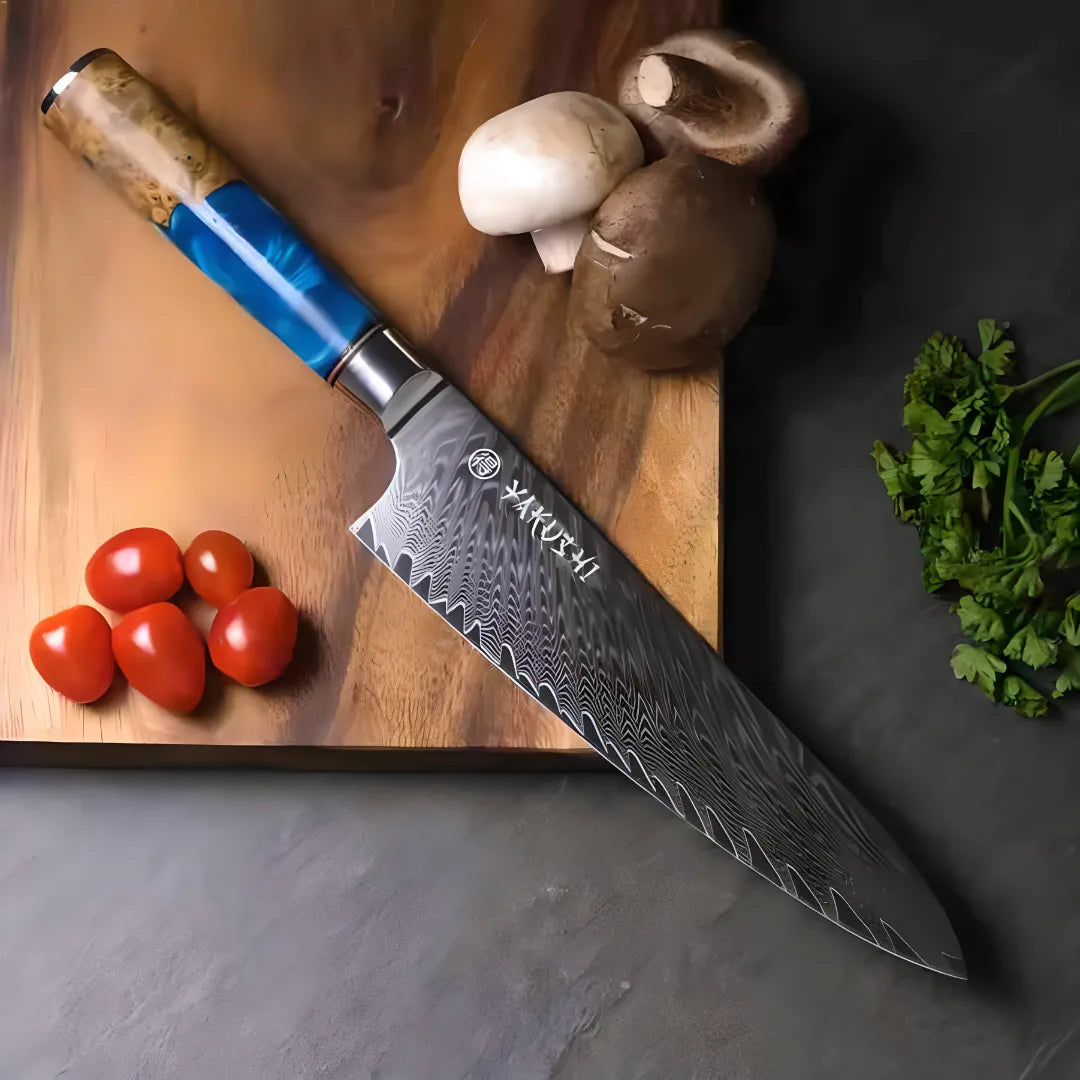
The Yakushi Damascus Chef Knife combines a familiar all-purpose profile with a double-bevel edge, stainless VG-10 cutting core and full-tang construction. It is designed for vegetables, fruit, herbs, fish fillets and boneless proteins.
Its pointed tip and gently curved profile support chopping, slicing, dicing, mincing, controlled draw cuts and gentle rocking. It is not intended for bones, frozen food, hard pits or shells, prying, twisting, edge scraping or cutting on glass, stone, ceramic or metal.
Your starter setup
Begin with four useful essentials
One well-chosen primary knife and the right support are usually more useful than a large collection bought before you understand your preferences.
One primary knife
Choose a Gyuto, chef knife or Santoku that fits your board, grip, ingredients and preferred motion.
A suitable board
Use a stable wood or suitable synthetic board with enough room for both the blade and food.
Protected storage
Keep the clean, dry edge in an appropriate sheath, block, drawer insert or secure magnetic rack.
A sharpening plan
Choose a suitable maintenance method or qualified professional before the knife becomes excessively dull.
Final buying review
Check these details before ordering
A useful product page should let you evaluate both the knife and the ownership routine. Pause if a detail that matters to your choice is missing.
The knife
- Blade type and intended foods
- Double- or single-bevel construction
- Blade length, height and overall dimensions
- Steel type and care instructions
- Handle material, weight and balance information
- Profile compatible with your cutting motion
The ownership experience
- Suitable cutting board already available
- Protected storage arranged
- Hand-washing and drying routine is realistic
- Sharpening plan or professional identified
- Current shipping, return and warranty terms reviewed
- Seller can answer missing specification questions
Your first practice session
Learn control before speed
Work slowly on an uncluttered surface. Speed should develop only after your grip, guiding hand and cutting path are consistent.
Stabilize the board
Use a level, dry work surface and a board that cannot slide. Give the blade and ingredient enough room.
Choose a secure grip
Try a pinch grip or handle grip without squeezing excessively. Keep the blade orientation predictable.
Protect the guiding hand
Keep fingertips away from the cutting path and move the guiding hand deliberately as the ingredient becomes smaller.
Match the motion to the profile
Use a controlled push, slice, rock or vertical chop that suits the blade shape and food. Let the edge cut without force.
Clean, dry and store it
Hand wash carefully, dry the blade and handle immediately, then place the knife in protected storage.
Avoid expensive mistakes
What beginners should not assume
Simple care routine
Protect the edge from day one
Follow the instructions supplied with the exact knife. These general habits protect many Japanese-style kitchen knives.
Hand wash carefully
Use mild soap and a soft sponge. Never leave a knife hidden in a sink or submerged in water.
Dry immediately
Remove moisture from the blade and handle before storage. Reactive steels may require additional maker-directed care.
Use a friendly surface
Choose wood or a suitable synthetic board. Avoid glass, stone, ceramic and metal cutting surfaces.
Protect it in storage
Do not leave a bare edge loose in a drawer where it can strike utensils or create a safety hazard.
Sharpen appropriately
Use the correct tool, angle and method—or a qualified professional—based on the knife’s bevel and condition.
Avoid lateral force
Do not twist the edge, pry with the tip, scrape sideways or force the knife through unsuitable materials.
Frequently asked questions
First Japanese knife questions
What is the best Japanese knife for a beginner?
For many beginners, a double-bevel Gyuto-style chef knife or Santoku is a practical first choice because either can handle a broad range of everyday preparation. The best model depends on your grip, workspace, ingredients, cutting motion and maintenance preferences.
Should a beginner choose a Santoku or Gyuto?
A Santoku may suit someone who prefers a relatively compact blade and flatter cutting profile. A Gyuto may suit someone who wants more tip reach, edge length and support for varied cutting motions. Neither is universally better.
Are Japanese knives difficult to maintain?
Maintenance depends on the steel, edge and construction. Many stainless Japanese-style knives have a straightforward routine: hand wash, dry promptly, store securely, use an appropriate board and sharpen with a suitable method.
What knife steel is suitable for a beginner?
Many beginners prefer corrosion-resistant stainless steel because it can reduce daily care compared with reactive carbon steel. Steel name alone is not enough; heat treatment, hardness, toughness and edge geometry also matter.
What blade length should a beginner choose?
Choose a length that fits your cutting board, workspace, common ingredients, grip and preferred motion. A 7- to 8-inch all-purpose knife works well in many home kitchens, but there is no universal best length.
Can a beginner sharpen a Japanese knife?
Yes, but sharpening requires the right tool, angle and method for the knife. A beginner can learn gradually on a suitable whetstone or use a qualified professional while developing the skill.
Does a beginner need a complete Japanese knife set?
Not necessarily. One capable all-purpose knife, a suitable board, safe storage and an edge-maintenance plan form a strong starting setup. Add specialist knives when your cooking habits reveal a recurring need.
What should I avoid cutting with a Japanese kitchen knife?
Unless the manufacturer designed the knife for the task, avoid bones, frozen food, hard pits, shells, glass or stone surfaces and non-food materials. Do not pry, twist or apply sideways force to a fine kitchen edge.
Selection and care references
These manufacturer and food-safety resources support evaluating knife purpose, comfort and balance, then using appropriate cutting surfaces, hand washing, prompt drying and protected storage.