
Knife Steel & Heat Treatment
Rockwell Hardness (HRC) in Technical Detail
HRC is one useful measurement of a knife blade—not a complete quality score. Learn how the Rockwell C test works, what common knife ranges imply, and why steel, heat treatment, geometry, and intended use must be evaluated together.
HRC in 60 Seconds
Resistance to permanent indentation under a standardized Rockwell C test.
Within a comparable steel and heat treatment, greater resistance to indentation and edge rolling.
Sharpness, toughness, wear resistance, corrosion resistance, edge geometry, or overall knife quality.
The Measurement
How the Rockwell C Test Works
Rockwell hardness is a differential-depth indentation test standardized for metallic materials. The C scale—written HRC—is commonly used for hardened knife steels because it uses a diamond indenter and a high total test force.
Prepare and Support
The test area must be clean, sufficiently thick, stable, and properly supported. Curvature, scale, movement, or testing too near an edge can distort the result.
Apply the Preliminary Force
A 10 kgf preliminary force seats the diamond indenter and establishes the reference depth used for the measurement.
Reach the Total Force
For HRC, force is increased to a total of 150 kgf. The indenter penetrates farther while the load is held under standardized conditions.
Measure Residual Depth
The additional force is removed while the preliminary force remains. The permanent increase in penetration depth determines the HRC value.
In the standard relationship, h is the permanent depth increase measured after the major-force cycle. Each Rockwell C point corresponds to 0.002 mm of residual penetration: a shallower indent produces a higher HRC number. HRC values are scale numbers, not “degrees” and not a material property expressed in conventional units.
Practical Interpretation
What Common Knife HRC Ranges Usually Mean
The ranges below are buyer-oriented descriptions, not formal quality grades. The same number can produce different real-world results when the alloy, microstructure, blade thickness, edge angle, or intended work changes.
| Approximate range | General character | Potential advantages | Potential tradeoffs |
|---|---|---|---|
| Below about 55 HRC | Comparatively soft for a modern kitchen-knife edge. | May tolerate impact and realignment well when paired with suitable steel and geometry. | Can be more prone to edge rolling or deformation and may need more frequent maintenance. |
| About 55–58 HRC | A practical, forgiving general-purpose region. | Can balance durability, straightforward sharpening, and ordinary kitchen use. | May not hold a very thin or highly refined apex as long as a harder, well-treated blade. |
| About 59–61 HRC | Common territory for many performance-focused Japanese-style knives. | Can support stable acute edges and good resistance to rolling when the steel and heat treatment are appropriate. | Usually demands better technique and avoidance of bones, frozen food, twisting, and hard cutting surfaces. |
| About 62 HRC and above | High-hardness or specialized territory for kitchen knives. | May support excellent edge stability and retention in steels designed and treated for the target. | Can reduce tolerance for impact or lateral force; sharpening difficulty depends strongly on carbide structure and wear resistance. |
These bands overlap. A knife should be judged by its exact steel, heat treatment, geometry, edge finish, task, and care requirements—not by the HRC number alone.
Three Different Properties
Hardness Is Not Toughness or Wear Resistance
Knife discussions often combine three distinct ideas. They interact, but one cannot be substituted for another.
Hardness
Resistance to localized permanent deformation or indentation. HRC measures this property under a defined test.
Toughness
Ability to absorb energy and resist cracking or fracture. HRC does not measure the force or energy required to chip a knife edge.
Wear Resistance
Resistance to material loss through abrasion or adhesion. Carbide type, size, distribution, volume, matrix, and hardness all influence it.
A knife cuts because of its apex width, edge angle, blade grind, surface finish, and cutting technique. Hardness can help an appropriate geometry remain stable, but a high-HRC blade can arrive dull and a lower-HRC blade can be sharpened extremely well.
Metallurgy in Sequence
How Heat Treatment Produces the Final HRC
Steel composition sets the available possibilities. Heat treatment determines how much of that potential becomes a useful blade. Exact temperatures, times, quench media, and tempering schedules are alloy-specific.
Austenitize
Heat dissolves selected carbon and alloying elements and prepares the steel for transformation.
Quench
Controlled cooling transforms much of the structure into hard martensite while distortion and cracking must be managed.
Optional Cold Treatment
For suitable alloys, sub-zero or cryogenic processing may reduce retained austenite before tempering.
Temper
Reheating reduces quench stresses and adjusts the balance of hardness, toughness, and dimensional stability.
Verify
Hardness testing checks whether the process reached its target, but performance still requires geometry and use testing.
More hardness is not automatically better heat treatment. Overheating can coarsen grain or create other problems; an unsuitable quench can cause distortion or cracking; insufficient or excessive tempering can leave an undesirable property balance. Read our companion guide on why heat treatment matters in Japanese knives.
Same Number, Different Knife
Why Two 60 HRC Blades Can Perform Differently
HRC compresses one indentation response into one number. It does not describe the blade’s complete microstructure or design.
- Different alloys: carbon, chromium, molybdenum, vanadium, tungsten, and other elements change hardenability, carbides, corrosion behavior, and wear.
- Different microstructures: grain size, carbide distribution, martensite condition, and retained austenite can differ at the same measured hardness.
- Different tempering: two heat-treatment paths can reach similar HRC values without producing identical toughness or stability.
- Different geometry: blade thickness, grind, thickness behind the edge, bevel angle, and apex finish often dominate cutting feel.
- Different surfaces: decarburization, coatings, cladding, or testing an unsuitable location can separate a reading from the cutting core’s behavior.
- Different use: a thin slicer and a heavy-duty knife need different property balances even when made from the same steel.
Testing Reality
Why HRC Readings and Product Claims Vary
A hardness claim may describe a design target, a batch range, a supplier specification, or an actual test result. The number is most useful when its context is clear.
- Location matters. A finished blade is thin, tapered, and sometimes clad. A test point needs suitable thickness, flatness, support, and distance from edges and other indents.
- Preparation matters. Scale, oil, roughness, curvature, vibration, or movement can affect depth measurement.
- Calibration matters. Machines, indenters, reference blocks, force application, dwell time, and operator procedure must comply with the chosen standard.
- Variation is normal. Heat treatment and measurement both have variation, so a responsible range can be more realistic than a universal exact integer.
- Decimals can imply false precision. A claim such as 60.0 HRC is not automatically more trustworthy than a documented range.
- Conversions are approximate. Converting between Rockwell, Vickers, Brinell, or tensile strength should not be treated as exact across every steel.
Choosing in Context
What Hardness Makes Sense for a Kitchen Knife?
There is no single ideal HRC for every cook. Start with the work, then evaluate the steel and geometry chosen to perform it.
Prioritize Tolerance
A moderate hardness and durable geometry can suit busy kitchens, less controlled technique, or users who value easy maintenance.
Balance Stability and Care
Many Japanese-style multipurpose knives use higher hardness to support refined edges, provided the user avoids impact and lateral stress.
Match the Whole System
High hardness can benefit thin, precise slicing geometry when the steel, heat treatment, board, technique, and sharpening are compatible.
Do Not Chase HRC
For forceful work, toughness and robust geometry may matter more than maximum hardness. Use a purpose-built tool for bones or frozen food.
Compare the exact steel, heat treatment, blade and edge geometry, intended tasks, maintenance, handle, balance, and maker’s specifications. Then treat HRC as one supporting data point. Continue with our guides to knife-edge retention, sharpening angles, and choosing the right Yakushi knife.
Common Misunderstandings
Four HRC Myths to Leave Behind
Myth
Higher HRC always means a better knife
Reality: an excessive or poorly achieved hardness can create an unsuitable balance. Steel, heat treatment, geometry, and task decide whether the target is useful.
Myth
HRC tells you how long the edge will last
Reality: hardness contributes to edge stability, but wear resistance, toughness, carbide structure, apex geometry, finish, board, and technique all affect retention.
Myth
Harder knives are always harder to sharpen
Reality: abrasive choice and the steel’s wear-resistant carbides can matter more than HRC alone. Some hard, fine-structured steels sharpen cleanly.
Myth
Damascus layers determine the cutting HRC
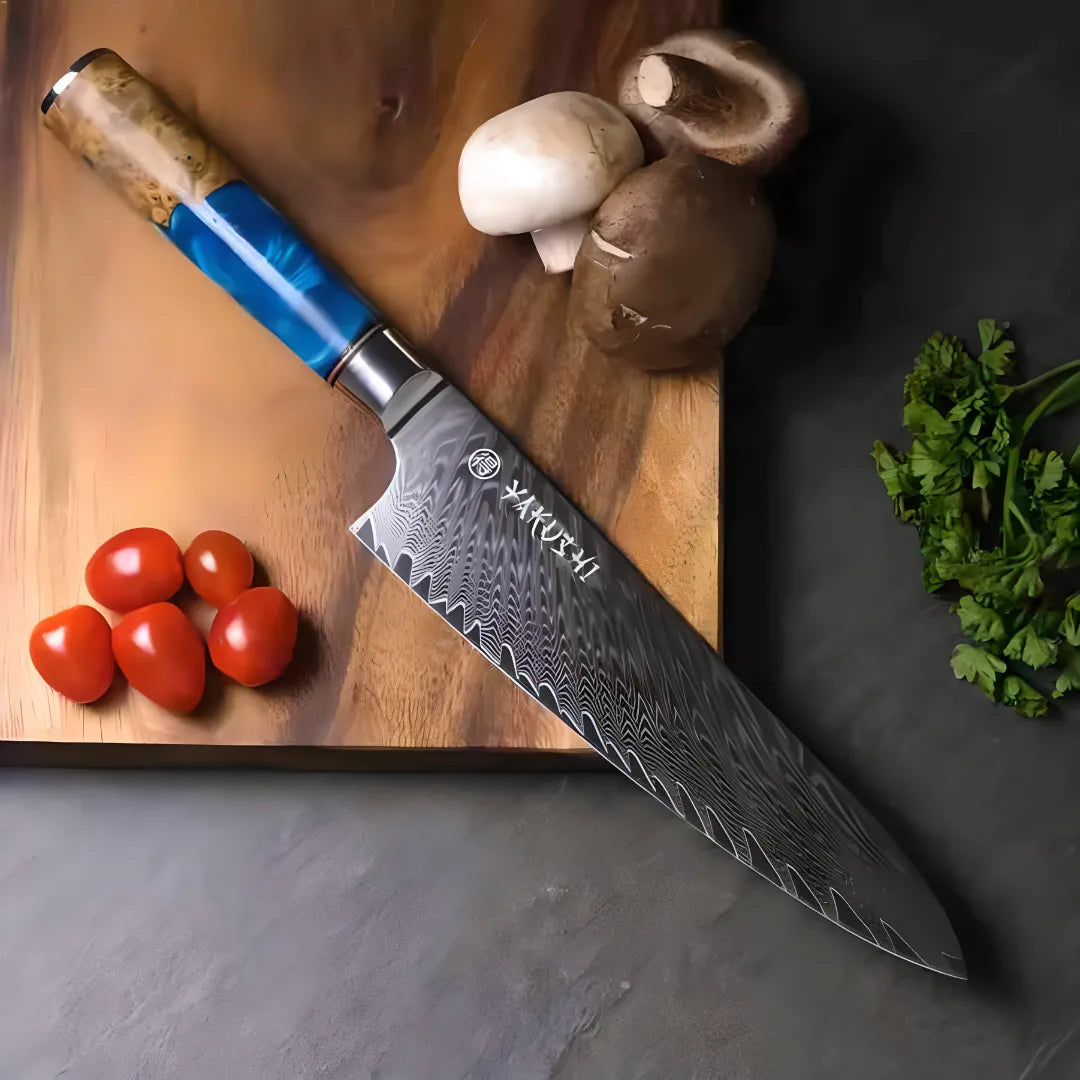
Reality: on a clad knife, the edge is formed by the cutting core. Decorative or protective outer layers can have different hardness and properties.
Technical References
Standards Behind the Measurement
For laboratory procedures, calibration requirements, applicable ranges, specimen conditions, and reporting, use the current complete standards rather than a consumer summary.
International test method for regular and superficial Rockwell hardness testing of metallic materials.
View the ISO standard overviewStandard test methods for Rockwell hardness of metallic materials, including verification and test requirements.
View the ASTM standardAn equipment-maker explanation of the differential-depth method, force sequence, scales, and common sources of error.
Review the testing overviewFrequently Asked Questions
Rockwell Hardness and Kitchen Knives
What does HRC mean on a kitchen knife?
HRC means the blade’s hardness was described using the Rockwell C scale. The test measures resistance to permanent indentation with a diamond indenter under standardized forces. It does not, by itself, measure sharpness, toughness, wear resistance, or overall quality.
Is 60 HRC good for a Japanese-style knife?
About 60 HRC can be a practical target for many Japanese-style kitchen knives, supporting refined edge geometry when the steel and heat treatment are appropriate. Whether it is “good” depends on the complete blade, intended tasks, and the user’s technique.
Does higher HRC mean better edge retention?
Not automatically. Higher hardness can improve resistance to edge rolling within a comparable steel, but wear resistance, toughness, carbide structure, edge geometry, sharpening finish, cutting surface, and technique also influence how long an edge performs.
Does higher HRC make a knife more brittle?
Increasing hardness can reduce tolerance for deformation or misuse, but brittleness is not determined by HRC alone. Steel composition, grain and carbide structure, heat treatment, residual stresses, and edge geometry all influence fracture resistance.
Are high-HRC knives harder to sharpen?
Not necessarily. Sharpening difficulty depends strongly on wear-resistant carbides, abrasive choice, edge geometry, and the amount of metal being removed. Some high-hardness fine-structured steels sharpen more readily than softer but highly wear-resistant steels.
Why do knife brands list an HRC range?
A range can reflect normal heat-treatment and measurement variation across batches or test locations. It may be more realistic than presenting one exact number for every blade. The usefulness of the claim depends on how the target and testing were established.
Can I test a knife’s HRC at home?
A reliable HRC result requires an appropriate calibrated tester, certified indenter and reference blocks, controlled force and dwell time, suitable specimen support, and a valid test location. Scratch files and informal comparisons do not reproduce a standardized Rockwell C result.
Does a Damascus pattern tell me the blade hardness?
No. A visible layered pattern does not establish the HRC of the cutting edge. On a clad knife, the cutting core and outer layers can have different compositions and hardness. Check the exact core steel and product specification.
Choose the Complete Knife
Compare Steel, Geometry, Purpose, and Care—not HRC Alone
Explore Yakushi knives by the work they perform, then use each product page to confirm its current steel, construction, dimensions, edge, and maintenance requirements.