
Best Japanese Knife for Meal Prep
Meal prep asks one knife to repeat dozens of cuts across vegetables, fruit, herbs and boneless proteins. This guide helps you choose a blade that fits your ingredients, board space, preferred motion and maintenance routine—so weekly prep feels controlled from the first onion to the final portion.
For most mixed meal prep, start with an 8-inch chef knife or gyuto.
A versatile chef-knife profile provides useful reach for larger produce and long slices while remaining manageable for chopping, dicing, mincing and portioning boneless proteins. Choose a santoku when you want a shorter all-purpose blade, or a nakiri when vegetables dominate your routine.
The lowest-regret setup
Begin with one comfortable double-bevel chef knife that fits your cutting board. Add a small paring or petty knife for detail work, then add a specialized vegetable knife only when your weekly routine gives it a clear job.
The best Japanese knife for each meal-prep routine.
The right answer changes with ingredient volume, board size and whether your sessions are vegetable-heavy, protein-heavy or genuinely mixed.
Best overall: chef knife or gyuto
Choose this for mixed vegetables, fruit, herbs and boneless proteins. An approximately 8-inch blade offers broad versatility without requiring the space of an extra-long knife.
Best compact option: santoku
A shorter multipurpose profile suits smaller boards, modest portions and cooks who prefer controlled push cuts with less blade extending beyond the ingredient.
Best for vegetables: nakiri
A tall rectangular blade and comparatively straight edge make repetitive vegetable slicing, dicing and chopping efficient. It is a specialist—not a bone cleaver.
Best complete setup: compact set
A chef knife, shorter santoku and small paring knife let you move between large board work, compact preparation and precise hand-sized tasks without forcing one blade to do everything.
Choose for actual weekly volume—not an imagined future kitchen.
A longer blade can make big batches more efficient, but only if your board and counter give it room. A comfortable santoku on a secure board is a better meal-prep tool than a longer gyuto you cannot control naturally.
Gyuto vs santoku vs nakiri for meal prep.
All three can excel on produce. Their biggest differences are cutting length, edge profile, tip design and how broadly they handle mixed tasks.
| Feature | Gyuto or chef knife | Santoku | Nakiri |
|---|---|---|---|
| Primary role | Versatile, all-purpose preparation. | Compact multipurpose preparation. | Dedicated vegetable preparation. |
| Typical feel | Longer reach with a pointed tip and useful belly. | Shorter, agile blade with moderate height. | Tall rectangular blade with a flatter edge. |
| Natural motions | Push cuts, draw slices, chopping and modest rocking when the profile supports it. | Push cutting, straight strokes and controlled slicing. | Push cutting and primarily straight up-and-down strokes. |
| Best meal-prep use | Mixed produce, herbs, fruit and boneless proteins. | Everyday mixed prep in a smaller workspace. | Large volumes of vegetables and leafy greens. |
| Main tradeoff | Needs enough board space and may feel long to some cooks. | Less reach for very large ingredients or long slices. | Less versatile for detailed trimming and protein work. |
| Who should start here? | Cooks who want one primary knife for most prep. | Cooks prioritizing compact control. | Plant-forward cooks who already own a general-purpose knife. |
Not sure which profile matches your hand?
Compare the Japanese gyuto, Japanese santoku and Japanese nakiri, or use Which Yakushi Knife Is Right for Me?
What makes a knife good for meal prep?
Meal prep magnifies small problems. A pressure point, unstable grip or blade that wedges in dense produce becomes much more noticeable after repeated cuts.
Comfortable dimensions
Blade length, height, weight, handle shape and balance should work with your hand and board. Look for enough knuckle clearance without extra length you cannot use safely.
Efficient geometry
A relatively thin cutting geometry can move through food with less wedging, while an edge appropriate to the steel and task balances cutting performance with durability.
Predictable profile
Choose an edge curve that matches how you cut. A curved belly supports selected rocking motions; a flatter profile suits push cuts and straighter board contact.
Practical steel
Stainless and stainless-clad options simplify care around wet ingredients. Fully reactive carbon steel can be rewarding, but it demands attentive cleaning and drying throughout long sessions.
Approachable bevel
A double-bevel edge is the versatile default for most home cooks and can usually serve either hand. Traditional single-bevel knives require specialized use and sharpening.
Maintainable edge
A knife is only efficient when you can keep it performing. Consider sharpening skill, local professional service and the abrasives your steel requires before purchasing.
Steel name does not decide performance by itself.
Geometry, heat treatment, edge finish, maintenance and technique all influence how a knife behaves. Use our Japanese knife steel guide and heat-treatment guide to understand the complete system.
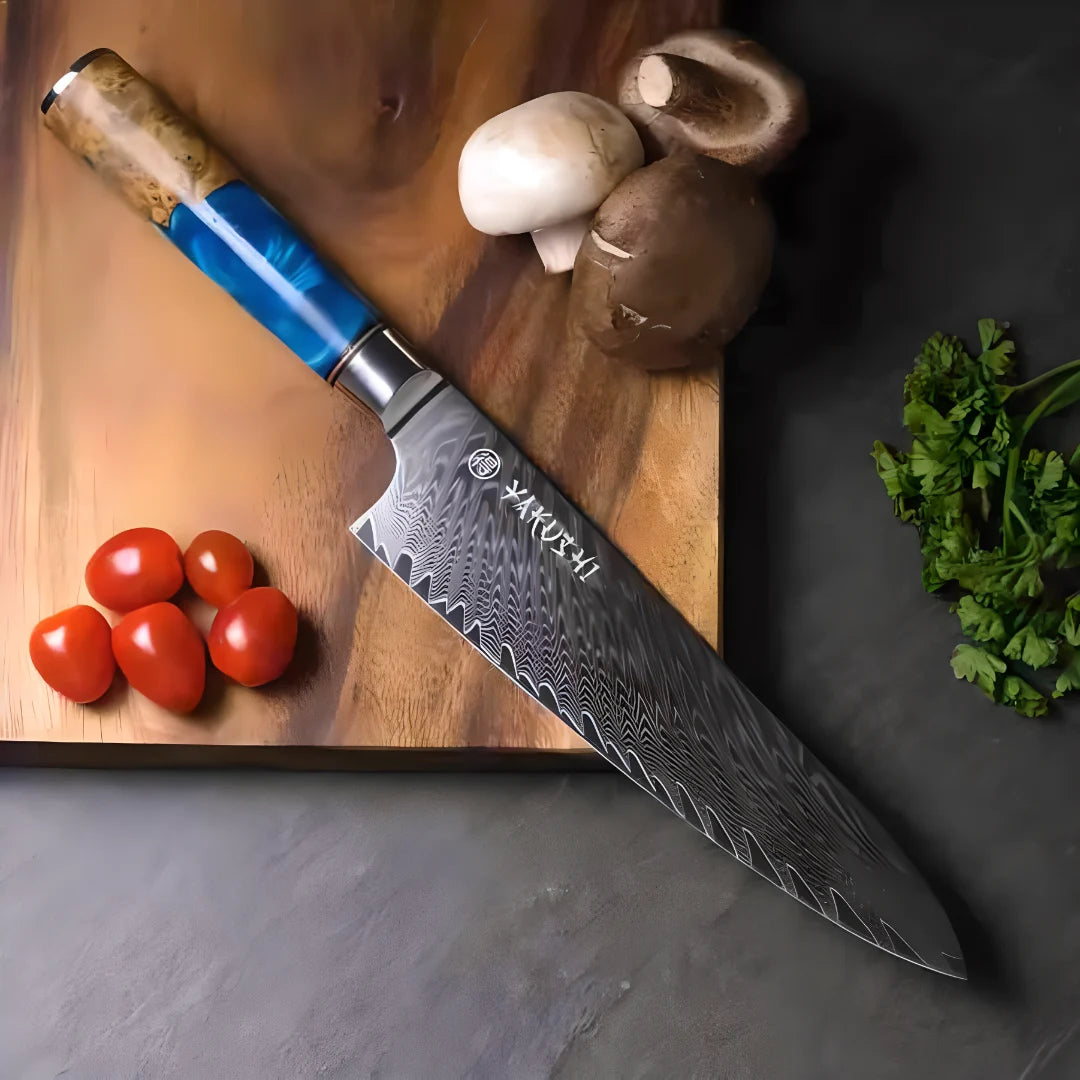
Yakushi 8-inch Damascus Chef Knife
This 8-inch chef knife combines the reach needed for cabbage, squash and long slices with the control required for herbs, aromatics and everyday board work. Its double-bevel VG-10 cutting core and curved all-purpose profile suit mixed meal-prep routines.
Use it for vegetables, fruit, herbs, cooked foods and boneless proteins. Keep it away from bones, frozen food, hard pits, prying and forceful twisting.
Three strong starting points.
Choose by coverage and fit. Current specifications, availability and pricing remain on each product page.
Best-value single knife
Yakushi Classic Chef Knife
An 8-inch, 192g Japanese-style chef knife with a high-carbon stainless-steel blade, curved profile, full-tang construction and double-bevel edge. It covers the core chopping, slicing, dicing, mincing and boneless-protein tasks of everyday meal prep.
Premium single knife
Yakushi Damascus Chef Knife
An 8-inch double-bevel chef knife with a VG-10 stainless cutting core, Damascus construction and all-purpose profile. Choose it when you want mixed-task versatility with a distinctive finish.
Best compact system
Yakushi Three-Piece Chef Set
The chef knife handles larger board work, the shorter santoku suits quick medium-scale prep and the paring knife covers peeling and precise trimming. It is a useful foundation when your routine genuinely spans all three task sizes.
Vegetables dominate your prep?
Compare specialist shapes in our guide to the best Japanese knife for vegetables, then consider the Yakushi Damascus Nakiri as a second knife beside your general-purpose blade.
Build a meal-prep knife system without clutter.
A focused system is easier to maintain and safer to organize than a block full of overlapping blades.
Start with one primary knife
Choose a chef knife, gyuto or santoku that handles most of your vegetables, fruit, herbs and boneless-protein preparation. This is the blade whose fit matters most.
Add a small precision knife
A paring or petty knife covers peeling, trimming, coring and close detail work that feels awkward with a full-size blade. Use an appropriate board whenever the cut allows.
Add a bread knife where needed
A serrated bread knife remains useful for crusty loaves and selected delicate-skinned produce. It solves a different task rather than duplicating your primary knife.
Specialize only after repetition
Add a nakiri, slicing knife or other specialist when a recurring weekly task clearly justifies it. The goal is faster selection and better technique, not collecting shapes.
Would a set be simpler?
Use our Japanese knife-set guide for home cooks or beginner knife-set guide to compare a matched system with buying one blade at a time.
A calmer, safer meal-prep workflow.
Good sequencing reduces repeated cleanup, cross-contamination risk and unnecessary handling of an exposed blade.
Plan cuts before opening packages
List vegetables, cooked foods and raw proteins in the order you will prepare them. Set out clean containers, towels and a discard bowl outside the knife path.
Stabilize the board
Use a flat, undamaged board on a nonslip base. If needed, place a clean, wrung-out damp towel underneath and confirm that the board cannot slide or rock.
Wash produce and keep zones separate
Rinse produce under running water and dry it. Use separate boards or thoroughly cleaned equipment for produce and raw meat, poultry or seafood.
Create stable ingredient shapes
Cut a flat base on round produce when practical, divide oversized ingredients into controllable sections and stop if the food or board begins to move.
Batch by motion
Group similar cuts—planks, sticks, dice or slices—while keeping perishable foods within safe handling limits. Reset the guide hand whenever accuracy begins to drift.
Clean, chill and store promptly
Wash tools and surfaces after each food category, place prepared perishables into appropriate containers and refrigerate promptly according to current food-safety guidance.
Food safety is part of efficient prep.
The FoodSafety.gov clean, separate, cook and chill guidance covers washing produce, preventing cross-contamination, using safe temperatures and promptly chilling prepared food.
Use the blade efficiently without rushing.
Do
- Use a relaxed, secure grip and keep the wrist comfortably aligned.
- Curl guide-hand fingertips back and keep the thumb out of the blade path.
- Match push, draw or controlled rocking motions to the blade profile.
- Use the blade's length rather than forcing it straight through food.
- Transfer ingredients with a bench scraper, blade face or spine.
- Pause when hands, handle or board become wet or slippery.
Avoid
- Cutting bones, frozen food or hard pits with a precision chef knife.
- Twisting the edge while it is embedded in an ingredient.
- Scraping sideways across the board with the sharpened edge.
- Cutting on glass, stone, ceramic or metal surfaces.
- Leaving a knife hidden in a sink or under a towel.
- Trying to catch a knife if it falls.
Speed comes after placement and control.
A sharp knife still presents a serious injury risk. Keep the cutting path clear and stop when distracted or fatigued. Review the CCOHS sharp-blade safety guidance and our chef-knife grip guide before practicing faster rhythms.
Protect the edge between meal-prep sessions.
Maintenance frequency depends on the steel, edge geometry, board, technique and volume of use. Performance—not an arbitrary calendar—should determine when the edge needs attention.
Use an edge-friendly board
Choose wood or a suitable synthetic cutting surface. Replace boards that rock, slide or have damage that prevents thorough cleaning.
Wash by hand
Use mild dish soap and a nonabrasive sponge, keeping hands away from the edge. Never drop the knife into cloudy sink water with other utensils.
Dry immediately
Dry blade and handle completely before setting the knife aside. Reactive steels require especially prompt care around acidic and wet ingredients.
Store the edge securely
Use a fitted sheath, stable knife block, protected drawer insert or suitable magnetic rack where the edge cannot contact hands or loose tools.
Sharpen for the knife's actual condition.
Learn the process in how to sharpen a Japanese knife, compare abrasives in best whetstones for Japanese knives and use the Japanese knife care guide for washing and storage.
Common questions from batch-cooking home chefs.
What is the best Japanese knife for meal prep?
For most mixed meal prep, an approximately 8-inch gyuto or Japanese-style chef knife is the strongest single-knife choice. It combines reach for larger ingredients with versatility across vegetables, fruit, herbs and boneless proteins.
Is a gyuto or santoku better for meal prep?
Choose a gyuto when you want more cutting length, long slicing strokes and broad mixed-task versatility. Choose a santoku when you prefer a shorter, agile multipurpose knife or have limited board space.
Is a nakiri good for weekly meal prep?
Yes—especially when vegetables dominate. Its tall blade and relatively straight edge support repetitive push cuts and chopping. Pair it with another knife for boneless proteins and detailed trimming.
What blade length is best?
An 8-inch chef knife is broadly useful, but the correct length depends on your hand, cutting board, counter space, common ingredients and preferred weight. Control matters more than choosing the longest option.
Is one knife enough for meal prep?
One versatile chef knife can cover most core board work. A small paring or petty knife is the most practical second addition, followed by a bread knife or specialist only when a recurring task requires it.
Should I choose stainless or carbon steel?
Stainless or stainless-clad construction is convenient for long sessions involving wet ingredients. Fully reactive carbon steel can perform beautifully but requires more attentive cleaning and drying during and after prep.
Can a Japanese chef knife cut meat?
A suitable chef knife can portion boneless meat and poultry, cooked proteins and fish fillets. Avoid bones, joints, frozen food and forceful twisting unless the specific knife is purpose-built for that work.
Which cutting board should I use?
Use a clean, stable wood or suitable synthetic board large enough for the knife and ingredient. Avoid glass, stone, ceramic and metal cutting surfaces because they are hard on fine edges.
How often should I sharpen a meal-prep knife?
Sharpen when cutting performance declines and normal edge maintenance no longer restores it. Frequency varies with steel, geometry, technique, board material and weekly volume.
How can I reduce fatigue during a long prep session?
Use a knife that fits your hand, keep the work close, stabilize the board, relax the grip and group similar cuts. Stop and rest if you develop pain, numbness, loss of grip or declining control.
Further reading from trusted sources
Start with one versatile knife that fits your kitchen.
Compare Yakushi chef knives for mixed meal prep, or choose a compact set when your routine regularly moves between large, medium and detailed cutting tasks.