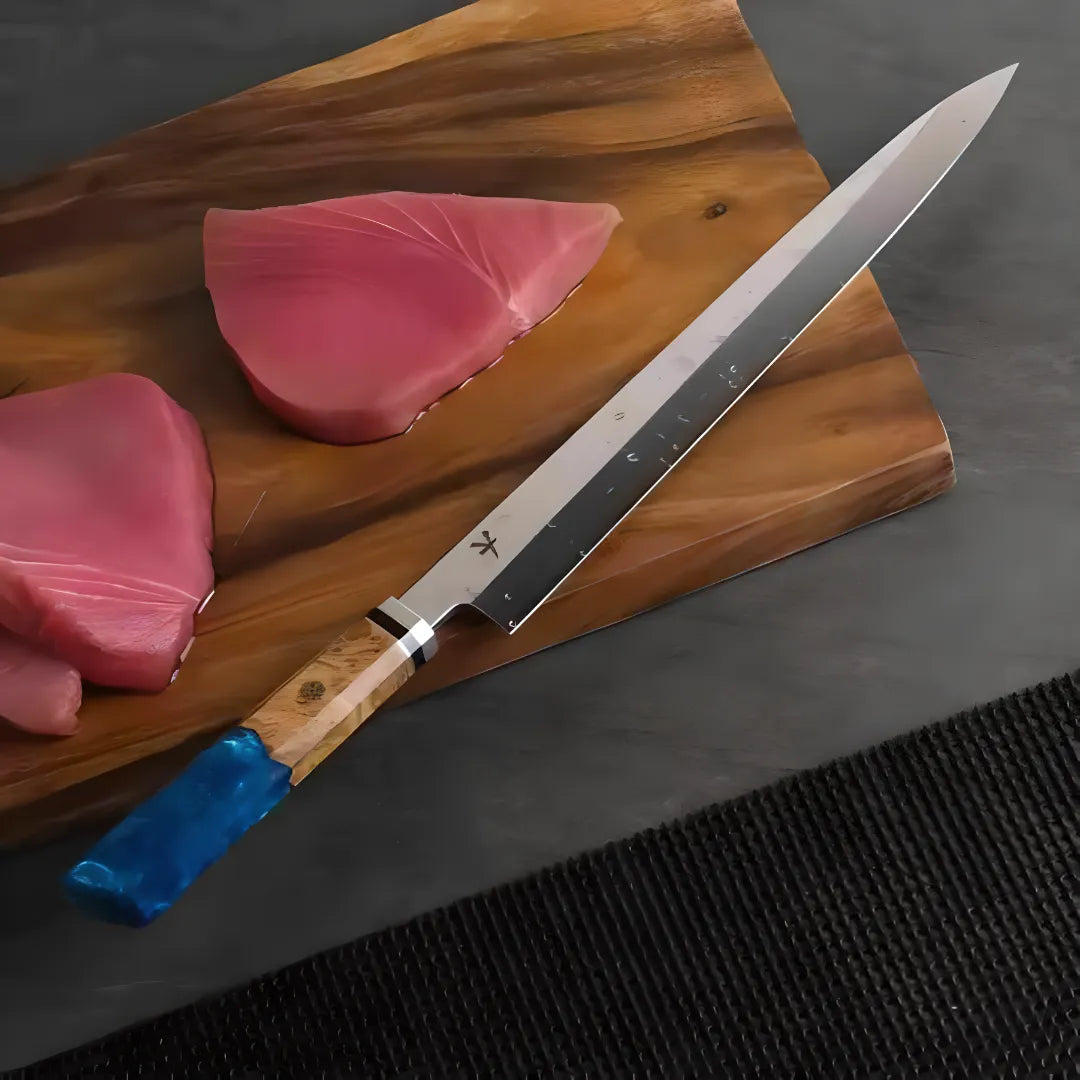
A sushi knife should make clean, smooth cuts without tearing delicate fish. The traditional Japanese knife for this job is the Yanagiba, also called a sashimi knife. Its long, narrow, single-bevel blade is designed for pull-cutting raw fish in one fluid motion, helping create clean slices for sashimi, nigiri, crudo, and sushi preparation.
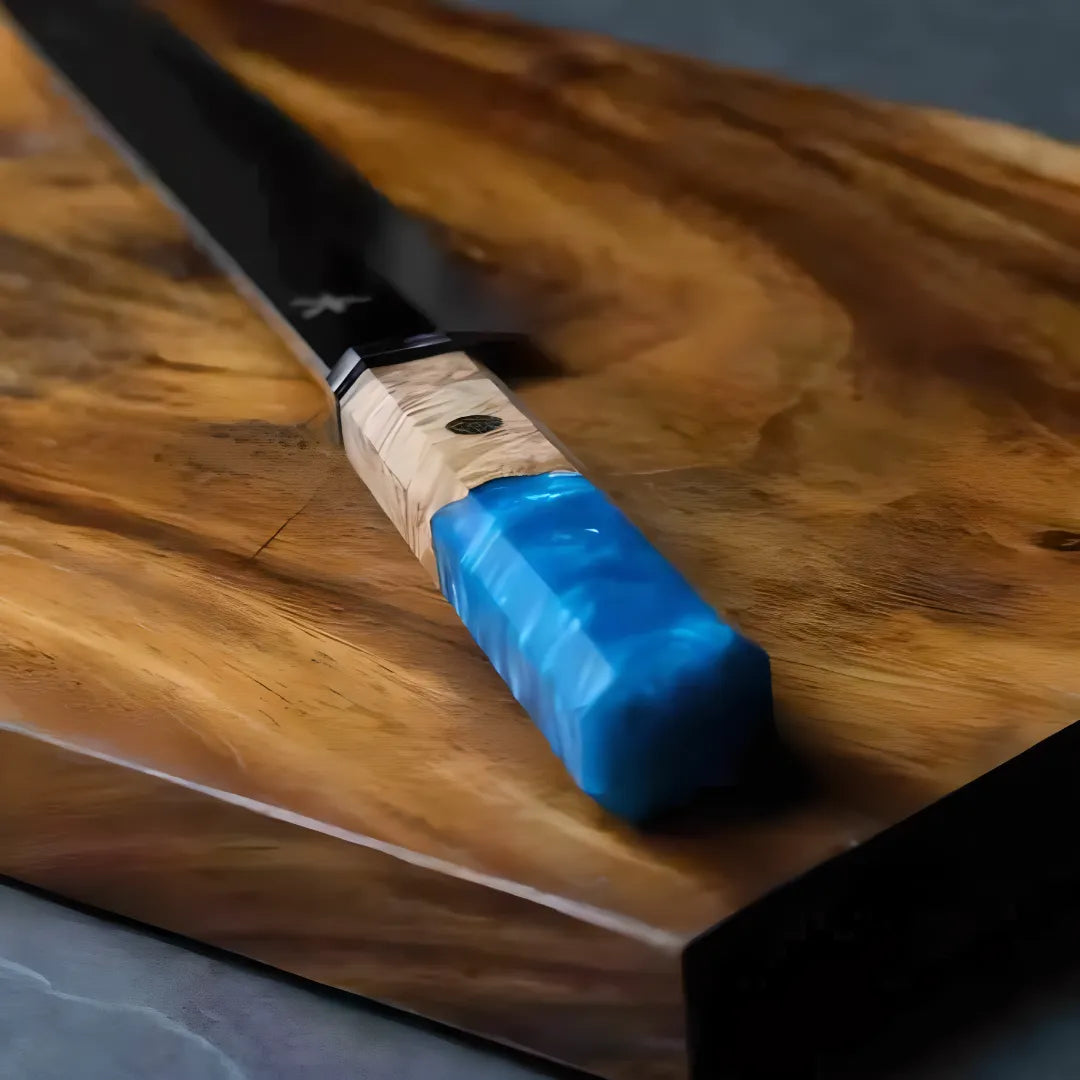
Yakushi’s Yanagiba Sashimi Knife features an 11-inch blade, single-bevel edge, 67-layer Japanese Damascus steel, and an ergonomic resin-wood handle for precise seafood slicing.
Filters
1 product
What Is a Sushi Knife?
A sushi knife is a highly specialized Japanese kitchen tool designed to execute the clean, precise cuts required for traditional sushi preparation. Unlike thick Western chef’s knives that can crush delicate ingredients, an authentic sushi knife features an ultra-thin spine and an incredibly sharp edge. This profile allows chefs to slice through sticky vinegared rice (shari), crisp nori seaweed, and tender seafood without tearing or squeezing out the fillings.
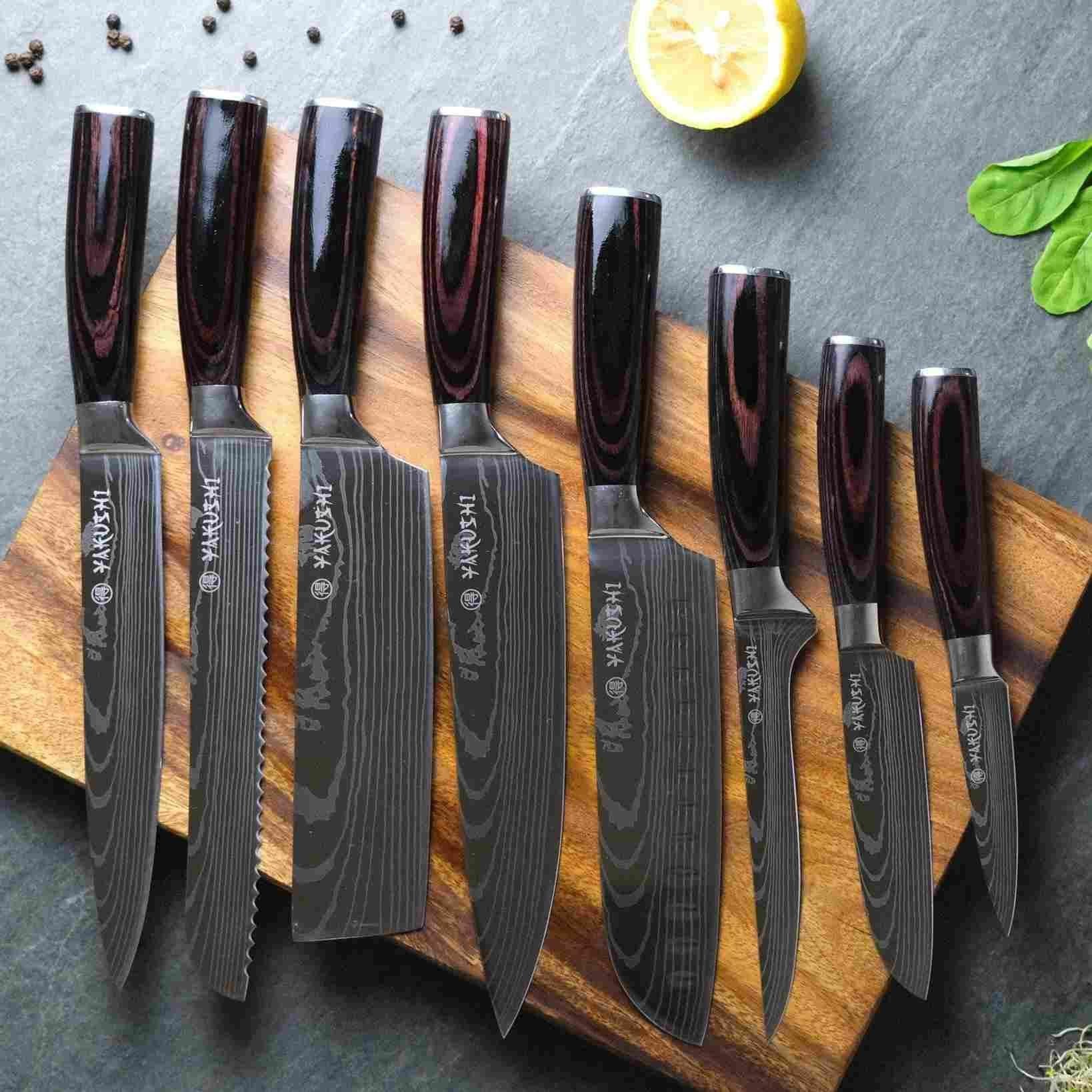
While the term covers a few different blade shapes, a professional Japanese sushi knife collection usually includes a Yanagiba for raw fish, a Deba for butchering, and a Usuba or Nakiri for preparing precise vegetable garnishes.
Why a Yanagiba Is the Classic Sashimi Knife
The Yanagiba—which translates directly to "willow-leaf blade"—is the undisputed king of the traditional Japanese raw-fish presentation. A Yanagiba is considered the definitive sashimi knife because its elongated, slender profile is engineered to slice through delicate proteins in a single, fluid pulling motion.
By using the full length of the blade from heel to tip, a chef avoids any sawing action. Sawing tears the microscopic cell walls of the seafood, which destroys the smooth texture and accelerates oxidation. When you use an authentic Yanagiba sashimi knife, the resulting cut leaves the surface of the fish mirror-smooth, sealing in the natural fats and unlocking the pure, unblemished flavor profile of premium tuna, salmon, or yellowtail.
Sushi Knife vs. Sashimi Knife vs. Yanagiba Knife
Understanding Sushi & Sashimi Knives
| Term | What shoppers usually mean |
|---|---|
| Sushi knife | General knife for sushi prep |
| Sashimi knife | Knife for slicing raw fish |
| Yanagiba knife | Traditional Japanese sashimi slicer |
| Sahimi knife |
Common Search Typo Misspelling of sashimi knife |
Understanding the differences between a sushi knife vs. sashimi knife vs. Yanagiba knife is essential when investing in high-end Japanese cutlery:
- Sushi Knife: A broad umbrella category. It includes specialized single-bevel blades but also covers versatile, double-bevel kitchen knives like a Santoku or Gyuto, which are ideal for cutting through multi-ingredient maki rolls.
- Sashimi Knife: A functional description for any blade used primarily to slice raw fish for sashimi.
- Yanagiba Knife: The specific, traditional Japanese blade shape engineered exclusively for sashimi. It features a long, narrow profile, a single-bevel edge, and a hollow-ground back to eliminate friction against the fish.
In short: Every Yanagiba is a sashimi knife, and every sashimi knife is a type of sushi knife, but not every sushi knife can handle the delicate task of a Yanagiba.
Single-Bevel vs. Double-Bevel: Why Precision Slicing Matters
The fundamental difference between Western and traditional Japanese cutlery lies in the edge geometry.
- Double-Bevel Knives: Standard kitchen knives are sharpened on both sides of the blade, usually forming a "V" shape. This configuration splits food evenly down the middle, making it perfect for chopping vegetables or slicing through dense meats.
- Single-Bevel Knives: A traditional Yanagiba is sharpened on only one side (typically the right side for right-handed chefs), creating a razor-sharp, chisel-like edge. The opposite side of the blade is slightly concave (urasuki).
This asymmetrical design creates a microscopic cushion of air between the blade and the fish, allowing the meat to peel away effortlessly. The single-bevel edge provides unparalleled precision, giving you complete control over the thickness of your sashimi slices while preventing the delicate flesh from bruising or tearing.
Choosing the Right Steel: Damascus, Carbon, and Stainless Sushi Knives
The performance of any professional sushi knife is dictated by its core metallurgy. When selecting a blade from the Yakushi collection, you will generally choose between three core materials:
- High-Carbon Steel: The choice of traditionalists. High-carbon steel can be sharpened to an atomic level of sharpness and boasts incredible edge retention. However, it requires immediate drying to prevent rust and patina development.
- Damascus Steel: Known for its mesmerizing, wavy layered patterns, Damascus sushi knives feature a hard core steel clad in multiple layers of softer stainless steel. This creates a blade that offers elite sharpness and flexibility alongside striking visual beauty.
- Stainless Steel Alloys: Modern premium stainless steels (like VG10 or AUS10) provide excellent sharpness and durability while remaining highly resistant to corrosion and staining, making them an excellent choice for fast-paced commercial kitchens or low-maintenance home setups.
What Length Yanagiba Do You Need? (210mm to 300mm)
To execute the perfect single-stroke pull cut, you must choose a Yanagiba length that matches your working space and experience level.
- 210mm to 240mm (8.5" to 9.5"): Ideal for home chefs, enthusiasts, and kitchens with limited counter space. These lengths offer excellent agility and are easy to control for those transitioning to traditional single-bevel knives.
- 270mm (10.5"): The gold standard and industry favorite. A 270mm Yanagiba provides the perfect balance of length and weight, allowing you to slice through standard-sized loins of salmon or tuna in one clean pull stroke without running out of blade.
- 300mm (12") and Up: Reserved for professional sushi chefs and master catalog prep. This length effortlessly handles large, deep-sea fish loins but requires expert hand control and a spacious sushi bar.
What Makes the Yakushi Yanagiba Different?
At Yakushi Knives, we bridge the gap between ancient Japanese blacksmithing traditions and the demands of modern culinary artists. Every Yakushi Yanagiba is forged using precision heat-treatment processes to achieve optimal core hardness, ensuring an edge that stays sharp through hundreds of precise service cuts.
Unlike mass-produced factory cutlery, our blades feature flawlessly executed hollow-ground backs (urasuki) and perfectly balanced handles. This intentional design reduces wrist fatigue during long prep shifts. When you choose a Yakushi sushi knife, you are investing in a meticulously balanced tool designed to act as an extension of your hand.
How to Use a Yanagiba Sashimi Knife
Using a single-bevel Yanagiba requires a deliberate technique that differs from standard kitchen dicing:
- The Grip: Hold the knife using a traditional "pinch grip." Place your thumb and index finger on the blade just ahead of the handle, resting your index finger along the spine for maximum directional tracking.
- The Stance: Stand at a comfortable angle to your cutting board, allowing your arm to move backward in a straight line.
- The Pull Stroke: Place the heel of the blade against the far edge of the fish loin. Pull the knife smoothly toward your body, utilizing the weight of the blade rather than applying downward pressure. Let the razor-sharp edge do the work.
- The Finish: Complete the cut just before reaching the tip of the knife, lifting the slice cleanly away from the loin.
The Single-Bevel Secret: Anatomy of a Yanagiba Blade
A traditional Japanese sashimi knife doesn't just look different—it operates on completely different principles of physics than a Western kitchen knife. While a standard knife is sharpened equally on both sides to form a symmetrical "V," a Yanagiba is a single-bevel tool, meaning it is entirely flat on one side and angled on the other, creating a razor-sharp, chisel-like edge.
This asymmetry is the secret behind the flawless, glass-like surface of professional sashimi, achieved through two hidden engineering features on the back of the blade:
1. The Urasuki (The Concave Back)
If you look closely at the completely flat back side of a Yakushi Yanagiba, you will notice it isn't actually flat—it features a subtle, precision-ground concave depression called the Urasuki. This hollow space creates a pocket of air between the blade and the fish. It prevents delicate, fatty raw fish from vacuum-sticking to the metal, allowing paper-thin slices to slide away completely undamaged.
2. The Uraoshi (The Flat Rim)
Surrounding that concave depression is a thin, perfectly flat border along the edges of the blade's back called the Uraoshi. This rim provides structural reinforcement to the ultra-thin cutting edge, ensuring that despite its incredible sharpness, the apex doesn't twist or warp under pressure.
💡 The Learning Curve Note: Because a single-bevel blade is angled only on one side, it will naturally push or "steer" slightly to the left as you cut straight down. This is completely normal! To counter this, master sushi chefs utilize a long, continuous, single-stroke pulling motion rather than pushing downward, allowing the absolute sharpness of the edge to do 100% of the work.
How to Care for a Sashimi Knife
Proper maintenance ensures your high-performance Yakushi sashimi knife remains a lifetime culinary partner. Follow these core rules to preserve the edge:
- Hand Wash Only: Never place your knife in a dishwasher. The heat, harsh detergents, and movement will chip the brittle edge and destroy the wooden handle. Wash with mild soap and warm water immediately after use.
- Dry Thoroughly: Wipe the blade completely dry with a clean towel after washing. If your blade has a high-carbon core, apply a drop of food-safe camellia oil (tsubaki) to prevent atmospheric rust.
- Use Proper Cutting Surfaces: Only slice on end-grain wooden or soft synthetic rubber cutting boards. Hard surfaces like glass, marble, or ceramic will dull or chip the edge instantly.
- Store Safely: Protect the razor edge by storing your Yanagiba in a wooden sheath (saya), a dedicated knife roll, or on a magnetic knife strip. Never toss it loose into a kitchen drawer.
Sushi, Sashimi, or Sahimi Knife? Common Questions Answered
What is the difference between a sushi knife and a sashimi knife?
While the terms are often used interchangeably by home cooks, a traditional sashimi knife is almost always a Yanagiba—a long, ultra-thin, single-bevel blade designed specifically to slice raw fish with a single, continuous pulling stroke. A sushi knife, on the other hand, can be a broader category. It includes the Yanagiba, but also encompasses versatile double-bevel blades like a Santoku or Gyuto, which are frequently used to cut complex sushi rolls containing seaweed, rice, and vegetables without crushing the roll.
Why do I keep seeing "sahimi knife" online?
When hunting for authentic Japanese cutlery, you might occasionally come across listings or guides referencing a sahimi knife. Don't be confused by the common typo—whether you search for a traditional single-bevel master tool or a casual sahimi knife, the culinary goal remains exactly the same. You are looking for a razor-sharp, precision-forged steel edge capable of slicing delicate seafood clean through in one smooth motion, preserving the texture, flavor, and visual beauty of the fish.
Can a beginner use a traditional Yanagiba knife?
Absolutely. While a single-bevel Yanagiba requires a slight adjustment in your slicing technique compared to a standard Western chef's knife, it is highly rewarding to use. The unique asymmetrical grind naturally pushes the sliced fish away from the blade, preventing sticking. For home chefs looking to elevate their homemade sushi nights, investing in an authentic Yanagiba is the quickest way to achieve restaurant-grade precision.
Why is high-carbon steel preferred for slicing raw fish?
High-carbon steel allows blacksmiths to forge a significantly harder, finer edge than standard stainless steel. For cutting raw fish, an incredibly sharp edge is non-negotiable; a dull blade will tear the delicate cells of the seafood, altering its texture and causing it to oxidize faster. Our Yakushi sushi and sashimi collections blend elite core hardness with protective outer cladding to give you the ultimate balance of edge retention and durability.
Frequently Asked Questions
About Sushi & Sashimi Knives
What knife is best for sushi?
The best knife for slicing raw fish and preparing sashimi is a traditional single-bevel Yanagiba. Its long, razor-sharp blade cuts through delicate fish in a single pulling motion without tearing the flesh. For a versatile kitchen setup that can handle slicing rolls, vegetables, and multi-ingredient sushi prep, a high-quality double-bevel Gyuto or Santoku is highly recommended. The Yakushi Japanese Knife Collections offer masterfully forged options across all of these categories to suit both professional sushi chefs and home enthusiasts.
What is a sashimi knife called?
A traditional Japanese sashimi knife is called a Yanagiba (which translates to "willow-leaf blade"). It is easily recognized by its long, exceptionally slender profile, pointed tip, and classic single-bevel edge geometry. This structural design is engineered exclusively to slide seamlessly through raw seafood with zero resistance, keeping the fats and flavors completely sealed within the fish.
Can I use a Yanagiba to cut sushi rolls (Maki)?
While you can use a Yanagiba to cut rolls, it is not its primary design. The long, ultra-thin, single-bevel edge of a Yanagiba sashimi knife is optimized strictly for raw fish. Sticky sushi rice and dense ingredients inside a roll can cause a single-bevel blade to steering slightly to one side. For cutting complex sushi rolls cleanly, a premium double-bevel knife like a Yakushi Gyuto or Santoku is generally preferred, as the symmetrical "V" edge cuts straight down through rice and seaweed without pulling.
What is the difference between a Yanagiba and a Sujihiki?
The primary difference lies in the edge geometry. A Yanagiba is a traditional Japanese single-bevel knife, meaning it is sharpened on only one side to create a razor-sharp, chisel-like edge ideal for precision raw fish prep. A Sujihiki is a double-bevel slicing knife, sharpened on both sides like a Western carver. While both are exceptional slicing tools, the Yanagiba offers unmatched precision for traditional sashimi, whereas the Sujihiki is more versatile and easier for Western cooks to use on both fish and cooked meats.
Is a Yanagiba the same as a sushi knife?
Not exactly. A Yanagiba is a specific type of sushi knife optimized strictly for slicing raw fish for sashimi. "Sushi knife" is an umbrella term that includes the Yanagiba, but also covers other specialized tools like the Deba (for fish butchery) and the Usuba (for precise vegetable work), as well as general-purpose double-bevel kitchen knives like a Gyuto, which are better suited for slicing constructed maki rolls.
Why are traditional Japanese sushi knives single-bevel?
Single-bevel construction allows for an incredibly acute, razor-sharp edge angle (often between 10 to 12 degrees) that would be too fragile on a double-bevel knife. Additionally, the back of a Yakushi single-bevel sushi knife features a slight concave grind (urasuki). This creates a pocket of air between the blade and the fish, drastically reducing surface friction and ensuring that delicate slices of tuna or salmon slide away cleanly without tearing.
Is a Yanagiba knife good for beginners?
While a traditional single-bevel Yanagiba requires a slight adjustment in your slicing technique compared to symmetrical Western blades, it is highly accessible for passionate beginners. The unique asymmetrical grind naturally assists the blade in peeling slices cleanly away from the loin. Investing in a premium, properly balanced single-bevel blade like a Yakushi Yanagiba makes learning authentic Japanese slicing techniques significantly easier and more rewarding.
Why does my sashimi knife steer or pull to the side when I cut downward?
If you are new to single-bevel knives, you will notice the blade naturally "steers" or drifts to the left as you slice down.This is completely normal and is a direct result of the asymmetrical single-bevel geometry. To master this, you must change your cutting motion. Instead of pushing down vertically like you would with a Western chef's knife, utilize a long, continuous heel-to-tip pulling motion. Let the absolute sharpness of the single-bevel edge glide through the fish using only the physical weight of the blade, which completely eliminates the steering effect.
How often should I sharpen my sashimi knife?
In a professional kitchen, a sushi chef may touch up their edge daily on a fine-grit whetstone. For home enthusiasts using a high-grade Yakushi sashimi knife, sharpening every 2 to 4 months is usually sufficient depending on your usage volume. To maintain the structural integrity of a single-bevel blade, never use manual pull-through sharpeners or electric wheels; always sharpen using high-quality Japanese water whetstones (typically a 1000-grit for edge setting and a 6000+ grit for mirror-polishing).
How do you sharpen a single-bevel sashimi knife without ruining the blade?
Sharpening a single-bevel Yanagiba requires a specific, disciplined whetstone protocol. You should never use a pull-through sharpener or a standard steel honing rod.
- The Front Side (Bevel): Lay the angled bevel completely flat against a fine-grit whetstone (1000 to 6000 grit) and push forward, maintaining the exact factory angle until a light burr forms on the back.
- The Back Side (Urasuki): To remove the burr, flip the knife over and lay the concave back side completely flat against your highest-grit polishing stone. Gently draw the blade backward, spine-first. Never lift the spine on the back side, or you will permanently ruin the precision engineering of the blade.
What length sashimi knife should I buy?
For most home chefs and sushi enthusiasts, a 240mm (9.5-inch) or 270mm (10.5-inch) Yanagiba is the ideal length. A 270mm blade is the industry favorite, providing enough runway to slide through standard-sized fish loins in a single clean pull stroke. Professional chefs working at high-volume sushi bars often prefer lengths of 300mm or more to handle exceptionally large, deep-cut fish loins.
Do you offer left-handed sushi and sashimi knives?
Because traditional Japanese sushi knives like the Yanagiba feature a single-bevel edge, they are inherently directional. Standard models are ground exclusively for right-handed use. If you are a left-handed chef, using a standard right-handed Yanagiba will cause the blade to veer wildly. At Yakushi Knives, we highly recommend that left-handed culinary artists source a dedicated left-handed single-bevel blade to ensure proper tracking and effortless slicing control.