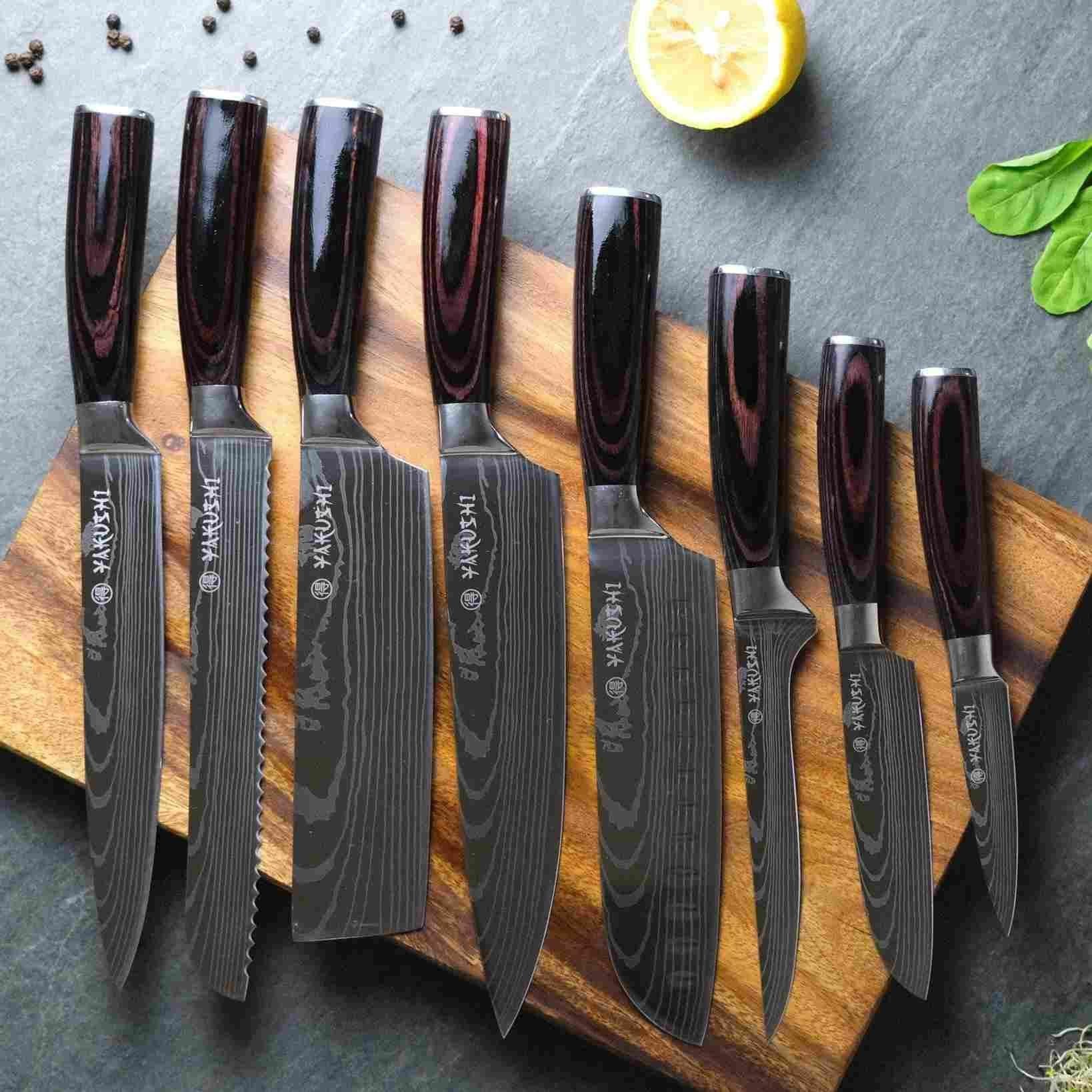
A whetstone is the best way to sharpen, refine, and polish premium kitchen knives without damaging the edge geometry. Yakushi whetstones are designed for Japanese-style kitchen knives, giving home cooks and chefs more control than pull-through sharpeners or electric systems.
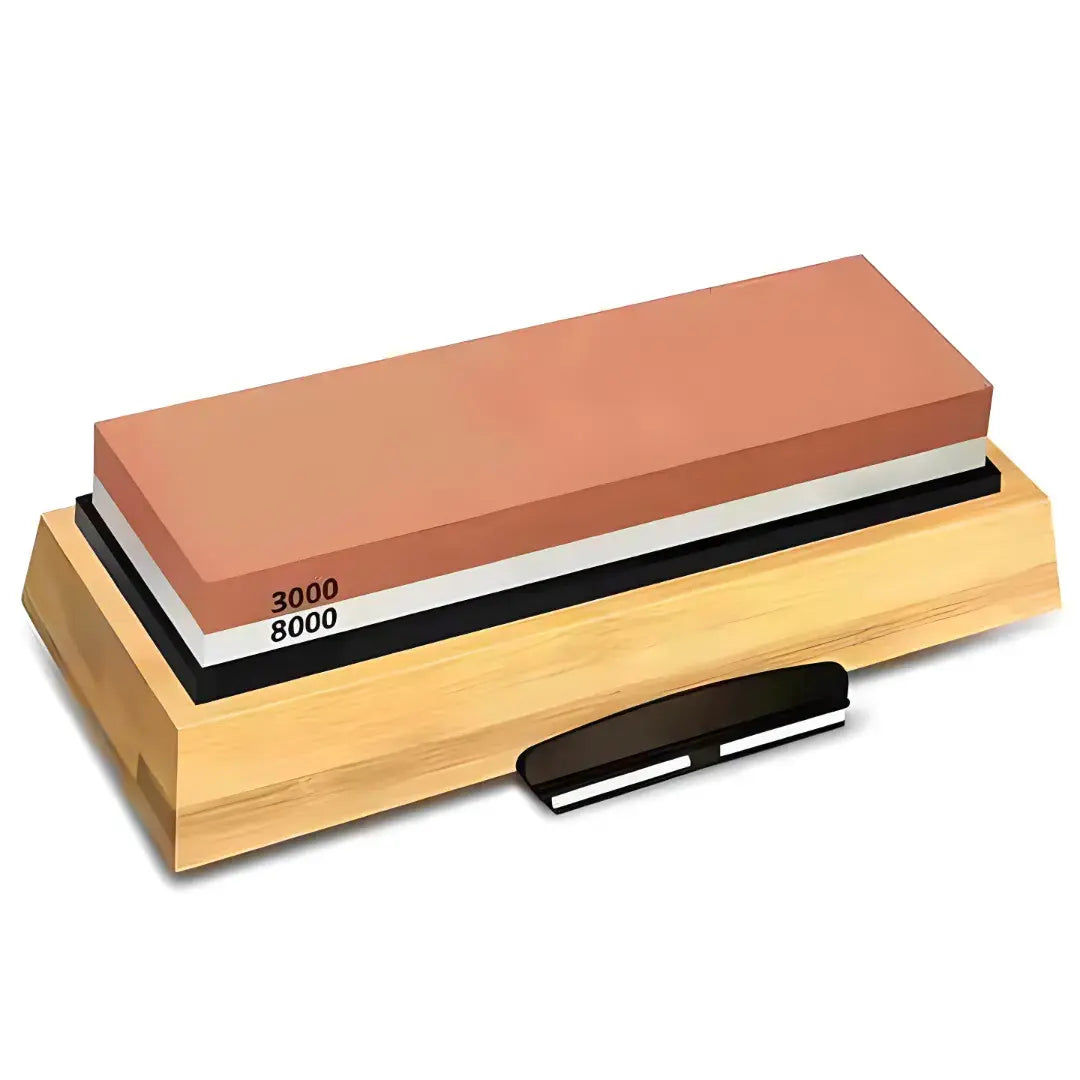
Use a lower grit stone for dull or damaged knives, a medium grit stone for routine sharpening, and a fine polishing stone for smoother, cleaner cuts. Our 3000/8000 grit whetstone is best for refining an already sharp edge and polishing Japanese knives to a cleaner cutting finish.
Filters
2 products
Shop Whetstones for Japanese Kitchen Knives
Unlock the true potential of your culinary cutlery with premium Yakushi Knives Japanese whetstones. Traditional Japanese knives—engineered from high-carbon steels like VG-10, AUS-10, and Blue Paper Steel—require specialized abrasive tools to maintain their razor-sharp, low-angle edge geometry.
Our collection of professional-grade water stones features synthetic corundum matrices engineered to shed worn abrasive particles rapidly. This process creates the ideal sharpening slurry required to apex, hone, and mirror-polish hard Japanese steel structures cleanly without ruining the blade's heat temper. Whether you are maintaining a double-bevel Gyuto or a single-bevel Yanagiba, our stones deliver the surgical precision your kitchen tools demand.
What Is a Whetstone?
A whetstone (often referred to as a water stone or sharpening stone) is a block of abrasive material used to sharpen, hone, and polish the cutting edges of steel tools and knives.
The word "whet" is an archaic English term meaning to sharpen or make keen, meaning a whetstone is literally a "sharpening stone"—independent of whether water or oil is used as a lubricant.
Modern high-performance whetstones are primarily synthetic water stones made from bonded aluminum oxide (corundum) or silicon carbide. They are engineered to be soaked in water before use, which lubricates the surface and washes away detached steel shavings (swarf) and worn abrasive grit to expose fresh, sharp cutting crystals.
Which Whetstone Grit Do You Need?
Whetstone grit numbers indicate the density and size of the abrasive particles embedded in the stone matrix. Selecting the right grit depends entirely on your knife's current edge condition and steel hardness:
- Coarse Grits (#400 to #800): Designed for rapid material removal. Use these for repairing chipped edges, thinning thick geometries, and reshaping completely blunt bevels.
- Medium Grits (#1000 to #3000): The foundational sharpening phase. These grits establish a clean cutting apex and create a highly functional "working edge" with excellent micro-serration density for slicing daily ingredients.
- Fine/Finishing Grits (#5000 to #8000): Used strictly for honing and polishing. These ultra-fine particles remove microscopic burrs and polish the steel to a mirror finish, reducing friction for effortless push-cuts through delicate proteins and herbs.
Use this text to share information about your brand with your customers. Describe a product, share announcements, or welcome customers to your store.
Best Whetstone for Beginners
For culinary enthusiasts entering the world of manual knife care, the 1000/6000 dual-sided whetstone is the undisputed best choice.
The #1000 grit side is forgiving enough to learn angle consistency while still stripping steel efficiently enough to form a noticeable tactile burr. The #6000 grit secondary side allows beginners to practice the delicate art of edge stropping and burr removal without the risk of over-polishing or accidentally rounding off the newly established apex.
Best Whetstone for Japanese Knives
Premium Japanese kitchen knives boast a high Rockwell Hardness Rating (typically 60+ HRC). To sharpen these rigid, thin edges cleanly, the best setup is a 3000/8000 grit combination stone.
Harder steels like VG-10 hold a highly refined apex incredibly well without rolling. Sharpening on a #3000 grit stone creates a clean, precise bevel, while an #8000 grit finishing stone refines the edge to a surgical mirror polish. This elite level of refinement is essential to exploit the narrow 15-degree (or lower) cutting angles characteristic of high-end Japanese cutlery.
How to Use a Whetstone
1.Soak the Stone:5-10 Minutes.
Submerge your water stone completely in clean water. Wait until all escaping air bubbles stop rising to the surface, indicating the internal porous matrix is fully saturated.
2.Establish Your Angle:15 to 20 Degrees.
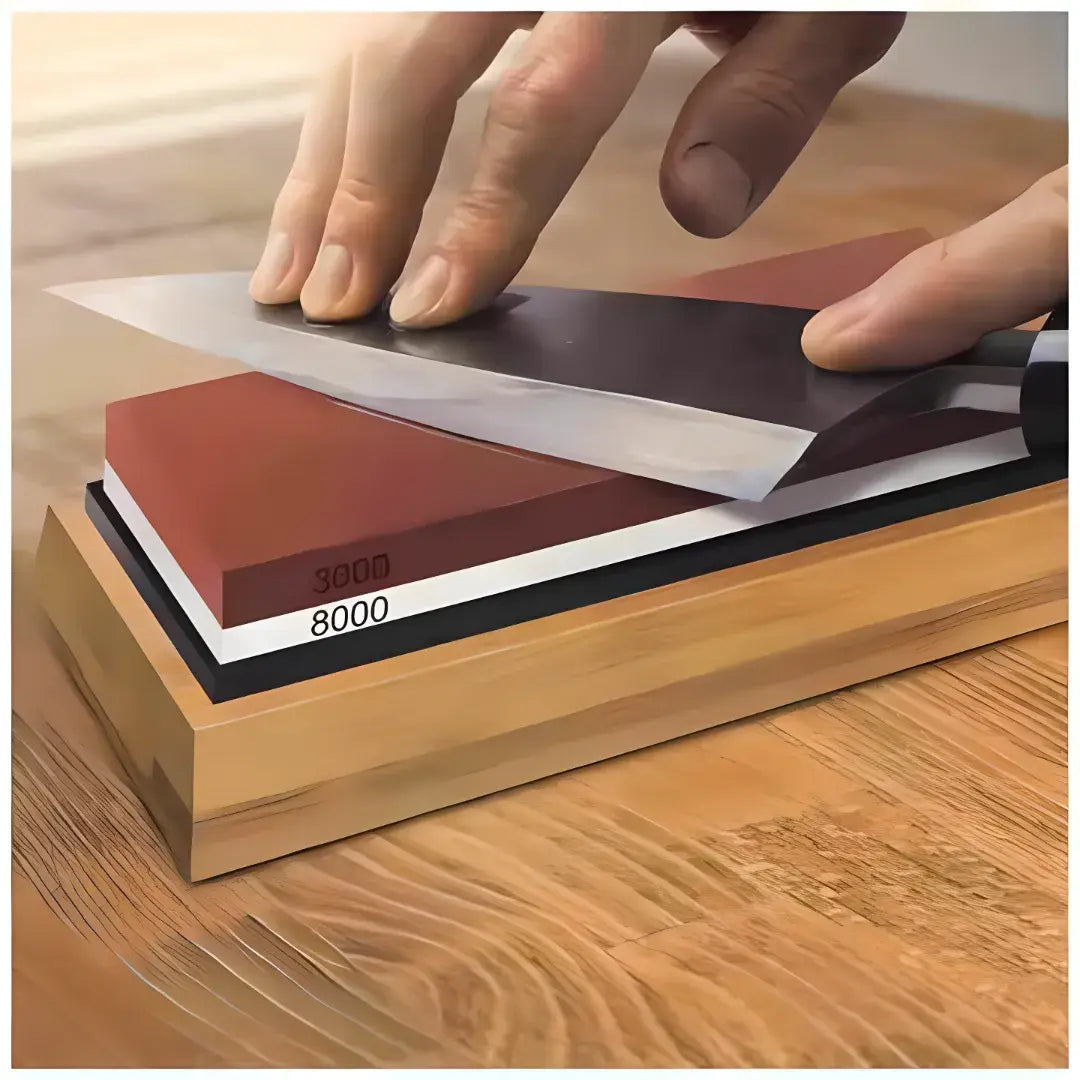
Place the stone on a non-slip base. Hold your knife blade at a consistent angle across the surface—typically 15 degrees for Western knives and 10 to 12 degrees for high-performance Japanese blades.
3.Form the Burr:Light to Medium Pressure.
Push and pull the blade smoothly across the stone from heel to tip. Maintain your angle until you feel a consistent microscopic ridge of metal—called a burr—forming on the opposite side of the edge. Flip the knife and repeat on the other side.
4.Hone and Polish:Stropping Motion.
Switch to the higher grit side of your stone. Use light, trailing edge strokes (pulling the blade away from the edge) to cleanly shear off the burr and polish the newly formed cutting apex.
How to Care for a Whetstone
Proper maintenance ensures your water stones retain an open, aggressive cutting face and a flat surface layout:
The Flattening Rule: Whetstones naturally wear down faster in the center during use, causing a curved indentation known as "dishing." Never use a dished stone, as it will distort your knife's edge geometry. Regularly flatten your water stones using a dedicated silicon carbide lapping plate or a diamond flattening stone to ensure a perfectly planar surface.
After use, rinse away all leftover metallic swarf and slurry. Allow your stones to air dry completely in a shaded, well-ventilated area before storage. Never dry them under direct heat or store them while damp, as trapped moisture can promote mold growth or weaken the structural synthetic binders.
Whetstone vs Pull-Through Knife Sharpener
While mechanical pull-through sharpeners offer speed and convenience, they are inherently destructive to premium cutlery—especially delicate Japanese kitchen knives.
Pull-Through Sharpener (V-Shaped Carbide) --> Strips metal vertically, tears the edge, distorts bevel profile.
Whetstone (Controlled Abrasive Surface) --> Refines metal horizontally, preserves steel lifespan, customizes apex angle.
Pull-through devices use rigid V-shaped tungsten carbide blades that scrape away steel vertically along the cutting edge. This high-friction process rips chunks out of brittle high-carbon steel, creates microscopic fractures, and forces a generic, wide cutting angle that ruins fine cutlery profiles.
In contrast, a whetstone removes steel parallel to the edge profile. This allows the user to completely control the sharpening angle, preserve the knife's structural longevity, and achieve an apex that is exponentially sharper and more durable than any mechanical alternative can produce.
Yakushi recommendation: Use a 400/1000 stone for dull or damaged knives, a 1000/6000 stone for regular sharpening, and a 3000/8000 stone for polishing premium Japanese knives.
400/1000 vs 1000/6000 vs 3000/8000 Whetstones
| Grit Range | Best For | Buyer Intent |
|---|---|---|
| 200–600 | Chips, damage, edge repair | Advanced / Repair |
| 800–1200 | Routine sharpening, dull knives | Best Beginner Choice |
| 2000–3000 | Refinement after sharpening | Better Cutting Feel |
| 4000–6000 | Fine finishing | Enthusiasts / Japanese Knives |
| 8000+ | Mirror polish, ultra-fine edge feel | Premium Finishing |
Japanese Whetstone Maintenance & Advanced Sharpening FAQ
What is a whetstone used for?
A whetstone is used to sharpen, refine, and polish the edge of a knife by removing small amounts of steel from the blade.
Is a 3000/8000 grit whetstone good for beginners?
It is good for beginners who already have reasonably sharp knives and want a smoother, more polished edge. For very dull knives, start with 400/1000 or 1000 grit first.
Are whetstones better than pull-through sharpeners?
For Japanese knives, whetstones give more control over sharpening angle, pressure, and edge refinement. Pull-through sharpeners are faster but can remove more steel and may create uneven bevels.
Do whetstones need to be soaked?
Many water stones need soaking before use, but exact soaking time depends on the stone. Some fine stones are splash-and-go or need only brief wetting.
Why does a burr keep folding back and forth instead of breaking off during whetstone sharpening?
This phenomenon is known as a wire edge or a stubborn, fatigued burr. It occurs when the steel at the cutting apex becomes highly ductile (flexible) from over-sharpening or excess pressure, causing the thin metal ridge to bend across the apex rather than cleanly shearing off.
To eliminate a wire edge on a whetstone, significantly reduce your downward pressure to almost zero (only the weight of the knife blade). Switch to edge-trailing strokes—pulling the blade strictly backward away from the cutting edge—on your highest grit finishing stone (#6000 or #8000). Alternatively, perform a few light passes through a clean block of end-grain hardwood or a leather strop to safely catch and snap the microscopic fatigued steel burr away from the true apex.
What is the exact difference between splashing-and-going vs. soaking a whetstone?
The difference lies entirely in the porosity and chemical bonding agents used to manufacture the synthetic stone matrix.
- Soaking Stones (Hydrophilic/Vitrifed bonds): These feature an open, porous structure that requires complete water submersion (typically 5 to 15 minutes) until all internal air pockets fill with water. This internal reservoir ensures a continuous release of lubricant to create a sharpening slurry during use.
- Splash-and-Go Stones (Magnesia/Resin bonds): These possess an incredibly dense, non-porous structure with binders that hold water strictly on the surface. Submerging a true splash-and-go stone can dissolve its internal bonding compounds, causing the stone to soften, crack, or warp.
Always check your stone's specifications; forcing a soaking stone to act as a splash-and-go will lead to high friction, rapid steel clogging (swarf loading), and deep scratches on your knife bevel.
How do you adjust your whetstone sharpening angle for single-bevel vs. double-bevel Japanese kitchen knives?
Sharpening single-bevel traditional Japanese cutlery (Kataba—such as Yanagiba, Deba, or Usuba) requires an entirely different kinetic approach than symmetrical double-bevel knives (Ryoba—such as Gyuto or Santoku).
Double-Bevel (Ryoba): 15° Angle (Side A) <--------> 15° Angle (Side B)
Single-Bevel (Kataba): Use Primary Bevel Flat <------> Polish Concave Back (Urasuki) Flat on Stone
- For Double-Bevel Knives: You must maintain a matching, consistent angle (typically 12 to 15 degrees) on both sides of the blade to establish a symmetrical cutting apex.
- For Single-Bevel Knives: You sharpen only the primary faceted side (Shinogi line down to the edge) by laying the flat bevel flush against the whetstone surface. To remove the burr from the opposite side, lay the entirely concave back face (Urasuki) dead flat against your highest finishing stone and push forward smoothly. Attempting to lift the knife to create a secondary bevel on the Urasuki side will permanently ruin the knife’s specialized geometry.
I really like the traditional look. They have perfect balance and grip. Incredibly sharp as well!

The Knives are perfect and sharp! I love chopping vegetables with my family now!

I ordered the 5 Piece Set and it exceeds my expectations!