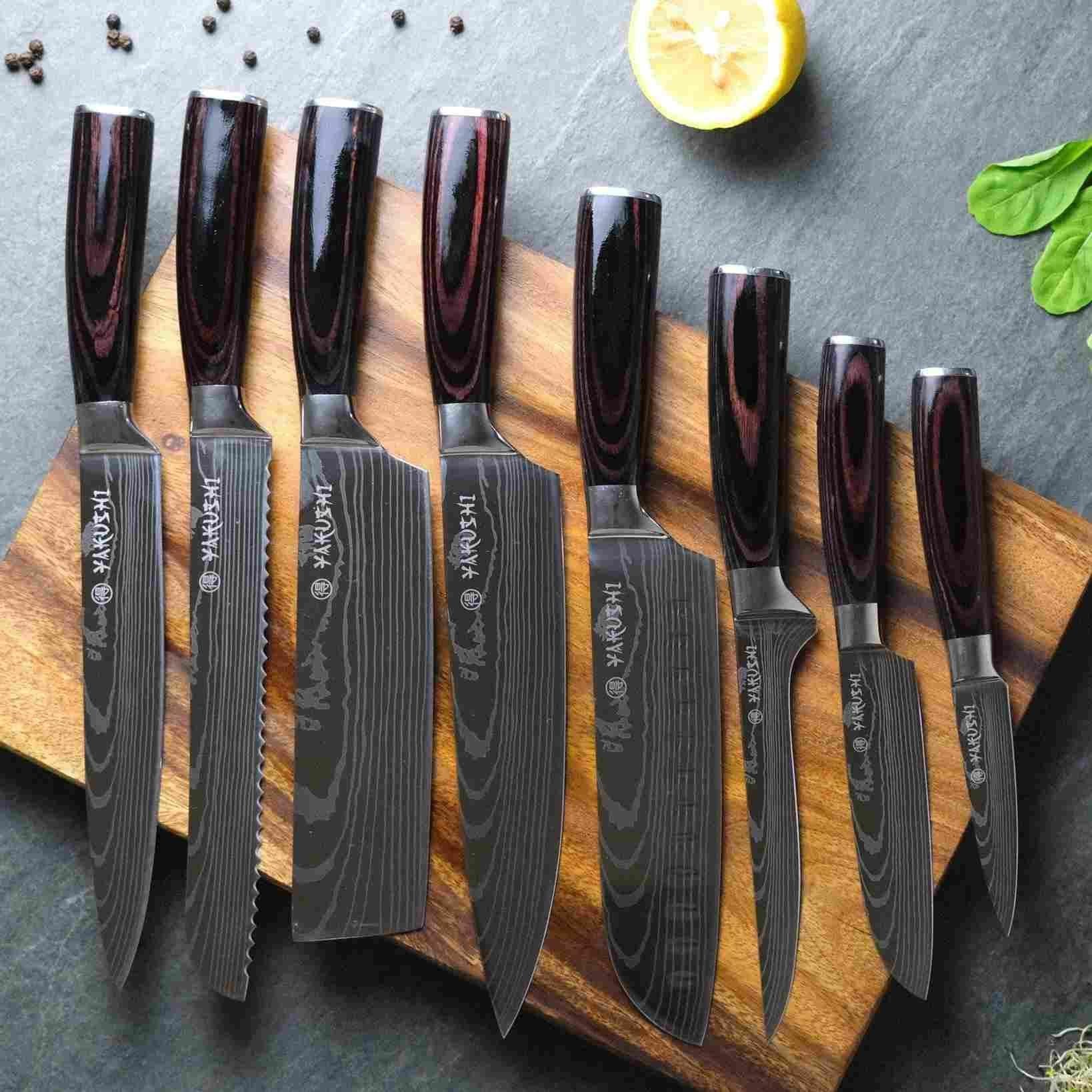
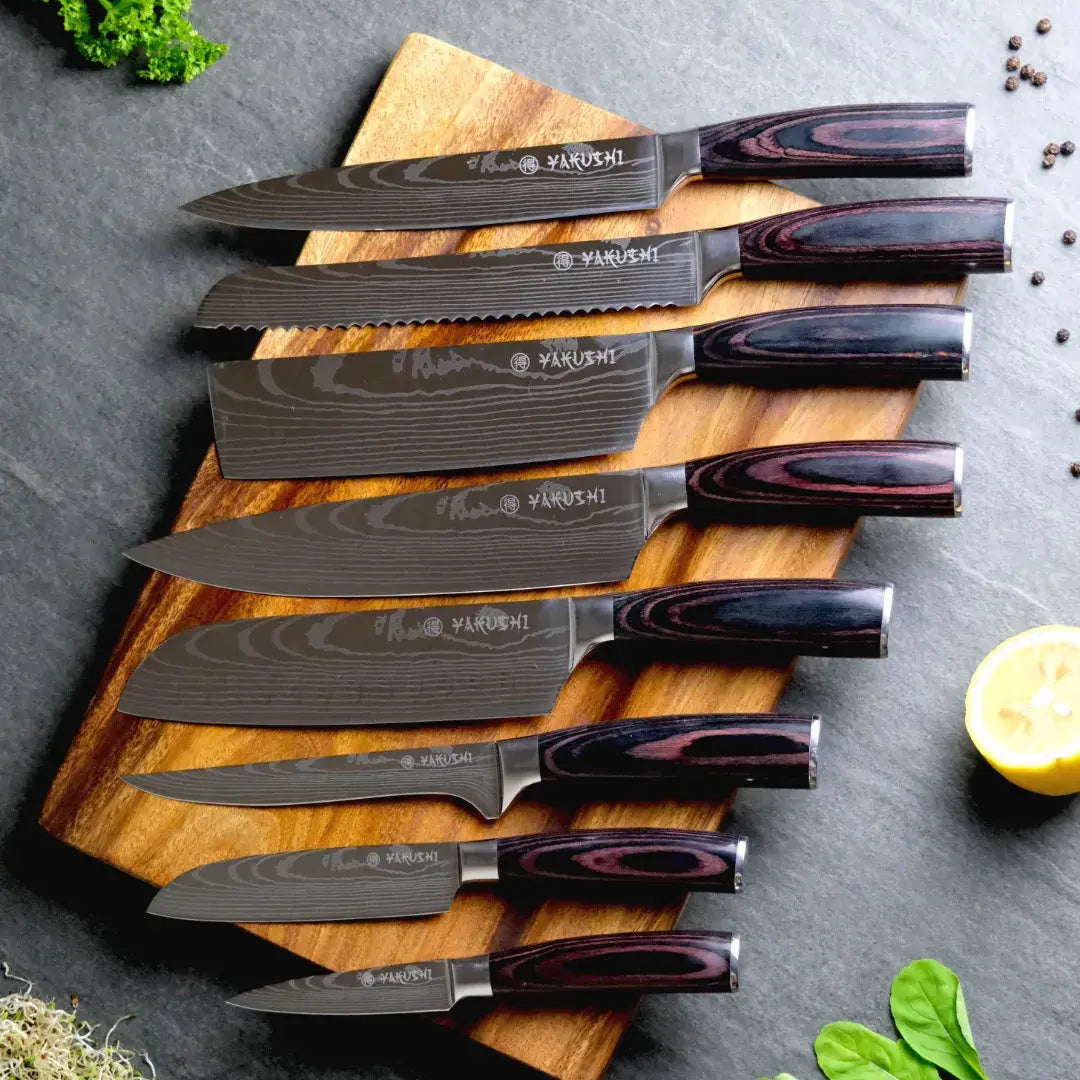
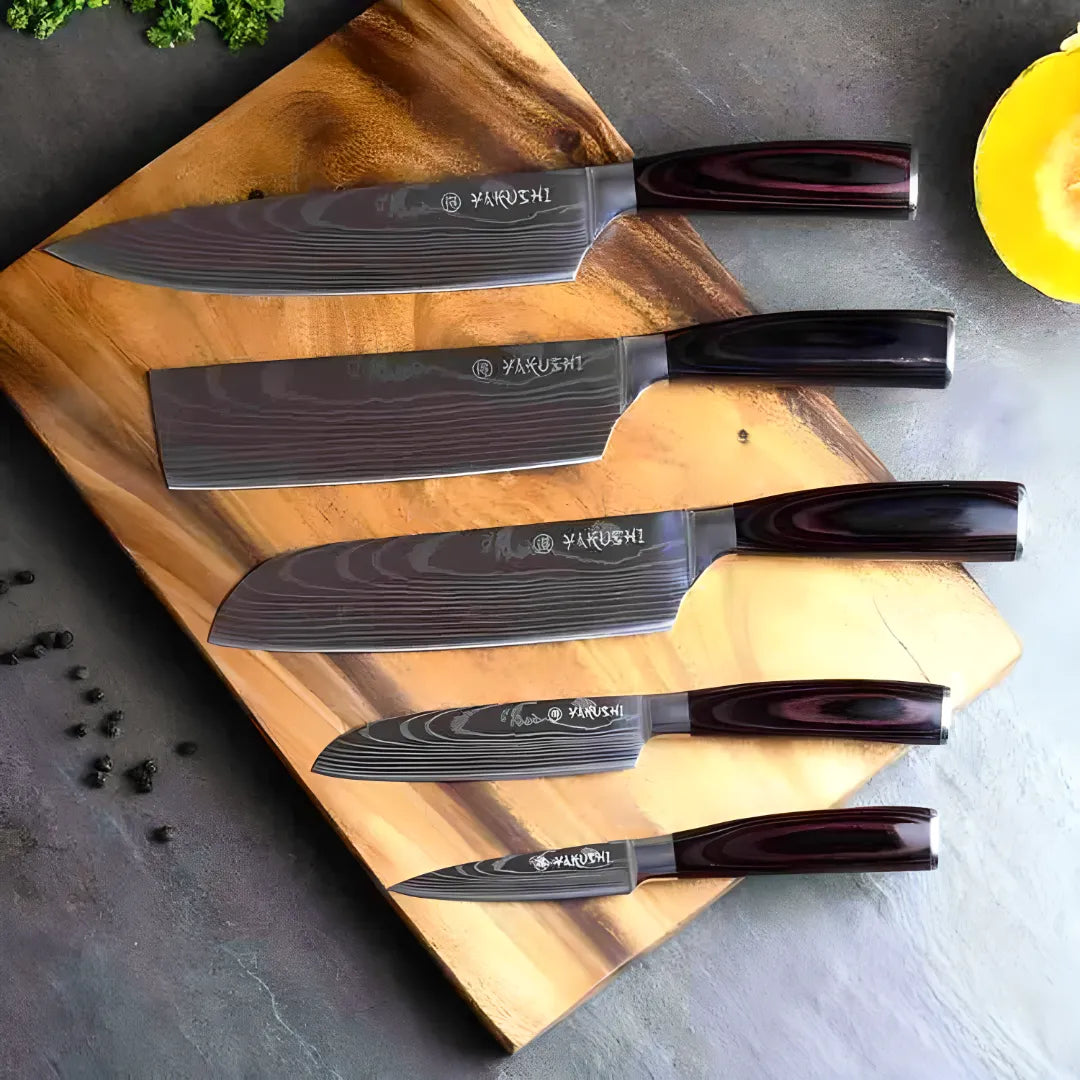
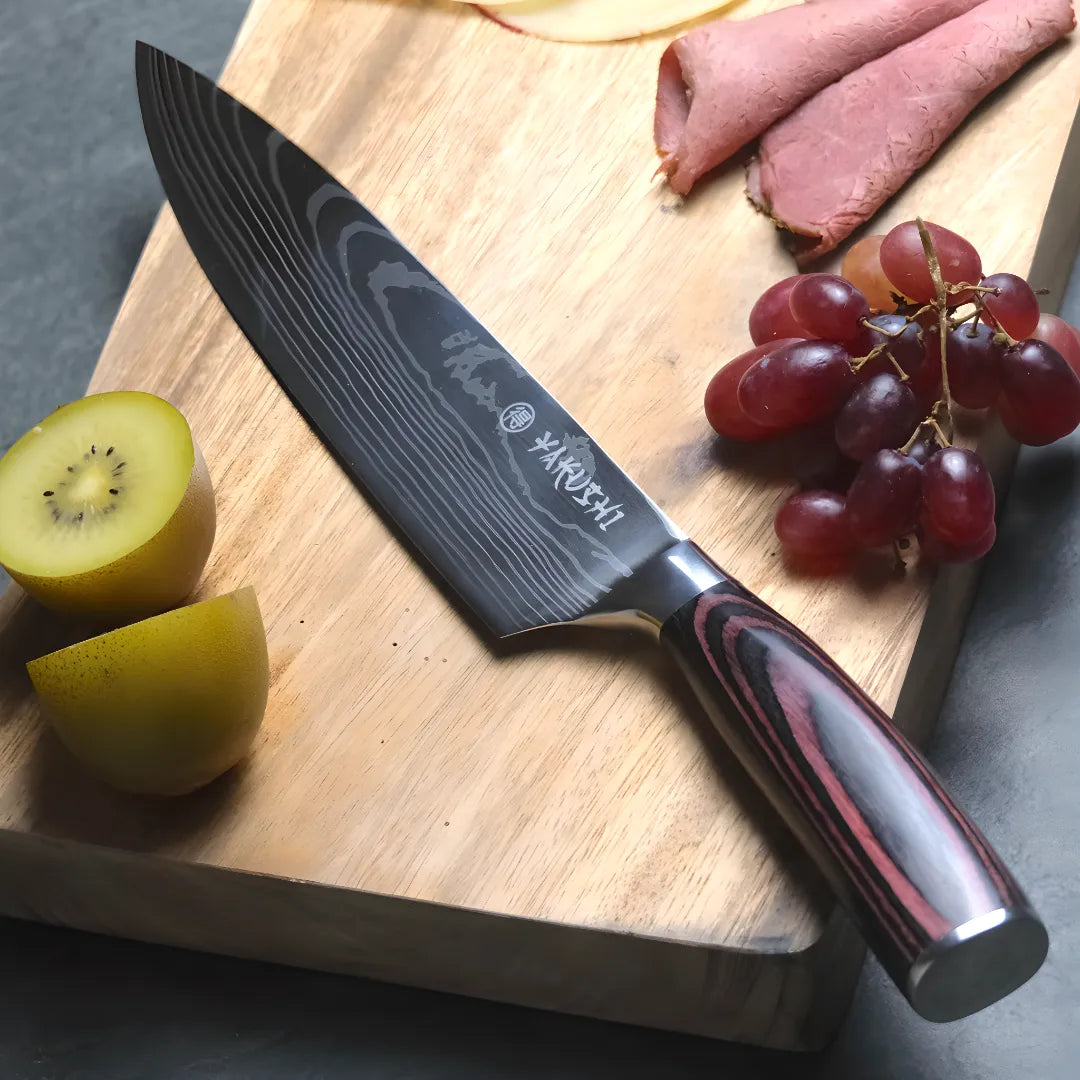
Upgrade your kitchen with a Japanese-inspired professional chef knife set built for sharpness, balance, and everyday prep. Yakushi knife sets combine high-carbon stainless steel blades, Pakka wood handles, double-beveled edges, and practical 3-piece, 5-piece, and 8-piece configurations for chopping, slicing, trimming, carving, and precision prep.
- High-carbon stainless steel blades
- HRC 60+ edge retention
- Pakka wood handles
- Double-beveled edges for easy sharpening
- 3-piece, 5-piece, and 8-piece set options
Filters
8 products
Kitchen Knife Set Comparison
| Set | Includes | Best for | Steel | Handle | Price |
|---|---|---|---|---|---|
|
8-Piece Yakushi Knife Set
★ Best Choice
|
Chef, santoku, paring, cleaver, bread, slicing, boning | Complete kitchen upgrade | High-carbon stainless steel | Pakka wood | $$$ |
| 5-Piece Master Chef Knife Set | Chef, santoku, paring, cleaver | Daily serious cooking | High-carbon stainless steel | Pakka wood | $$ |
| 3-Piece Chef Knife Set | Chef, santoku, paring | Minimalist essential setup | High-carbon stainless steel / Damascus-style | Pakka wood | $ |
What Is a Chef Knife Set?
A chef knife set is a curated collection of essential kitchen blades designed to handle a wide range of culinary tasks. Rather than relying on a single, all-purpose blade, a complete set provides specialized cutting tools engineered for specific tasks—from breaking down dense proteins to executing paper-thin vegetable slices. Investing in a cohesive kitchen knife set ensures uniform balance, matching steel performance, and organized storage across your entire culinary toolkit.
How to Choose the Best Chef Knife Set for Your Kitchen
Finding the best chef knife set requires looking beyond the sheer number of pieces in a block. To choose a set that elevates your cooking and lasts a lifetime, evaluate these three foundational factors:
1. Match Your Culinary Style
If your cooking involves a lot of delicate slicing, fine dicing, and precision prep work, a lightweight Japanese-inspired set is ideal. If you frequently chop through heavy bone and dense frozen foods, look for heavier, thicker blades.
2. Blade Geometry and Edge Profile
The angle of the blade determines how cleanly it moves through food. Traditional western knives use a wide 20-degree edge angle focused on durability. The best professional knife set options typically leverage a razor-sharp 15-degree double-bevel or single-bevel edge, minimizing surface friction and preventing cells in fresh ingredients from tearing.
3. Handle Ergonomics and Balance
A premium knife should feel like a natural extension of your hand. Look for ergonomic handles crafted from durable, moisture-resistant materials like Pakkawood or G10 composite. The balance point should sit right where the blade meets the handle, reducing wrist fatigue during long prep sessions.
Professional Knife Set vs. Basic Knife Set: What’s the Difference?
The difference between a mass-market retail block and a best professional knife set comes down to materials, structural integrity, and manufacturing precision.
- Steel Composition: Basic sets use soft, low-grade stainless steel that dulls after a few uses. Professional sets feature premium high-carbon stainless steel alloys that maintain a razor-sharp edge through months of heavy kitchen use.
- Blade Construction: Low-end knives feature stamped blades glued into cheap plastic handles. Professional culinary sets feature forged construction, ensuring the blade steel runs continuously through the handle for maximum structural strength.
The Anatomy of a Professional Japanese Chef Knife
To understand why premium Japanese blades perform so effortlessly, it helps to understand the engineering terms that define their anatomy:
- The Core (Hagane): The inner layer of high-hardness steel that forms the cutting edge, responsible for the knife's exceptional sharpness and edge retention.
- The Cladding (Jigane): Outer layers of softer stainless steel wrapped around the core to protect it from corrosion, chipping, and wear. This often creates a beautiful, wavy Damascus pattern.
- The Tang: The extension of the blade steel that runs into the handle. A full-tang design offers superior balance and structural integrity.
- The Bevel: The angled surface that forms the cutting edge. A symmetric 15-degree double-bevel offers extreme precision while remaining easy for both left and right-handed cooks to maintain.
What Should a Chef Knife Set Include?
A highly functional kitchen toolkit focuses on utility over clutter. A premium professional chef knife set should ideally feature these core configurations:
- The Anchor (Chef's Knife / Gyuto): The multi-purpose workhorse of the kitchen, usually 8 inches long, designed for slicing, dicing, and heavy chopping.
- The Precision Tool (Santoku): A Japanese-style multi-purpose blade with a flatter edge profile, perfect for ultra-thin vegetable slicing and clean push-cuts.
- The Detailer (Paring Knife): A small, nimble 3.5-inch blade meant for peeling, coring, and intricate off-board tasks.
- The Specialist (Utility Knife): A mid-sized blade filling the gap between your paring and chef's knife, ideal for precise slicing of smaller meats and cheeses.
Why Choose a Professional Japanese Knife Set?
Professional chefs and passionate home cooks worldwide favor Japanese knife sets for their uncompromising focus on precision craftsmanship. Unlike bulky western cutlery, a Japanese-engineered chef knife set is lighter, more agile, and ground to a significantly sharper cutting angle.
Because the steel is harder, the blades can be forged much thinner. This allows you to glide through delicate herbs, ripe tomatoes, and premium proteins without bruising the food or losing valuable juices on your cutting board.
Commercial-Grade Integrity: Built for the High-Volume Kitchen
Standard residential kitchen cutlery is built for occasional, low-impact prep work. However, a high-volume professional kitchen demands a completely different tier of metallurgical and structural engineering. Our professional knife sets are specifically built to withstand the punishing, multi-hour daily workloads of commercial hot-lines and heavy catering prep.
When investing in a professional-grade set, three critical factors dictate its survivability in a commercial space:
1. Superior Carbide Stability (60+ HRC Core)
In a fast-paced kitchen, you do not have time to stop and sharpen your blade every hour. Our professional sets feature ultra-hard Japanese super-steel cores enriched with cobalt and vanadium. This metallurgical matrix creates exceptionally dense, wear-resistant carbides that allow the 15-degree factory edge to slice cleanly through hundreds of pounds of dense produce and proteins before requiring maintenance on a whetstone.
2. Moisture-Proof, Structural Handles
Cheap wood or low-density plastic handles easily crack, warp, or harbor bacteria when exposed to constant moisture, high temperatures, and commercial cleaning agents. Our professional sets utilize high-pressure composite handles (such as G10 or premium stabilized Pakkawood) that are completely non-porous. They will not absorb water, oils, or food juices, ensuring 100% food-safe sanitation and a slip-resistant grip even when working with wet or greasy hands.
3. Impact-Resistant Cladding
Extreme hardness can inherently make steel brittle. To ensure your blades don't chip during rapid tap-chopping, our professional cutting cores are jacketed in multi-layered, shock-absorbing stainless steel cladding. This composite engineering gives you the absolute best of both worlds: the surgical sharpness of hard Japanese steel paired with the rugged impact resistance required for heavy line-work.
What Is the Best Knife Steel for a Professional Set?
High-Carbon Stainless Steel vs. Traditional Carbon Steel
Traditional carbon steel holds an incredible edge but requires meticulous drying to prevent immediate rusting. The modern gold standard for a best professional knife set is premium high-carbon stainless steel, such as VG10 or multi-layered Damascus alloys. These advanced formulations offer an optimal balance: the high carbon content allows for an ultra-hard core (typically 60+ HRC) that holds its edge for months, while Chromium additions provide reliable corrosion resistance against acidic foods.
Japanese vs. German Chef Knife Sets: What's the Difference?
Japanese vs. German Knife Sets
Choosing between these two legendary styles depends entirely on your cooking philosophy and technique:
| Attribute | Japanese Chef Knife Sets | German Chef Knife Sets |
|---|---|---|
| Rockwell Hardness | Ultra-Hard (60+ HRC) | Medium-Soft (56-58 HRC) |
| Edge Geometry | Razor-Sharp 15-degree edge | Durable 20-degree edge |
| Blade Profile | Thinner, lightweight precision | Thicker, heavy-duty mass |
| Best Performance | Clean slicing, fine dicing, julienne | Heavy chopping, bones, dense roots |
| Edge Retention | Long-lasting; requires less honing | Dulls faster; requires frequent steel alignment |
Blade length must match the physical scale of the animal or protein you are processing:
- 6 to 7-Inch Blades (The Hybrid Standard): The ideal size for home kitchens, backyard BBQ prep, and camp cooking. It offers the agility needed to break down whole chickens, duck, and pork loins, while retaining enough mass to chop cleanly through thick root vegetables or dense squash.
- 10 to 12-Inch Blades (The Primal Master): Designed for processing massive, whole primal cuts of beef or large game. The extended edge length is mandatory for executing single, flawless drawing slices across whole briskets, prime rib roats, or large salmon sides without sawing back and forth, which tears muscle fibers and ruins presentation.
How to Clean and Maintain a Professional Chef Knife Set
Proper maintenance protects your investment and ensures your blades remain safe and razor-sharp for a lifetime of cooking.
1.Hand Wash Immediately After Use:Never use a dishwasher.
The intense heat, harsh detergents, and banging motion of a dishwasher will ruin your handle material, dull the cutting edge, and induce chipping. Always hand wash with mild dish soap and warm water.
2.Dry Completely Thoroughly:Prevent oxidation.
Never let your high-carbon kitchen knives air dry in a sink rack. Wipe them down immediately with a clean microfiber towel from the spine down to the cutting edge to eliminate any lingering moisture.
3.Store Safely and Securely:Protect the edges.
Allowing loose blades to knock against each other in a utensil drawer will quickly dull and nick the steel. Store your set safely using a dedicated wooden knife block, a magnetic wall strip, or individual blade guards.
4.Maintain with Quality Whetstones:Sharpening vs Honing.
Avoid aggressive pull-through carbide sharpeners, which shave away precious steel unevenly. Instead, use premium dual-grit whetstones (such as a 3000/8000 grit combination) to safely polish and restore your 15-degree edge profile.
Frequently Asked Questions About
Knife Sets for Pro Level Chefs
Is a 3-piece, 5-piece, or 8-piece chef knife set better?
The right set size depends on your cooking habits. A 3-piece set (typically a Chef’s knife, utility knife, and paring knife) is perfect for minimalists who stick to basic daily meal prep. A 5-piece set introduces specialized slicing tools like a Santoku or bread knife, making it the sweet spot for passionate home cooks. An 8-piece professional knife set is best for culinary enthusiasts and executive chefs who require a complete range of specialized edges, including dedicated boning, carving, and herb-chopping blades.
Are these knives suitable for a commercial kitchen environment?
Yes. Our professional chef knife sets are engineered for high-volume, commercial use. Unlike standard residential knives that use softer steel and porous handles, our professional blades feature ultra-hard Japanese super-steel cores (rated at 60+ HRC) for extreme edge retention during long shifts. The handles are constructed from high-density, non-porous materials (like G10 or stabilized Pakkawood) that resist moisture, grease, and heat, ensuring a slip-resistant grip and meeting strict commercial sanitation standards.
Can these professional knives go through a commercial dishwasher?
Absolutely not. No professional-grade cutlery should ever be subjected to a commercial dishwasher. The extreme heat, high-pressure water jets, and harsh caustic detergents will rapidly dull the microscopic cutting edge, corrode the high-carbon steel core, and compromise the structural integrity of the handle. Professional knives must be hand-washed with mild soap and warm water, and dried immediately with a towel after service.
What is the difference between a chef knife set and a kitchen knife set?
While the terms are often used interchangeably, a traditional chef knife set focuses strictly on high-performance culinary preparation blades (like Gyutos, Santokus, and paring knives). A general kitchen knife set is broader and frequently includes non-prep cutlery, such as serrated steak knives for table settings, kitchen shears, and sharpening steels inside a storage block.
What knives are essential for a culinary student or professional starter set?
For anyone entering a professional kitchen, a massive 8-piece set is often unnecessary. We recommend starting with a foundational 3-piece to 5-piece set that covers 95% of daily prep. A true professional foundation requires:
- A Primary Workhorse: An 8-inch or 10-inch Gyuto (Chef Knife) for heavy protein and vegetable prep.
- A Detail Specialist: A 5-to-6-inch Petty (Utility/Paring Knife) for off-board work, peeling, and intricate garnishes.
- A Chopping Specialist: A Nakiri or Santoku for rapid, fatigue-free vegetable chopping.
Are professional chef knife sets worth it?
Yes, investing in a high-quality best professional knife set saves money and frustration over time. Mass-market stamped knives dull quickly, causing you to crush food rather than slice it, which leads to quicker hand fatigue and increased safety slips. A professional forged set holds its edge significantly longer, offers superior balance, and can be continuously resharpened to a razor-edge for decades.