Yakuba Knives Set in Box

Butcher Knives

5,000+ Customers Yearly

5,000+ Customers Yearly

3 Month Warranty

3 Month Warranty

Free USA Shipping

Free USA Shipping

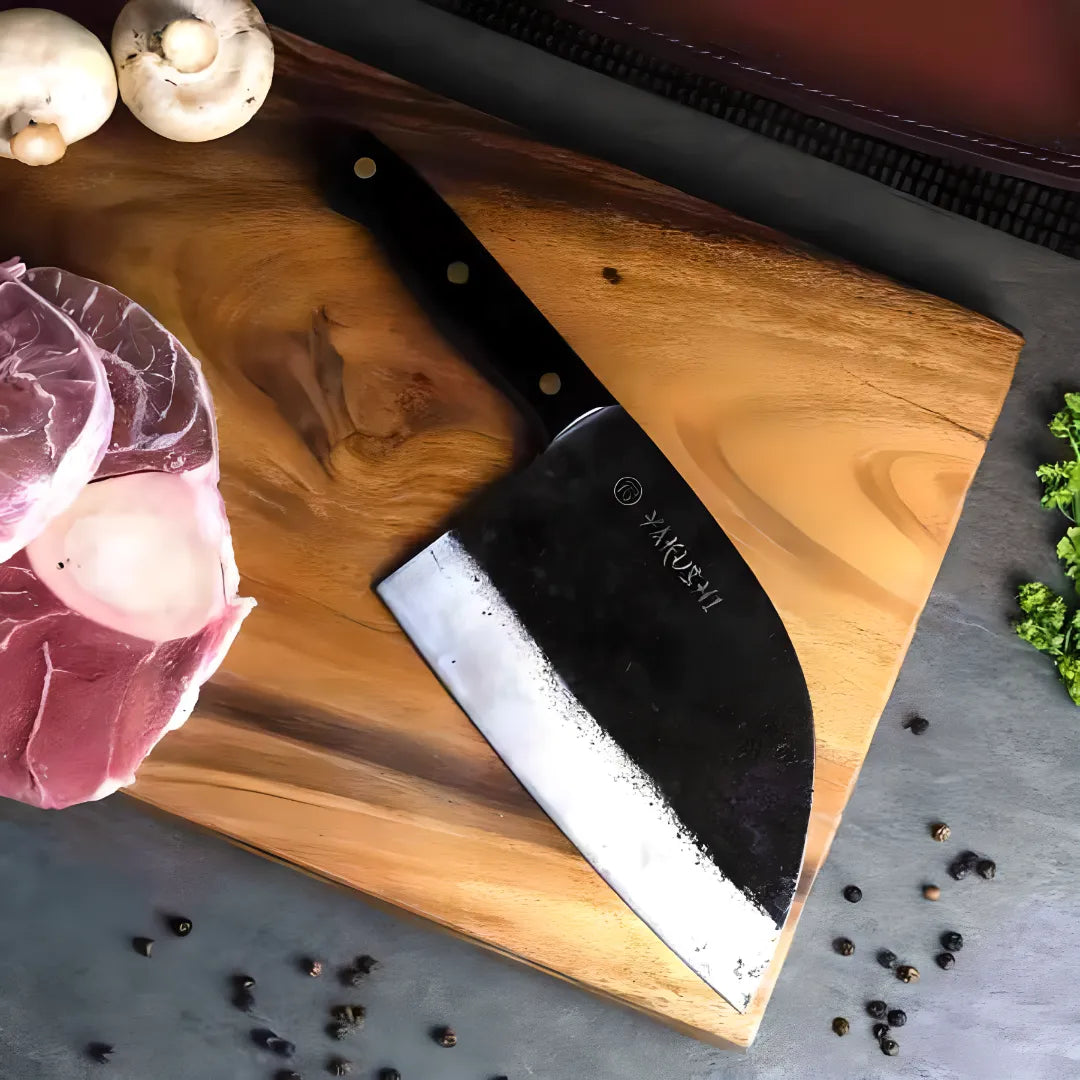
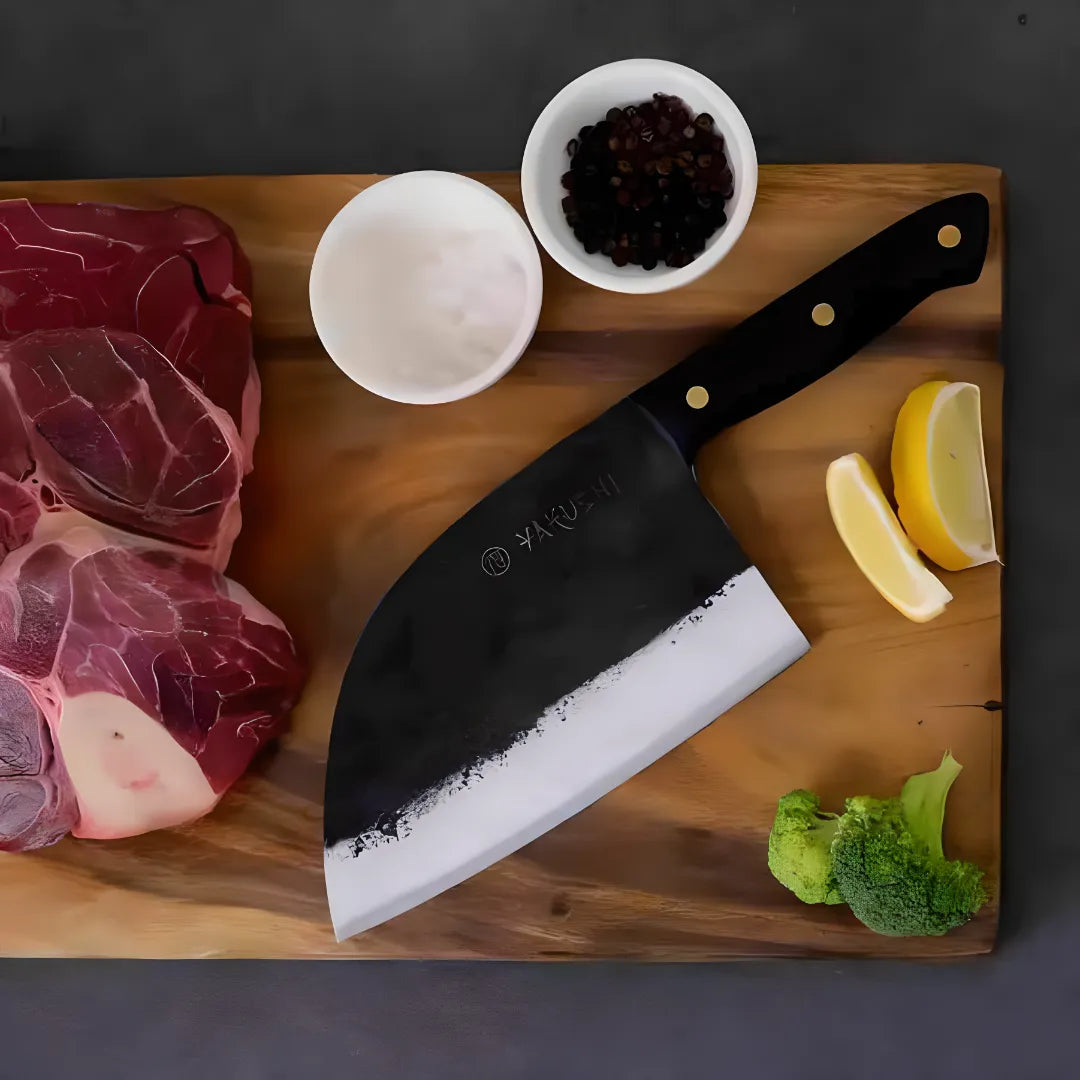
Yakushi butcher knives are built for cooks who need more power than a standard chef knife but more control than a traditional meat cleaver. Our 7-inch Serbian-style butcher knife is designed for BBQ prep, poultry breakdown, ribs, meat chopping, hard vegetables, camp cooking, and heavy kitchen tasks.

With a 390g full-tang blade, high-carbon Serbian steel, a double-beveled edge, and a polished Pakka wood handle, this butcher knife gives home cooks and pitmasters the weight needed for demanding prep while still feeling controlled in the hand. It is best for meat prep, poultry joints, ribs, brisket prep, hard squash, root vegetables, and rustic chopping. It should not be used on frozen food, thick beef bones, or as a replacement for a bone saw.

Filters

Sort by:

Handcrafted Butcher Knives & Heavy-Duty Meat Cleavers

Butcher & Heavy Prep Knife Selection

Knife Type Best for Blade Shape Cutting Motion Should it cut bones?
Yakushi Serbian Butcher Knife BBQ prep, poultry, ribs, meat chopping, hard vegetables Wide 7-inch Serbian-style blade Downward chopping, push cuts, short slicing LIMITED
Small poultry joints only
Traditional Butcher Knife Trimming fat, slicing meat, breaking down large cuts Long curved blade Long slicing and sawing strokes SOMETIMES
Depending on design
Meat Cleaver Bones, joints, heavy chopping Tall rectangular heavy blade Vertical chopping YES
If built for bones
Boning Knife Removing bones, trimming silver skin, precision meat prep Narrow pointed blade Precise trimming and detail work NO

Best Butcher Knife for BBQ, Poultry, and Meat Prep

Finding the best butcher knife means finding a tool that balances raw splitting power with surgical edge geometry. Backyard pitmasters, professional chefs, and home charcuterie enthusiasts all require a blade that handles heavy-duty animal breakdown without crushing delicate muscle fibers. The Yakushi collection is engineered to deliver exactly that: an uncompromising blend of maximum downward kinetic force and razor-sharp edge retention that transforms large-scale meat preparation from a chore into a precise art form.

What Is a Butcher Knife?

A butcher knife is a specialized culinary tool engineered explicitly for processing, dressing, and portioning whole animal carcasses or large primal cuts. While the category includes several historical design profiles, a premium butcher knife is universally defined by its rigid spine, substantial blade height or curve, and an intentional weight distribution that utilizes gravity to glide through thick tissue. Unlike flexible boning knives or lightweight Japanese utility blades, an authentic butcher knife features a robust edge geometry designed to withstand repeated contact with dense muscle structures, tough silver skin, and connective cartilage without micro-chipping.

What Are Butcher Knives Used For?

The primary mechanical utility of a butcher knife centers on efficient protein processing. Its specific culinary applications include:

  • Primal Breakdown: Segmenting massive sections of beef, pork, or venison into manageable sub-primals.
  • BBQ and Brisket Prep: Trimming thick fat caps uniformly and slicing through smoked briskets or ribs in single, clean strokes to preserve moisture.
  • Poultry Portioning: Halving whole chickens, separating wings, and cleanly splitting breastbones or joints.
  • Skinning and Hide Removal: Utilizing the sweeping belly curve of specialized butcher profiles to cleanly separate hide from flesh without puncturing the underlying muscle.

Yakushi Butcher Knife: Key Specs

Core Metallurgy: Ultra-hard VG10 high-carbon Japanese steel core.

Cladding Architecture: 67 layers of pattern-welded Damascus stainless steel for enhanced structural flexibility and atmospheric corrosion resistance.

Rockwell Hardness (HRC): 60-62 HRC for professional-grade, long-lasting edge retention.

Edge Geometry: Traditional double-bevel edge, precision-honed to a razor-sharp 15 degrees per side (30 degrees inclusive).

Spine Thickness: 3.0mm at the bolster, tapering forward to maximize downward splitting physics while retaining a clean cutting profile.

Construction: Full-tang assembly running seamlessly from tip to pommel for ultimate safety under lateral load.

Handle Material: Polished, moisture-resistant Pakkawood secured with heavy-duty structural rivets.

Total Weight: 390 grams of forward-balanced cutting momentum.

Butcher Knife vs Meat Cleaver vs Boning Knife

Understanding Blade Geometry & Mechanics

Selecting the correct tool for your kitchen workflow depends entirely on understanding the distinct differences in structural architecture and mechanical intent.

Knife Type Blade Geometry & Design Primary Cutting Motion Primary Application
Butcher Knife Long, heavy, often curved blade with a rigid spine and pronounced belly. Long drawing slices, sweeping strokes, and controlled downward chops. Trimming fat caps, portioning steaks, slicing briskets, and parting out poultry.
Meat Cleaver Massive, thick-spined rectangular footprint with an obtuse, durable edge. Vertical, high-velocity hacking utilizing pure downward kinetic momentum. Splitting heavy marrow bones, chopping frozen meats, and forceful primal fracturing.
Boning Knife Narrow, ultra-thin, highly flexible or semi-rigid narrow profile. Intricate tracing, surgical piercing, and close-quarters contour scraping. Separating tender muscle directly from bone, silver skin removal, and precision deboning.

Anatomy of an Elite Butcher Knife: Balance and Tang

The performance of a heavy-duty butcher knife relies heavily on its structural balance point. An elite blade features a full-tang construction, meaning the single sheet of forged high-carbon steel extends completely from the tip through the entire length of the handle scales.

Partial tang configurations or rat-tail tangs are structural liabilities in butchery; they create severe stress-concentration points where the blade meets the handle, frequently snapping under the intense torque of splitting cartilage. By utilizing a full-tang architecture, Yakushi shifts the balance point slightly forward toward the bolster. This creates a "blade-heavy" bias that permits gravity and natural arm momentum to execute the downward split, significantly reducing repetitive wrist strain and forearm fatigue.

Handle Ergonomics: Grip Security in Wet Conditions

During extended processing sessions, a knife handle is constantly exposed to slick moisture, internal fluids, and rendered animal fats. If a handle material absorbs moisture or lacks an ergonomic flare, the hand will slip forward onto the razor-sharp heel of the blade.

Yakushi utilizes premium, highly dense Pakkawood and composite scale materials that are pressure-treated with food-safe phenolic resins. This engineering creates a completely non-porous, moisture-resistant surface that will not swell, crack, or harbor bacterial growth. The handle profile is sculpted with an ergonomic contour that widens significantly toward the butt end, acting as a physical mechanical stop that locks into your palm, ensuring an unyielding grip even when completely wet.

High-Carbon Steel vs. Stainless Steel Butcher Knives

When selecting an optimal steel type for meat preparation, chefs face a distinct engineering trade-off:

  • Standard Stainless Steel: Contains high chromium content (greater than 13%). It resists rust exceptionally well but is metallurgically soft (typically 54-56 HRC). It dulls rapidly when sliding against bone, requiring constant steeling, and tends to deform rather than hold a surgical edge.
  • High-Carbon VG10 Steel: Infused with elevated carbon, vanadium, and cobalt levels. It allows the blade to be hardened to an incredible 60+ HRC. The result is an exceptionally fine molecular edge that stays razor-sharp through hundreds of pounds of meat processing. While high-carbon steel demands strict maintenance to prevent atmospheric oxidation, the cutting performance and edge longevity are vastly superior to standard stainless steel.

How to Choose the Right Blade Length for Butchery

Blade length must match the physical scale of the animal or protein you are processing:

  • 6 to 7-Inch Blades (The Hybrid Standard): The ideal size for home kitchens, backyard BBQ prep, and camp cooking. It offers the agility needed to break down whole chickens, duck, and pork loins, while retaining enough mass to chop cleanly through thick root vegetables or dense squash.
  • 10 to 12-Inch Blades (The Primal Master): Designed for processing massive, whole primal cuts of beef or large game. The extended edge length is mandatory for executing single, flawless drawing slices across whole briskets, prime rib roats, or large salmon sides without sawing back and forth, which tears muscle fibers and ruins presentation.

Who This Butcher Knife Is Best For

The Yakushi High-Carbon Butcher Knife is purpose-built for dedicated home cooks, avid hunters, backyard BBQ pitmasters, and professional culinary artists who regularly process whole proteins. If you value an aggressive, blade-heavy instrument that uses its own physical weight to glide through dense connective tissue, thick-skinned meats, and poultry joints with minimal effort, this knife is meticulously designed for you.

Who Should Not Buy This Butcher Knife

You should not buy this premium Japanese VG10 high-carbon butcher knife if you are looking for a cheap, soft utility tool to repeatedly bash through frozen beef leg blocks or dense commercial cattle femur bones. Because high-carbon steel is hardened to 60+ HRC to deliver clean, surgical cuts, it is structurally rigid. If your cooking style involves high-velocity hacking directly against hard metals, stone countertops, or thick structural beef bones, you should use a softer, low-grade, blunt Western commercial meat cleaver instead.

Safe Butchering: Proper Hand Placement and the Pinch Grip

Operating a large, heavy butcher blade safely requires transitioning away from standard casual handle grips to a secure, professional hold:

  1. The Pinch Grip: Place your thumb and the lateral side of your index finger directly onto the base of the blade face, just forward of the bolster. Wrap your remaining three fingers tightly around the wooden handle scales. This provides absolute lateral stability, completely preventing the heavy blade from twisting or rolling when making forceful downward contact.
  2. The Guide Hand Claw: Always curl the fingers of your non-cutting hand inward into a strict "claw grip," tucking your valuable fingertips completely under your knuckles. Rest the flat side of the butcher blade gently against your guard knuckles to guide your cutting increments safely.

How to Safely Store Large Butchering Blades

Because a professional butcher knife carries substantial weight and a razor-sharp edge, storing it loose in a cluttered kitchen drawer is highly dangerous. It will rapidly destroy the fine edge via metal-on-metal collision and presents a serious laceration hazard. Safe storage methods include:

  • High-Intensity Magnetic Wood Strips: Wall-mounted strips utilizing rare-earth neodymium magnets hidden behind a soft wooden exterior to securely hold the heavy full-tang blade.
  • Form-Fitting Wooden Saya Sheaths: A traditional custom wooden guard that slides tightly over the blade face, safely locking the edge for drawer or knife roll transport.
  • Wide-Slot Countertop Blocks: Specialized blocks designed with horizontal slots wide enough to accept heavy butcher profiles without scraping the edge.

Full-Tang Integrity: Why Weight and Balance Matter in Butchery

When you are breaking down large subprimal cuts, splitting poultry joints, or prepping a massive brisket for the smoker, your knife's construction dictates how much effort your arm has to put in. Standard kitchen knives use partial-tang designs—where a thin metal rod is glued inside a hollow handle—which creates a dangerous snapping point under heavy stress.

Our butcher collection focuses on heavy-duty, full-tang construction paired with premium, high-density handles to give you two distinct mechanical advantages:

1. Unified Structural Strength

Because a single piece of solid, hand-forged steel runs continuously from the tip of the blade straight through to the butt of the handle, there are zero weak joints. It can easily withstand repetitive, high-impact downward forces without the risk of the blade breaking away from your grip.

2. Momentum-Driven Cutting (390g Weight class)

With a robust weight class averaging around 390 grams, these blades are intentionally heavier than a standard chef's knife. This extra heft uses the physical laws of gravity and momentum to do the heavy lifting for you. The weight of the blade drives the cut straight down through tough muscle and cartilage, radically reducing wrist fatigue during long prep sessions.

How to Care for a High-Carbon Butcher Knife

To preserve the structural integrity and pattern-welded art of your high-carbon blade, you must adhere to these strict maintenance rules:

  1. Hand Wash Exclusively: Wash your blade immediately after use with warm water and mild dish soap. Never place it in a dishwasher. The extreme heat, thermal cycling, and aggressive caustic detergents will instantly ruin the wooden handle and dull the fine edge.
  2. Dry Immediately: Wipe the steel completely dry with a clean microfiber cloth before storage. Leaving standing water on high-carbon steel induces rapid oxidization, leading to rust spots and edge pitting.
  3. Apply Food-Safe Mineral Oil: If storing the knife for an extended period, apply a micro-layer of food-safe mineral oil (such as Tsubaki or knife-grade camellia oil) to the blade surface to establish a protective barrier against atmospheric humidity.

How to Sharpen a Butcher Knife

To maintain a precise 15-degree edge on a heavy-duty butcher knife, avoid destructive mechanical pull-through sharpeners or high-speed grinding wheels. Utilize traditional whetstone sharpening:

  1. Saturate the Stones: Submerge your dual-grit whetstone (1000-grit for setting the edge bevel; 6000-grit for fine polishing) in water for 10 to 15 minutes until air bubbles stop escaping.
  2. Lock in the Angle: Place the blade face against the whetstone surface at a consistent 15-degree angle. (A reliable visual reference is the height of two standard pennies stacked flat beneath the spine of the knife).
  3. Execute Controlled Strokes: Applying smooth, moderate downward pressure with your fingertips near the edge, sweep the blade across the stone from the heel to the sweeping tip. Pull the knife back smoothly without pressure. Repeat this uniform motion across the entire length of the blade.
  4. Detect the Burr: Continue sharpening the initial side until you can feel a consistent, microscopic raised edge of steel (a burr) uniform along the opposing side of the blade. Flip the knife over and mirror the exact process.
  5. Refine and Polish: Transition to the ultra-fine 6000-grit polishing stone or a leather strop to gently stroke away the microscopic burr, refining the cutting edge to an incredibly clean, mirror finish.

Frequently Asked Questions About Butcher Knives

Explore the collections