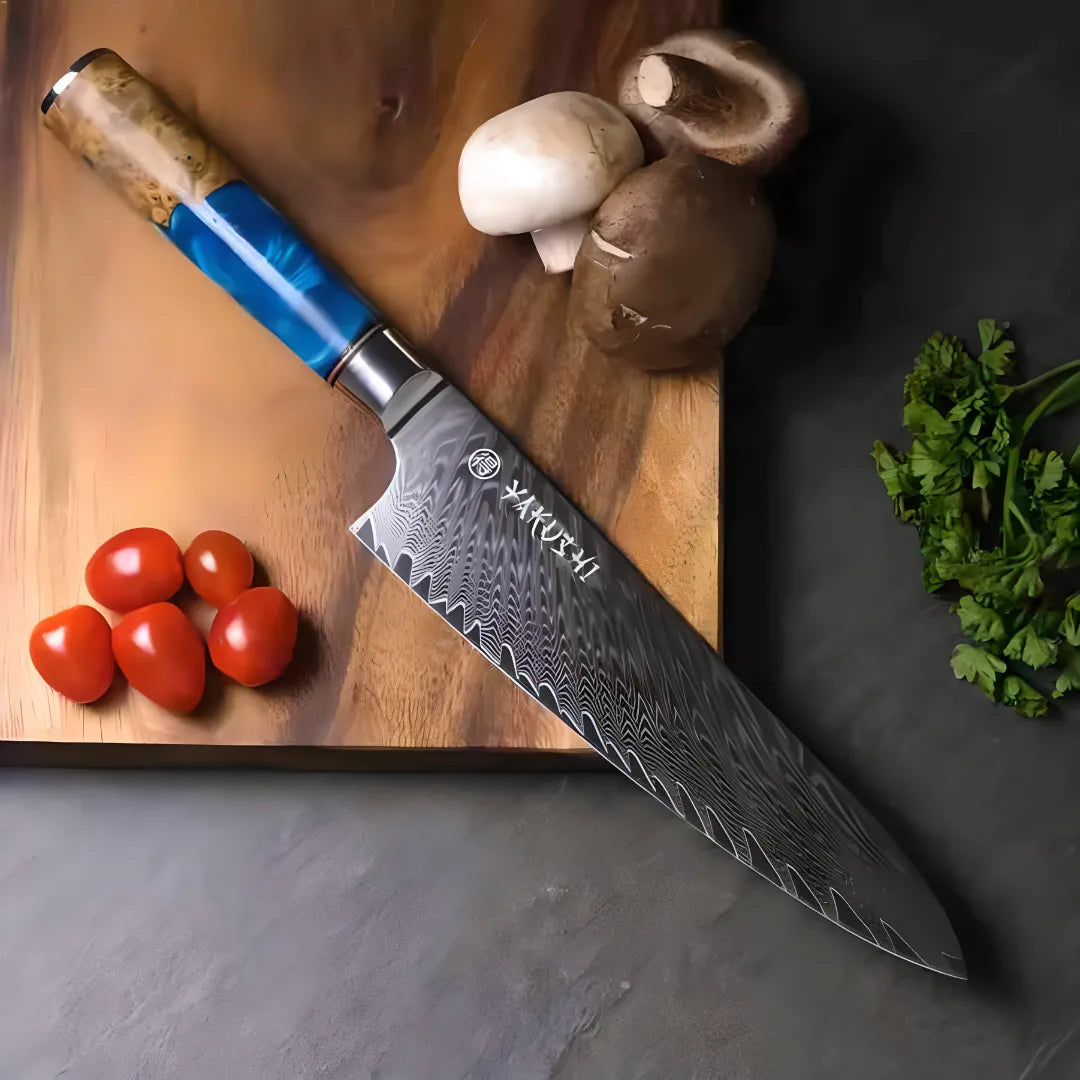
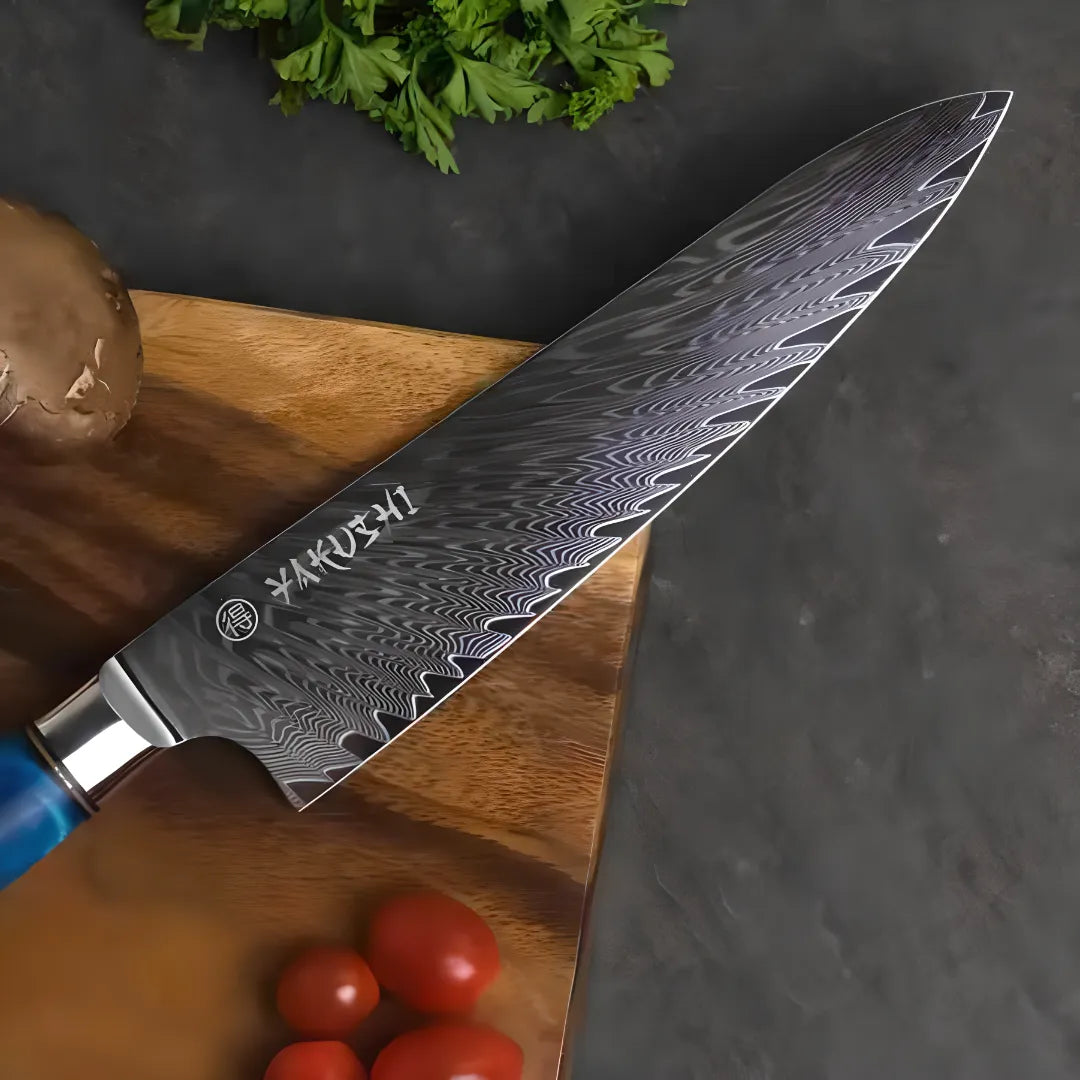
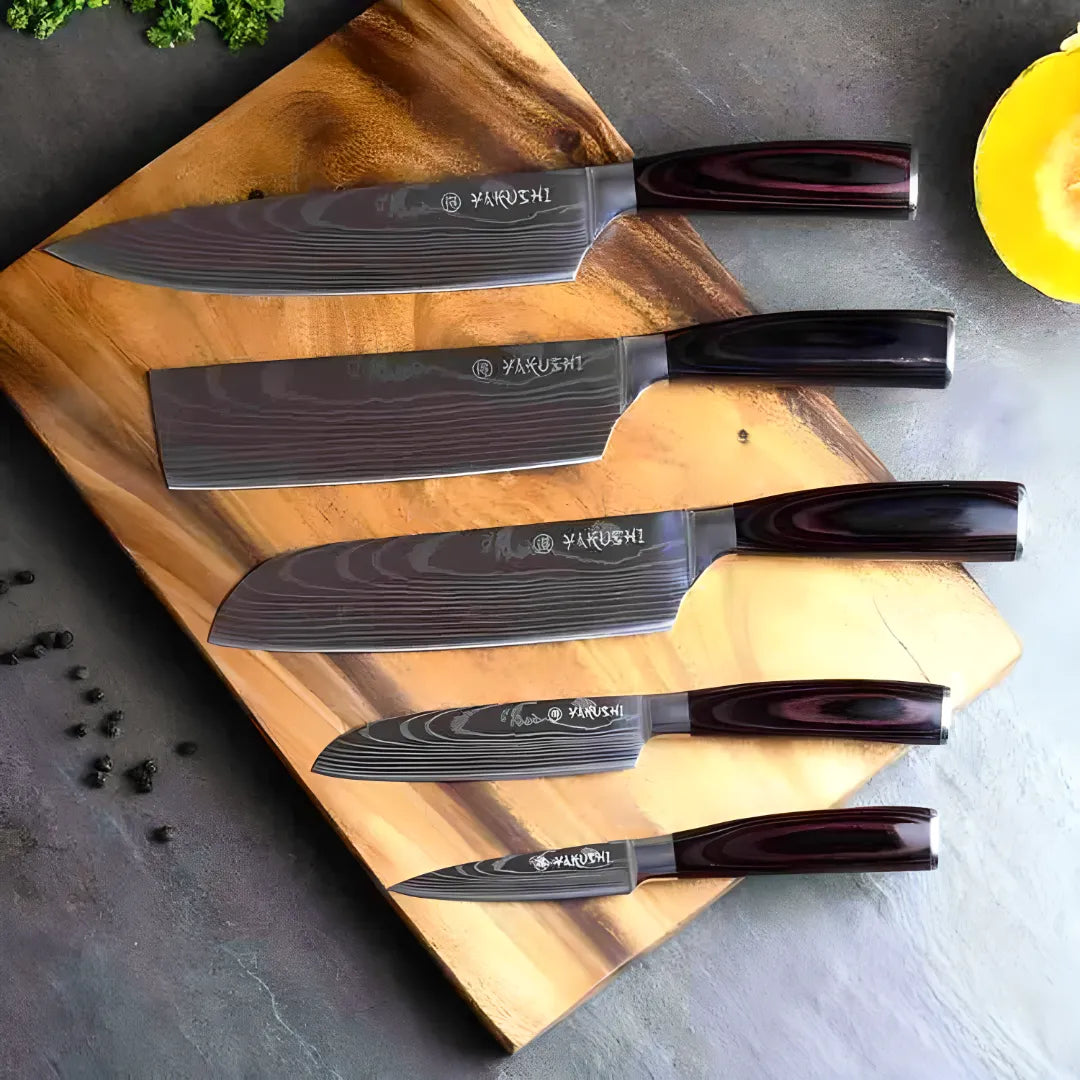
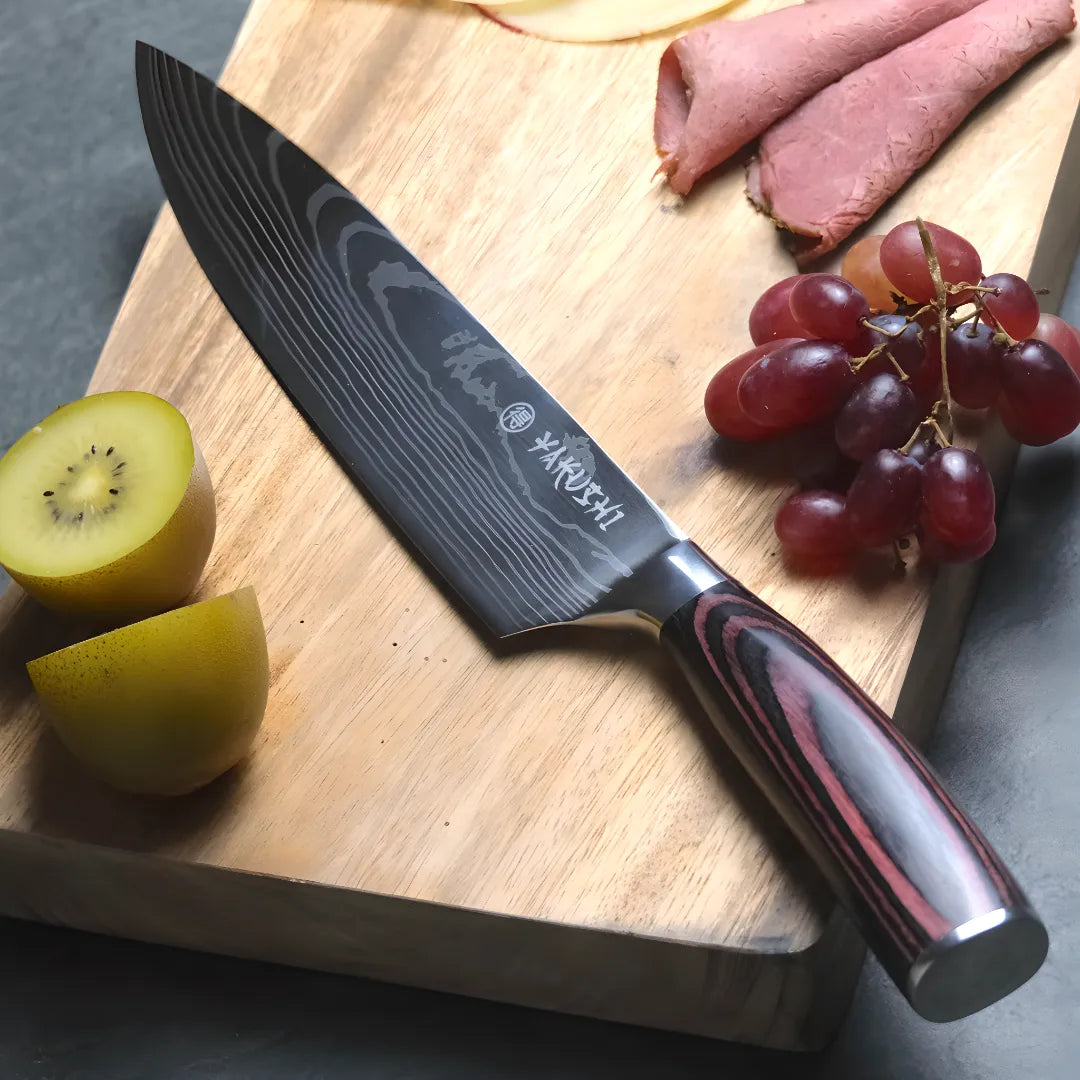
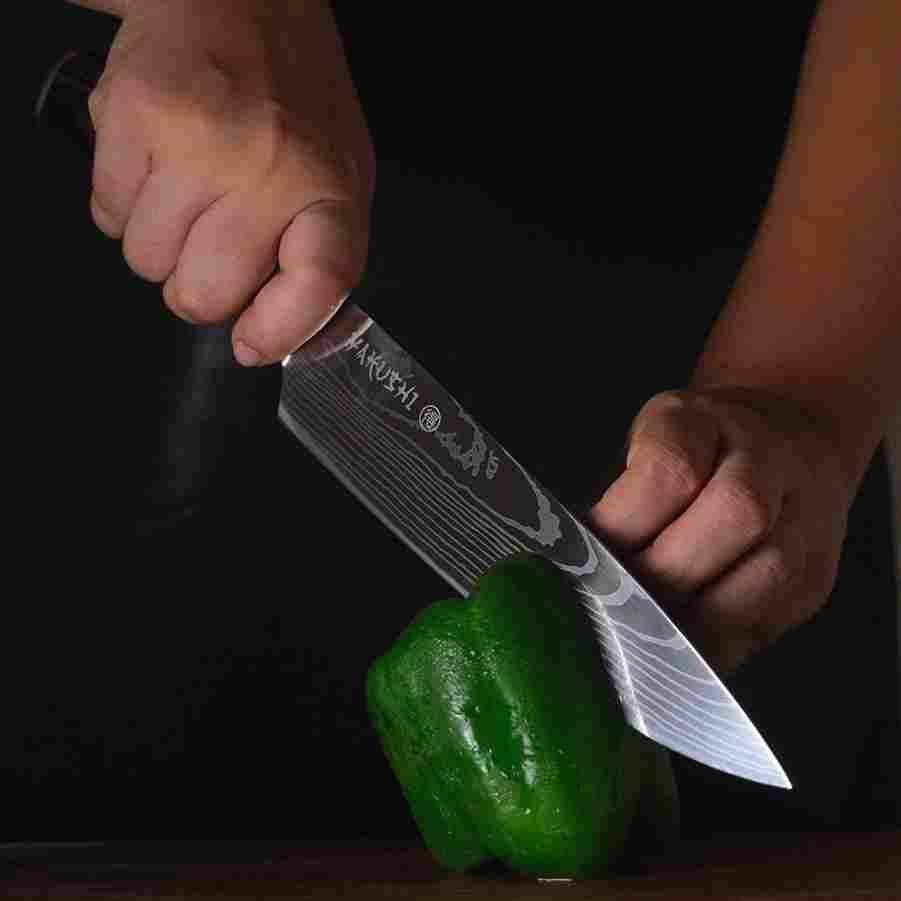
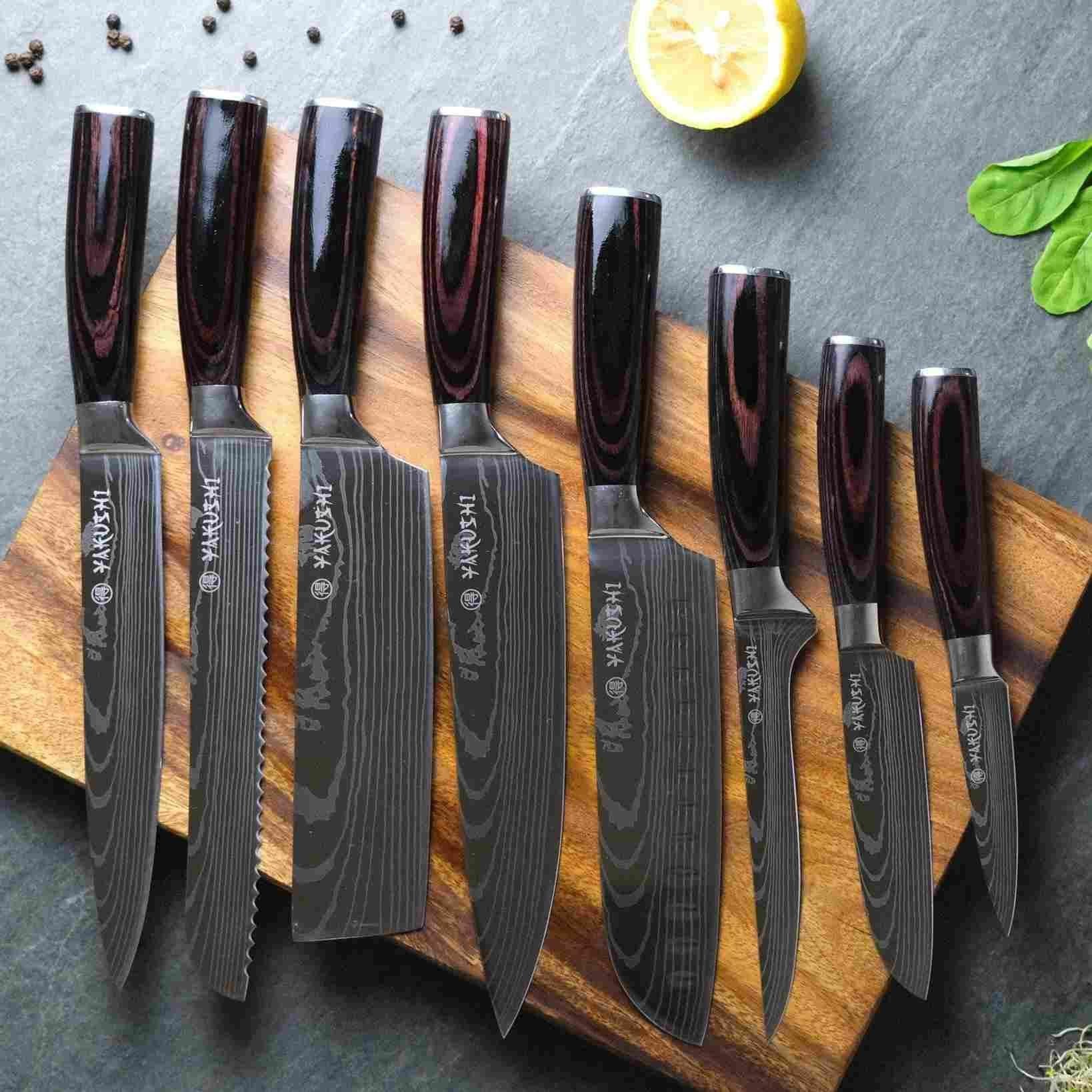
A Japanese chef knife is built for sharp, precise, controlled cutting across everyday kitchen tasks — from slicing vegetables to portioning proteins and preparing fine garnishes. This Yakushi collection features Japanese-style chef knives and Japanese kitchen knives designed for home cooks and serious food enthusiasts who want a sharper, lighter, more precise alternative to standard Western chef knives.
Filters
4 products
What Is a Japanese Chef Knife?
A traditional Japanese chef knife is a precision culinary tool engineered for exceptional sharpness, edge retention, and balance. Known historically as a hocho, modern Japanese kitchen knives blend centuries of traditional blacksmithing techniques—derived from samurai sword manufacturing—with advanced metallurgy.
Unlike standard mass-produced cutlery, an authentic Japanese knife features high-carbon steel, a significantly thinner blade profile, and a more acute edge angle. These characteristics allow the blade to glide through proteins and vegetables with minimal cell damage, preserving the texture, juices, and flavor profile of the ingredients.
A Japanese chef knife is a sharp, precise, all-purpose kitchen knife inspired by Japanese blade geometry. The most common Japanese chef knife is the Gyuto, which is used for slicing vegetables, cutting proteins, mincing herbs, and everyday prep.
Best Japanese Chef Knives from Yakushi
| Category | Product Details | Best For |
|---|---|---|
| Best Overall |
8" Damascus Steel Chef Knife
Features premium 67-layer pattern-welded Damascus steel surrounding a high-performance cutting core.
|
Daily prep, slicing, presentation, gifting. |
| Best Value |
Japanese-Style 8" High-Carbon Chef Knife
Engineered with durable, ultra-sharp high-carbon steel optimized for exceptional edge retention.
|
First Japanese-style chef knife. |
| Kitchen Upgrade |
5-Piece Master Chef Knife Set
A comprehensive set covering essential profiles like the Gyuto, Santoku, and Nakiri for a full kitchen overhaul.
|
Buyers who want multiple Japanese kitchen knives. |
| Best Gift |
Damascus Chef Knife with Premium Handle
Features intricate steel ripples paired with an elegant, highly ergonomic resin and stabilized wood handle.
|
Premium presentation. |
Japanese Chef Knife vs. Western Chef Knife
While both tools serve as kitchen workhorses, differences in steel composition, edge geometry, and weight dictate distinct cutting styles.
Japanese vs. Western Chef Knives
| Feature | Japanese Chef Knife (e.g., Gyuto) | Western Chef Knife (German/French) |
|---|---|---|
| Steel Hardness | High-Carbon (60 to 64+ HRC) | Softer Steel (56 to 58 HRC) |
| Edge Angle |
12 to 15 degrees per side
✓ Ultra-sharp precision
|
20 to 22 degrees per side
(Durable edge profile)
|
| Blade Thickness | Distal taper, ultra-thin spine and edge | Thicker spine, heavy bolster |
| Weight & Balance | Lightweight, balance point shifted forward | Heavier, balance point at the bolster |
| Sharpening Method | Whetstone execution required | Honing steel maintenance, automated pull-throughs |
Because Western knives use softer steel, they dull faster but are tough enough to strike bone, frozen foods, and heavy squash without breaking. Japanese knives use harder, more rigid steel. This allows them to hold an incredibly sharp, acute edge 15 degrees or less for months of intensive use, though it requires precise cutting techniques to avoid chipping.
Japanese chef knives are usually lighter, thinner, and sharper than Western chef knives. Western chef knives are generally heavier and more durable for rough chopping, while Japanese chef knives prioritize precision, thin slicing, and edge retention.
Which Japanese Chef Knife Should You Choose?
Selecting the right profile depends entirely on your kitchen workflow and ingredient preparation style.
For most home cooks, an 8-inch Japanese-style chef knife is the best starting point because it balances control, blade length, and versatility. Choose Damascus or VG-10-style steel for edge retention and a premium look, or high-carbon stainless for easier maintenance.
The Gyuto (The Multi-Purpose Workhorse)
The Japanese equivalent of the Western chef's knife. Featuring a curved belly that allows for both rock-chopping and push-cutting, the Gyuto typically ranges from 8 to 10 inches. It is the ideal primary knife for slicing proteins, dicing vegetables, and executing precision prep work.
The Santoku (Three Virtues)
"Santoku" translates to "three virtues" or "three uses," referring to its excellence in slicing, dicing, and mincing. Shorter than a Gyuto (usually 6.5 to 7 inches) and featuring a flatter edge profile with a "sheep's foot" tip, the Santoku is optimized for an up-and-down push-cutting motion, making it perfect for home kitchens and compact prep spaces.
The Kiritsuke (The Master Chef’s Profile)
Characterized by its striking, sword-like "K-tip" (reverse tanto profile), the Kiritsuke is a hybrid master knife. The clipped point allows for micro-precision tip work, while the long, relatively flat edge excels at long, clean slicing strokes through fish, cooked proteins, and dense vegetables.
The Nakiri (The Vegetable Specialist)
A double-bevel knife with a rectangular profile and a flat, blunt tip. The Nakiri is designed specifically for processing volume vegetables. Its flat edge makes full contact with the cutting board in a single downward stroke, ensuring clean cuts through skins and fibers without leaving "accordion" vegetable chains behind.
Japanese Knife Selection Guide
| Knife Type | Best for | Choose this if |
|---|---|---|
| Gyuto / Chef Knife | Everyday slicing, chopping, proteins, vegetables | You want one main Japanese chef knife |
| Santoku | Smaller kitchens, vegetables, fish, meat | You prefer a shorter all-purpose knife |
| Kiritsuke / Bunka | Precision cuts, tip work, visual style | You want a more aggressive Japanese profile |
| Nakiri | Vegetables, herbs, clean push cuts | You cook lots of produce |
| Knife Set | Full kitchen upgrade |
Complete Upgrade
You want multiple Japanese kitchen knives
|
Gyuto vs. Santoku: Which Japanese Style Fits Your Kitchen?
If you are looking for a singular, all-purpose Japanese chef knife to handle 90% of your daily meal prep, your choice will inevitably come down to two legendary blade profiles: the Gyuto and the Santoku. While both are master multi-tool blades capable of processing meats, fish, and vegetables, their physical geometry dictates entirely different handling dynamics on the cutting board.
The Gyuto (The Japanese Chef's Knife)
The word Gyuto literally translates to "beef sword." It is the Japanese adaptation of the classic Western chef's knife, featuring a longer, leaner profile that typically ranges from 8 to 10 inches in length.
- The Design: The Gyuto features a distinct, sweeping curve along the belly of the blade that tapers into a razor-sharp, ultra-pointed tip.
- The Motion: Because of its curved belly, the Gyuto is incredibly versatile. It accommodates a traditional Japanese forward push-cut, but still allows for a familiar Western rock-chop. The needle-like tip makes it exceptional for precision work, like scoring fat caps or making intricate slices in proteins.
- Best For: Cooks who want maximum blade length, frequently process larger cuts of meat, or prefer a rocking cutting motion.
The Santoku (The Knife of Three Virtues)
The word Santoku translates to "three virtues" or "three uses," representing its mastery over slicing, dicing, and mincing. It was designed specifically for the home cook, offering a more compact, nimble footprint that usually ranges from 5.5 to 7 inches.
- The Design: The Santoku features a much flatter edge profile with a blunt spine that curves dramatically down to meet the tip (often called a sheep's-foot blade).
- The Motion: Because the edge is almost entirely flat, the Santoku is built for clean, efficient vertical push-chopping and rapid up-and-down tap-chopping. Because the entire edge contacts the cutting board at once, it completely eliminates "accordion cuts" where vegetable slices remain stuck together.
- Best For: Cooks with smaller workspaces, those who prefer a lightweight and highly agile blade, or anyone whose daily prep is heavily focused on vegetables, herbs, and boneless proteins.
| Feature | The Gyuto | The Santoku |
|---|---|---|
| Primary Meaning | "Beef Sword" (Japanese Chef Knife) | "Three Virtues" (Slice, Dice, Mince) |
| Standard Length | 8 to 10 inches (200mm - 240mm) | 5.5 to 7 inches (140mm - 180mm) |
| Blade Profile | Sinuous belly with an acute, sweeping tip | Flat edge profile with a sheep's-foot tip |
| Cutting Style | Versatile push-cut, pull-slice, or rock-chop | Flat vertical push-cut or rapid tap-chop |
| Workspace Feel | Authoritative; excels with large ingredients | Nimble; excels in compact kitchen spaces |
Steel, Handle, and Blade Length Guide
1. The Steel: Core & Core Hardness
The performance of a premium knife is determined by its core alloy. We utilize premium VG-10 Stainless Steel, a high-carbon alloy enriched with cobalt, vanadium, and chromium.
- Edge Retention: Vacuum heat-treated to a Rockwell Hardness rating of 60 to 62 HRC.
- Chemical Profile: The high carbon content ensures razor-sharp edge execution, while the 15% chromium content provides exceptional corrosion and rust resistance compared to volatile reactive carbon steels (like Shirogami or Aogami).
2. The Handle: Wa-Handle vs. Yo-Handle
- Traditional Wa-Handle: An ergonomic, lightweight wooden handle (typically octagonal or D-shaped). The Wa-handle shifts the balance point of the knife forward toward the tip of the blade, encouraging a professional "pinch grip" and reducing wrist fatigue during prolonged prep sessions.
- Western Yo-Handle: A heavier, full-tang, riveted handle molded to the shape of the fingers, offering a familiar, substantial grip and centered balance point.
3. Selecting Your Blade Length
- 210mm (8.2 inches): The industry standard size for versatility. Long enough to slide through large roasts, yet agile enough for mincing garlic.
- 180mm (7.1 inches): Ideal for home cooks or those working in restricted counter spaces who find longer blades intimidating.
- 240mm (9.5 inches): Preferred by high-volume professional chefs for slicing large proteins and processing dense produce with a single stroke.
Understanding Japanese Blade Construction and Aesthetics
San-Mai (3-Ply Lamination)
Premium Japanese blades are rarely made of a single piece of metal. Instead, they use a San-Mai construction method. A hard core steel (like VG-10) is clad between two outer layers of softer, more resilient stainless steel. This architectural sandwich provides the best of both worlds: an ultra-hard cutting edge protected by a structural outer jacket that adds shock-absorption, durability, and flexibility.
Damascus Steel Finishes
The distinct wavy patterns rolling along the blade profile are created by folding and layering multiple sheets of steel over the core alloy. Beyond its striking, historic aesthetic, a multi-layer Damascus clad protects the core steel, minimizes surface friction, and assists in preventing food from suctioning or sticking to the blade face during rapid slicing.
Japanese Chef Knives vs. Western Chef Knives: The Core Differences
When upgrading your kitchen toolkit, understanding the design philosophy difference between traditional German/Western cutlery and a Japanese chef knife is critical to choosing your preferred workflow.
1. Steel Hardness & Edge Retention
- Western Knives: Typically forged from a softer steel alloy (around 54 to 56 HRC). While highly durable, this soft metal rolls its edge quickly under heavy use, requiring frequent steeling or honing to stay functional.
- Japanese Knives: Utilize premium high-carbon super steels (like VG-10 or AUS-10) hardened to an impressive 60+ HRC. This extreme hardness allows the cutting edge to stay razor-sharp for months of daily home use without dulling.
2. Blade Weight & Precision Geometry
- Western Knives: Feature a thick, heavy spine with a wide "V" edge angle (usually 20 to 22 degrees per side). They act more like wedges, splitting food apart with physical weight and mass.
- Japanese Knives: Noticeably lighter, thinner, and ground to an ultra-acute angle (typically 12 to 15 degrees per side). This razor-thin profile allows the blade to effortlessly glide through cell walls without bruising delicate ingredients like herbs or fish.
3. The Shape of the Cut
- Western Knives: Forged with a deep, dramatic curve along the cutting belly, designed for a continuous rocking-style motion.
- Japanese Knives: Feature a flatter, sleeker belly profile (especially on the Gyuto and Santoku shapes) that prioritizes clean, precise vertical push-cutting and pull-slicing.
How to Care for and Maintain a Japanese Kitchen Knife
To prevent edge damage, micro-chipping, or oxidation, high-end Japanese knives require specific maintenance protocols:
- No Dishwashers: The intense heat, harsh chemical detergents, and physical knocking inside a dishwasher will dull the edge, pit the steel, and warp or split wooden handles. Hand-wash immediately after use with mild dish soap and warm water.
- Dry Completely & Immediately: High-carbon edges can oxidize quickly. Wipe the blade entirely dry with a clean towel immediately after washing. Never leave the knife sitting wet in a sink.
- Cutting Surfaces: Use only end-grain wooden cutting boards, soft rubber blocks, or high-quality composite boards. Avoid cutting on glass, ceramic, marble, granite, or stainless steel counters, as these ultra-hard surfaces will fold or chip the acute 15-degree edge instantly.
- Zero Bone or Frozen Food Contact: Do not use these knives to chop bones, cartilage, pits, or hard-frozen ingredients. For heavy-impact tasks, always use a dedicated heavy-gauge Western cleaver.
- Proper Sharpening: Never use handheld mechanical pull-through sharpeners or Western vertical steel honing rods on a 60+ HRC blade, as they can cause micro-fractures along the edge. Maintain and restore the edge exclusively using synthetic whetstones (1000 grit for maintenance, 6000+ grit for polishing).
Why Buy from Yakushi?
At Yakushi, we eliminate the gap between traditional artisan quality and modern culinary demands. Our collection of Japanese chef knives is crafted using authentic vacuum-treated VG-10 core steel, forged to an exacting 60+ HRC standard, and hand-finished with traditional Damascus cladding.
We cut out traditional multi-tier importer markups to deliver professional-grade chef tools directly to culinary enthusiasts and working chefs alike. When you choose a Yakushi knife, you are investing in a perfectly balanced, edge-retaining instrument engineered for lifelong precision in the kitchen.
Frequently Asked Questions
About Japanese Chef Knives
What is a Japanese chef knife?
A Japanese chef knife (historically rooted in traditional hocho blacksmithing) is a premium kitchen tool engineered from high-carbon steel. Known for its ultra-thin blade profile, lightweight balance, and highly acute edge angle (12 to 15 degrees), it is designed to execute incredibly precise, clean cuts through proteins and vegetables with minimal resistance.
Do Japanese chef knives require special cutting techniques?
They do not require advanced professional training, but they do require you to adapt your rhythm to the flat edge geometry. Because premium Japanese chef knives feature an ultra-hard, rigid steel core ground to a razor-thin profile, you should use a clean forward push-cut or a smooth backward pull-slice. You should completely avoid heavy lateral twisting, slamming, or trying to rock-chop through hard materials like bone or frozen foods, as the lack of flexibility in hard steel can cause the edge to chip under twisting pressures.
What is the difference between a Japanese chef knife and a Western chef knife?
The primary differences lie in steel hardness, blade thickness, and edge geometry.
- Japanese knives use harder steel (60 to 64+ HRC), allowing for a thinner blade and a sharper, longer-lasting edge (15 degrees). They are lightweight and balanced toward the tip.
- Western knives (German or French) use softer steel (56 to 58 HRC), resulting in a thicker blade with a wider angle (20 to 22 degrees). They are heavier and less prone to chipping, making them tougher but less sharp.
What is the difference between a Gyuto and a standard Western chef knife?
While both serve as the primary multi-purpose workhorse in the kitchen, their design philosophies are completely different. A Western chef knife is typically heavier, forged from softer steel, and features a deep, curved belly made for a continuous rocking motion. A Japanese Gyuto is noticeably lighter, thinner, and forged from ultra-hard premium steel. This allows the Gyuto to hold a much sharper, more acute 15-degree edge angle that effortlessly glides through ingredients using a precise vertical push-cut or pull-slice rather than wedging through them.
Is a Gyuto the same as a Japanese chef knife?
A Gyuto is the Japanese equivalent of a classic Western multi-purpose chef's knife. While "Japanese chef knife" is an umbrella term that includes specialized blades like the Santoku (vegetable/slicing hybrid) and Nakiri (vegetable cleaver), the Gyuto is specifically designed as the primary, all-purpose workhorse for slicing, dicing, and processing both meat and produce.
What is the best Japanese chef knife for beginners?
For those transitioning from Western cutlery, the Santoku or an 8-inch Gyuto made from VG-10 stainless steel is highly recommended. VG-10 steel offers a perfect introductory balance: it features a professional-grade Rockwell hardness of 60+ HRC for incredible sharpness, but retains strong rust and corrosion resistance, requiring less maintenance than highly reactive pure carbon steels.
What size Japanese chef knife should I buy?
210mm (8.2 inches): The industry standard and most versatile length for both home cooks and professional chefs.
180mm (7.1 inches): Ideal for smaller hands, compact prep stations, or home cooks who prefer maximum agility over long slicing capability.
240mm (9.5 inches): Preferred by high-volume professionals for slicing large cuts of protein and clearing dense produce in a single stroke.
Are Japanese chef knives good for everyday cooking?
Yes. Multi-purpose profiles like the Gyuto and Santoku are engineered specifically to handle 90% of daily kitchen tasks, including slicing proteins, dicing aromatics, mincing herbs, and prepping vegetables. They streamline everyday cooking by reducing hand fatigue and making prep work significantly faster.
Can Japanese kitchen knives cut meat?
Absolutely. In fact, the Gyuto was originally designed in Japan specifically for processing beef ("Gyuto" translates literally to "cow sword"). These knives excel at gliding through raw or cooked boneless proteins, slicing roasts, and clean-cutting poultry. Note: They should never be used to cut through dense bones or frozen meat.
Can Japanese chef knives go in the dishwasher?
No. Hand-wash only. The intense thermal heat, harsh abrasive detergents, and physical movement inside a dishwasher will dull the refined 15-degree edge, pit the high-carbon steel, and permanently warp or crack premium wooden handles. Wash with mild soap, rinse, and towel-dry immediately.
How do I sharpen a Japanese chef knife?
Premium Japanese knives should be maintained and sharpened exclusively on synthetic whetstones (typically using a 1000-grit stone for regular edge maintenance and a 6000+ grit stone for a mirror-polish finish). Avoid mechanical pull-through sharpeners or standard ribbed Western vertical honing steels, as the hard, rigid steel can catch and chip on them.
How often do Japanese chef knives need to be sharpened?
Because our Japanese chef knives utilize premium high-carbon super-steels (like VG10 or AUS10) hardened to a high 60+ HRC rating, they retain their factory razor sharpness significantly longer than standard cutlery. For the average home cook preparing meals daily, a proper Japanese blade will only require a true sharpening session on a whetstone every 3 to 6 months. To keep the edge completely aligned between those sessions, a quick, light pass over a ceramic honing rod every few weeks is all that is required.
What is the difference between Damascus and stainless Japanese chef knives?
"Damascus" refers to a traditional blade-crafting aesthetic where multiple layers of steel are folded over a central core alloy, creating a distinct, wavy surface pattern that reduces friction and prevents food drag. "Stainless" refers to the chemical composition of the steel alloy (like VG-10), which contains chromium to resist rust. Yakushi knives combine both features, utilizing a high-carbon VG-10 stainless steel core clad in multi-layer Damascus protective steel.
Are Japanese chef knives worth it?
Yes. For culinary enthusiasts and professional chefs, a premium Japanese knife is an invaluable investment. Because of the superior hardness (60+ HRC), it retains a razor-sharp edge up to four times longer than a standard Western knife. This structural precision prevents food from being crushed during preparation, preserving ingredient juices, textures, and presentations.
What is the difference between VG10, carbon steel, and powder metallurgy steel in Japanese knives?
It comes down to maintenance versus performance. Traditional carbon steels (like White Steel/Shirogami and Blue Steel/Aogami) hold an unmatched edge but are highly reactive and will rust or discolor if not oiled immediately. VG10 is a premium high-carbon stainless steel that offers a balance of exceptional edge retention (60+ HRC) and hassle-free rust resistance. Powder steels (like SG2/R2) offer even higher hardness but are more expensive and difficult to sharpen.
What is the difference between a single-bevel and a double-bevel Japanese knife?
Single-bevel knives (Kataba) are sharpened on only one side, creating an asymmetrical blade used for highly specific traditional Japanese tasks (like slicing raw fish or shearing vegetables). Double-bevel knives (Ryoba) are sharpened on both sides (typically at a $50/50$ or $15/15$ degree balance), making them intuitive and versatile for both left- and right-handed Western cooking styles. All Yakushi chef knives utilize a versatile double-bevel edge.
What is a "double-bevel" edge, and can left-handed cooks use these knives?
A double-bevel edge means the cutting apex is ground symmetrically on both sides of the blade (typically a 50/50 balance at 15 degrees per side). This makes our Japanese chef knives completely ambidextrous and 100% safe for both right-handed and left-handed cooks. Traditional, specialized Japanese knives (like a single-bevel Yanagiba) are only ground on one side and require right or left-hand specific builds, but our multi-purpose Gyuto and Santoku chef knives offer universal comfort for everyone.
Why is my Japanese knife chipping, and how do I prevent it?
Because Japanese knives use incredibly hard, thin steel, they are rigid rather than flexible. Chipping occurs when the blade is subjected to lateral (twisting) pressure, used on hard surfaces (like glass, marble, or bamboo cutting boards), or used to cut through bone, frozen foods, or dense pits. To prevent chipping, stick to a straight up-and-down or slicing motion on end-grain wood or soft rubber cutting boards.
Are Japanese knives single-use, or can they replace my entire block?
Multi-purpose profiles like the Gyuto or Santoku are designed to be your absolute primary kitchen workhorse, replacing your chef's knife, utility knife, and slicing knife all at once. The only tasks they should not perform are heavy-impact bone hacking or cutting through frozen foods, for which you should keep a cheap Western cleaver on hand.
Which Yakushi Japanese chef knife should I choose?
Choose the Yakushi Gyuto if you want an all-purpose, long-bladed workhorse for multi-ingredient prep and rocking-motion cuts.
Choose the Yakushi Santoku if you prefer a compact, lightweight blade optimized for rapid up-and-down push-cutting.
Choose the Yakushi Kiritsuke if you want a striking, professional profile with an aggressive "K-tip" designed for micro-precision slicing and tip work.