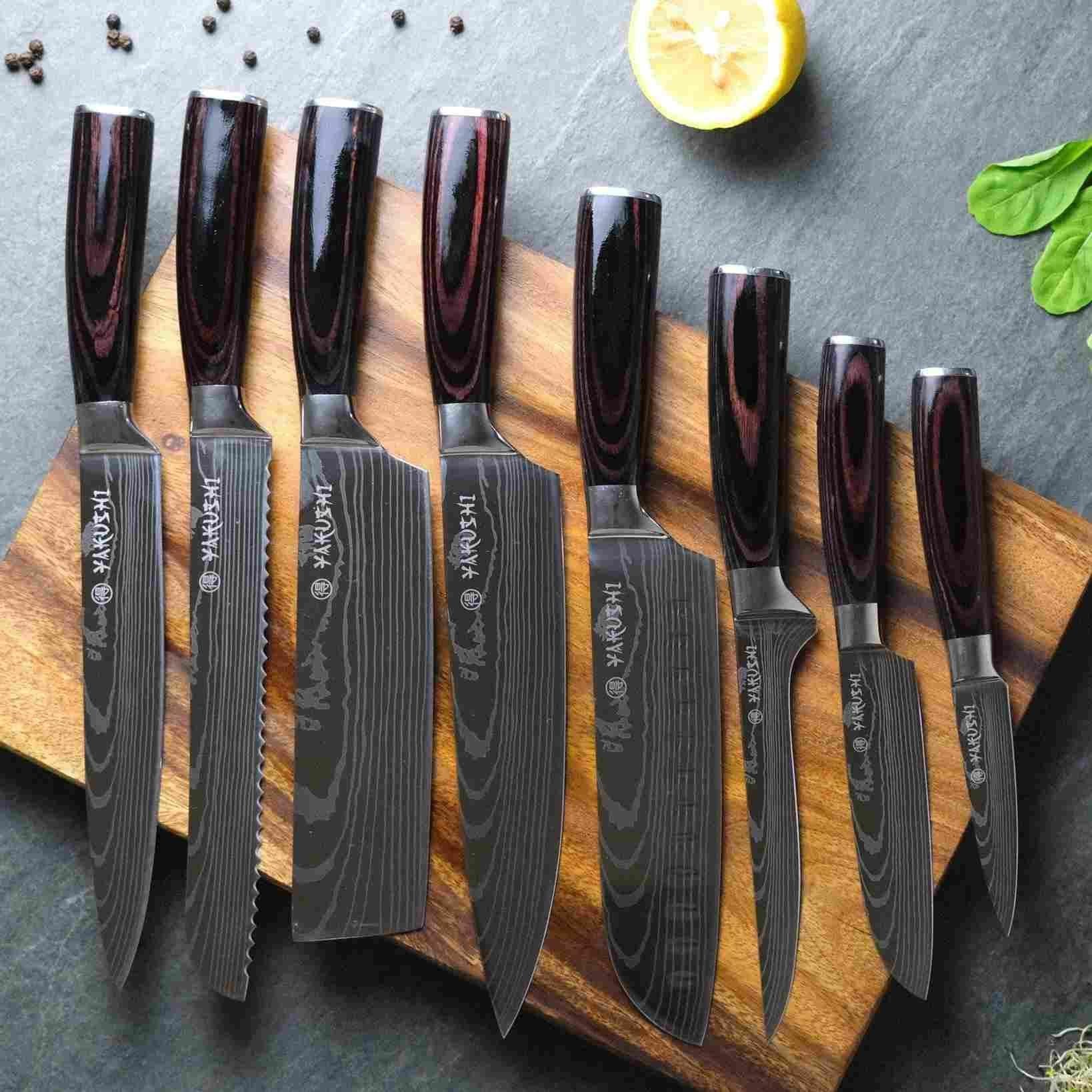
Controlled board contact
The relatively straight profile suits forward-and-down push cuts, controlled chopping, and longer pull slices. It places less emphasis on continuous rocking than a more curved chef knife.
Precision with a distinctive K-tip
The Yakushi 8-inch Kiritsuke-style knife pairs a flatter cutting edge and angled K-tip with a symmetrical double bevel, 192g build, and octagonal coloured-sandalwood handle.
A modern double-bevel Kiritsuke-style knife brings a flatter edge, long slicing reach, and a low precision tip to the home kitchen. Shop the single Yakushi model below, then use the guide to understand its verified construction, best cutting motions, care requirements, and limits.
Filters
1 product
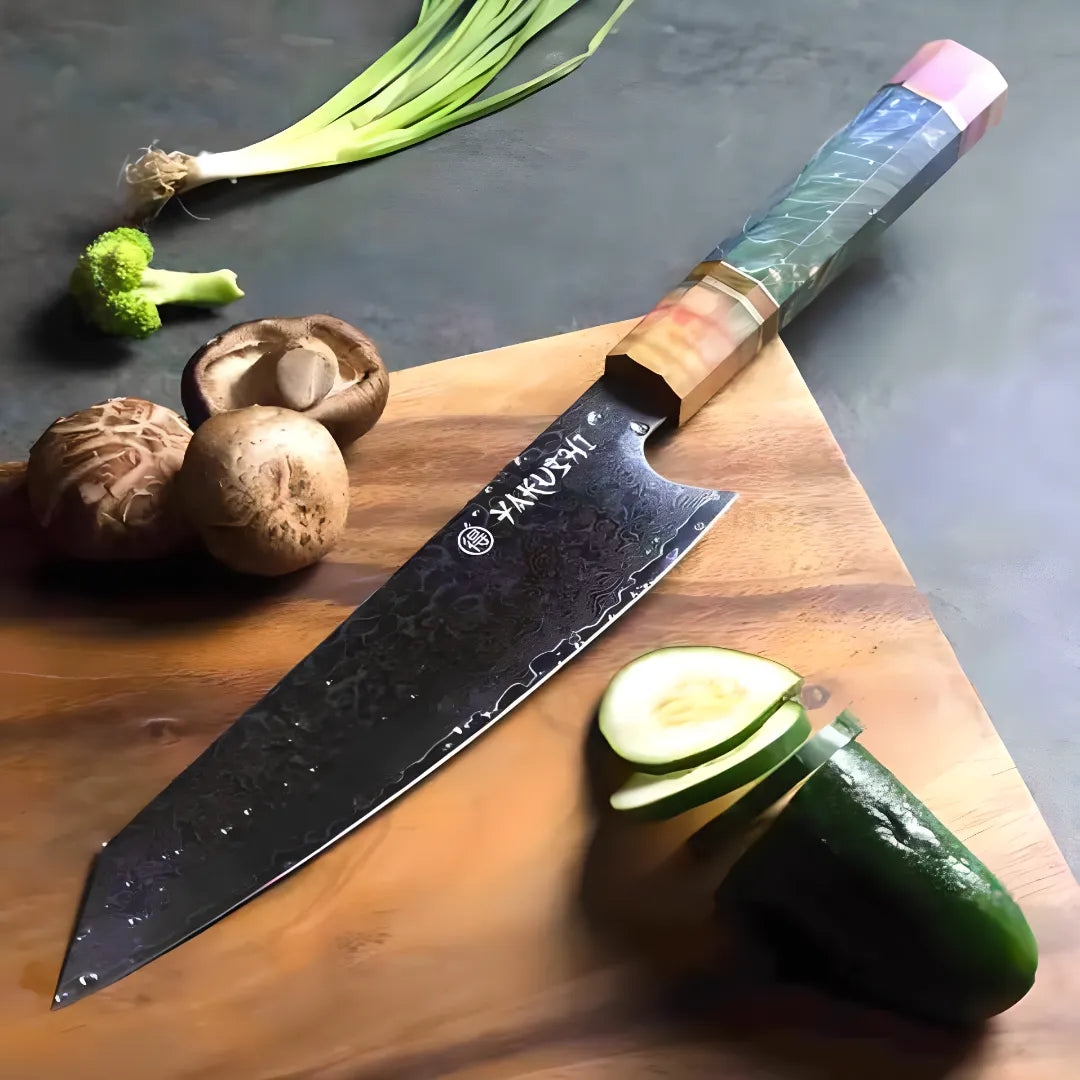
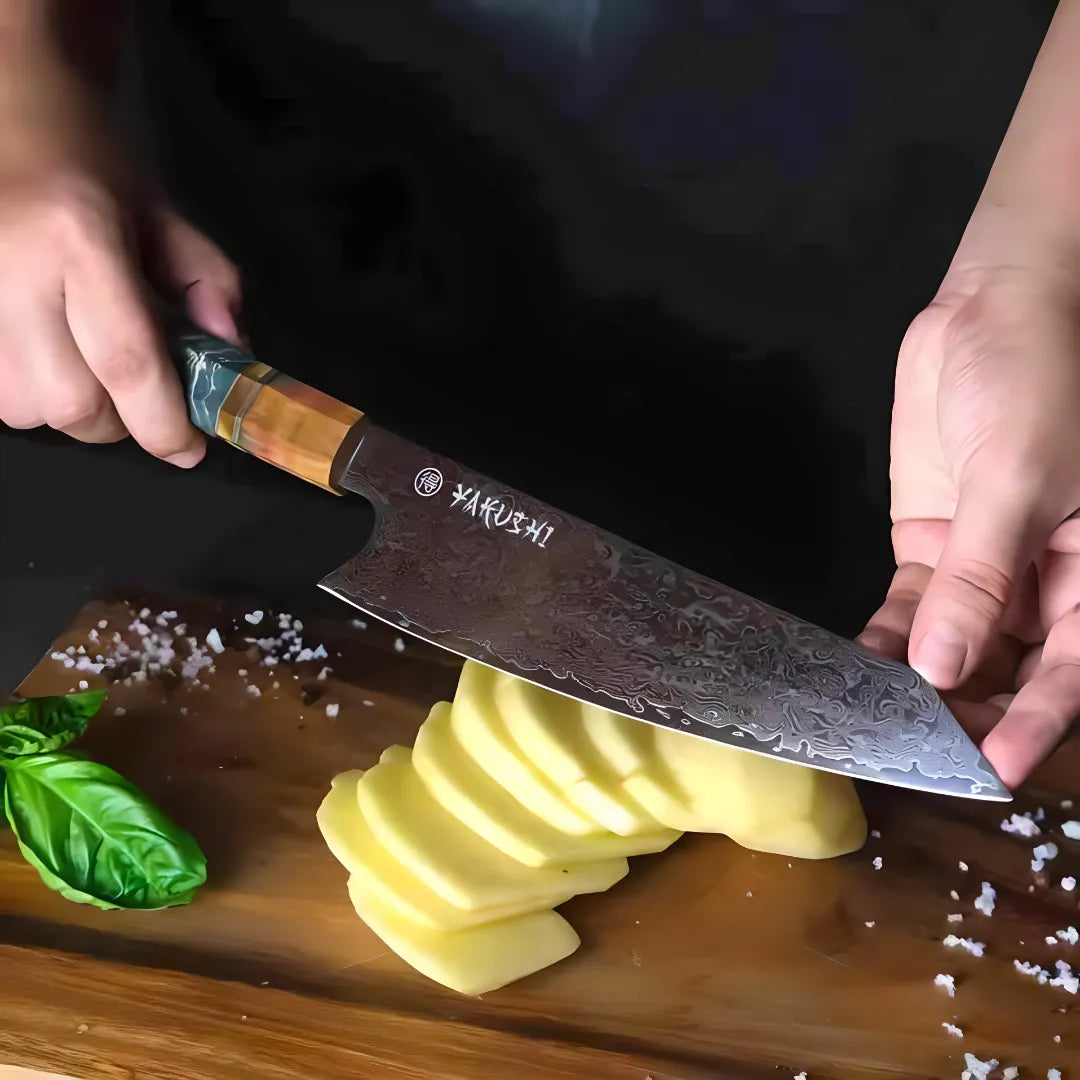
A distinctive profile with practical purpose
A modern Kiritsuke-style knife combines a longer cutting edge, a relatively flat profile, and a sharply angled K-tip. The shape rewards controlled push cuts, long pull slices, and precise tip work. Yakushi uses a symmetrical double bevel, making this model more approachable than a specialized traditional single-bevel Kiritsuke.
Know exactly what you are buying
The collection currently contains one Kiritsuke product offered in sets of one, two, or three identical knives. These specifications follow the current product page without adding an unverified core-steel grade, layer count, hardness, or universal sharpening angle.
| Feature | Verified specification | Why it matters |
|---|---|---|
| Knife type | Japanese-style double-bevel Kiritsuke knife | A modern, either-hand interpretation of the distinctive Kiritsuke profile |
| Blade length | 8 inches / 20.32 cm | Provides useful reach for vegetables, boneless proteins, and long pull slices |
| Total length | 34 cm / 13.38 inches | Helps buyers assess board space, storage, and overall handling |
| Weight | 192g | A manageable but present feel for controlled preparation |
| Blade material | Patterned stainless steel | Matches the current published material rather than assuming a specific core steel |
| Blade finish | Damascus-style flowing pattern | Creates the visual character associated with the product without overstating its manufacture |
| Profile | Flatter cutting edge with angled K-tip | Supports push cutting, pull slicing, scoring, trimming, and shallow tip work |
| Edge and handedness | Symmetrical double bevel; suitable for either hand | More familiar and approachable than specialized single-bevel geometry |
| Construction | Half tang | The verified construction pairs the blade with its octagonal handle |
| Handle | Octagonal coloured sandalwood | The faceted shape provides clear hand indexing and a distinctive finish |
| Set options | One, two, or three identical Kiritsuke knives | Choose multiples for gifting or separate kitchens—not additional knife types |
Geometry guides the motion
The relatively straight profile suits forward-and-down push cuts, controlled chopping, and longer pull slices. It places less emphasis on continuous rocking than a more curved chef knife.
The low, narrow point gives the cook useful visibility and control when scoring, trimming, coring peppers, making shallow incisions, or starting exact cuts.
The edge is sharpened on both sides, so right- and left-handed cooks can use it without the steering behavior associated with some traditional single-bevel knives.
The verified weight creates a present but manageable feel. The octagonal coloured-sandalwood handle helps the hand recognize the knife’s orientation during careful prep.
Use the profile as designed
A Kiritsuke-style knife performs best when the edge stays aligned and the cook chooses deliberate push cuts, pull slices, and shallow tip work. Avoid twisting the blade inside an ingredient or forcing the K-tip sideways.
Use a wood or suitable synthetic board with enough room for the 34cm knife. If the board moves, secure it with a damp towel underneath.
Guide the flatter edge through vegetables, fruit, and herbs with a controlled forward-and-down motion. Lift the blade to reset instead of twisting it against the board.
Draw the long edge smoothly through boneless meat, cooked proteins, or fish fillets. Let the edge do the work rather than sawing aggressively or striking bone.
Use the point for scoring, trimming, shallow slicing, and controlled detail work. Never pry, twist, or lever with the narrow tip.
Clear limits protect the edge and tip
Choose by profile and preferred motion
| Knife | Typical profile | Preferred motion | Best reason to choose it |
|---|---|---|---|
| Kiritsuke-style knife | Longer, flatter edge with a sharply angled K-tip | Push cuts, pull slices, and shallow detail work | Long slicing reach combined with precise tip control |
| Gyuto or chef knife | Pointed all-purpose profile with more curve through the edge | Chopping, slicing, draw cuts, and gentle rocking | A forgiving primary knife for the broadest mix of everyday tasks |
| Santoku | Shorter all-purpose blade with a compact profile | Push cuts, controlled chopping, and slicing | Maneuverability for smaller boards, hands, and preparation jobs |
| Nakiri | Tall rectangular vegetable blade without a pointed working tip | Up-and-down chopping and push cutting | Focused vegetable preparation and consistent board contact |
A simple ownership routine
Use mild dish soap and warm water after use. Do not soak the knife or place it in a dishwasher.
Dry immediately, then use a fitted sheath, stable knife block, or safe magnetic rack that prevents contact with other utensils.
Use a suitable whetstone, quality guided system, or trusted professional service. Preserve the existing geometry instead of assuming a universal angle.
The FDA recommends using separate cutting boards for fresh produce and raw meat, poultry, or seafood, and washing utensils and surfaces between tasks. Review the complete safe food handling guidance when planning kitchen workflow.
Explore related blade shapes, build safer cutting technique, and choose sharpening and storage tools that protect a precise edge and pointed K-tip.
Straight answers
A Kiritsuke is a Japanese knife profile recognized by its relatively long, flat edge and sharply angled K-tip. Traditional versions may be specialized single-bevel knives, while modern Kiritsuke-style knives commonly use a more approachable double-bevel edge.
Use it for push cutting vegetables, controlled chopping, long pull slices through boneless proteins and fish fillets, and precise scoring, trimming, coring, or shallow slicing with the K-tip.
It has a symmetrical double-beveled edge. That makes it suitable for right-handed and left-handed cooks and avoids the specialized steering behavior associated with some traditional single-bevel knives.
The current product specification identifies patterned stainless steel with a Damascus-style flowing finish. This collection guide does not assign an unverified core-steel grade, layer count, or Rockwell hardness.
The blade is 8 inches or 20.32cm, the complete knife is 34cm or 13.38 inches long, and the listed weight is 192g.
It can serve as a primary knife for cooks who prefer push cutting, pull slicing, and precise tip work. A more curved chef knife may feel more natural for cooks who rely heavily on continuous rocking.
This model’s flatter edge is better suited to push cuts, controlled chopping, and pull slices. Gentle movement is possible, but repeated exaggerated rocking is less natural than it is with a curved chef knife.
No. Keep the blade away from bones, joints, frozen food, hard pits, and shells. Never twist the edge inside dense ingredients or use the pointed K-tip for prying.
The set of one includes one 8-inch Kiritsuke knife, the set of two includes two identical knives, and the set of three includes three identical knives. The larger options do not contain additional blade types.
Hand-wash it with mild dish soap, dry it immediately, and store the edge and K-tip safely. Maintain the existing double bevel with a suitable whetstone, guided system, or professional service rather than imposing an unsupported universal sharpening angle.
Choose one Yakushi Kiritsuke for your own kitchen or select a set of two or three identical knives for gifting and separate preparation spaces.