
Best Whetstones for Japanese Knives
The best whetstone is the one that matches your knife's present condition and the edge you want—not simply the stone with the highest number. Use this guide to choose a useful grit progression, understand water-stone types and build a stable sharpening setup without buying unnecessary equipment.
Start with the job the stone must perform.
For a normally dull double-bevel kitchen knife, a medium water stone around 800–1200 grit is a versatile starting point. Add a finer stone only when you want to refine an edge already created on the medium stone. Coarse stones are for repair or reshaping; very fine stones are optional finishing tools.
A simple two-stone strategy
Use approximately 1000 grit to establish a practical working edge, then choose roughly 3000–6000 grit for optional refinement. If your edge is already sharp and merely needs a smoother finish, a fine combination such as 3000/8000 may be all you need.
Which whetstone grit do you need?
Begin with the lowest grit required to solve the actual problem, then make sensible steps toward the finish you want.
Chipped or heavily worn
Typical range: about 200–600 grit before medium sharpening.
Coarse stones remove steel quickly. They suit controlled repair and geometry work, but serious chips, cracks or valuable single-bevel knives belong with an experienced sharpener.
Normally dull
Typical range: about 800–1200 grit.
This is the core sharpening range for rebuilding a practical kitchen edge. If you are buying one stone for routine double-bevel sharpening, this is usually the most useful place to begin.
Sharp but less refined
Typical range: about 2000–4000 grit.
Use a finer stone to smooth an established bevel, reduce coarser scratches and tune cutting feel. It is not a substitute for creating an apex on a lower grit when the knife is truly dull.
Fine finishing
Typical range: about 5000–8000+ grit.
High grits can further refine and polish a sound edge. They are optional and task-dependent; a more polished edge is not automatically the best edge for every ingredient or steel.
Grit ranges are guides, not universal conversions.
Different grit standards, abrasive materials, binders and stone designs can make two stones with the same printed number behave differently. Compare stones within the maker's system and follow the supplied progression rather than treating every grit label as identical.
What a whetstone's grit number actually tells you.
Lower numbers generally indicate larger abrasive particles and faster material removal. Higher numbers generally indicate finer particles and a more refined scratch pattern. The number alone does not guarantee sharpness.
| Approximate range | Primary role | Good use | Important caution |
|---|---|---|---|
| 200–600 | Repair and reshaping | Removing small chips, correcting a very blunt edge or starting controlled thinning. | Removes steel quickly and can change geometry fast. Stop if damage exceeds your skill. |
| 800–1200 | Primary sharpening | Restoring an ordinary dull double-bevel kitchen knife and forming a useful working edge. | Confirm the edge is apexed and deburred before moving to a finer stone. |
| 2000–4000 | Edge refinement | Smoothing the scratch pattern and refining an already established edge. | May be too slow to repair significant dullness on its own. |
| 5000–8000+ | Fine finishing | Light finishing passes, polished bevels and specialized edge tuning. | More polish does not compensate for an incomplete apex or persistent burr. |
Do not diagnose every problem as dullness.
A knife can cut poorly because of a fatigued edge, chips, thick geometry behind the edge, an unsuitable angle or a remaining burr. Review Japanese knife anatomy and our guide to knife edge retention before removing large amounts of steel.
Types of sharpening stones compared.
Stone behavior depends on abrasive, bond, hardness, porosity and how quickly fresh abrasive is exposed. Choose for feedback, maintenance and the steels you actually sharpen.
Synthetic water stones
Predictable and widely available in useful grit ranges. Some release abrasive quickly and give clear feedback; softer stones can dish sooner and require more flattening.
Soaking stones
Porous stones may need time in water before use. Soaking requirements vary, so follow the stone's instructions rather than applying one universal time to every product.
Splash-and-go stones
Dense stones designed for surface wetting offer quick setup. A true splash-and-go stone should not be soaked unless its manufacturer explicitly says that it can be.
Diamond plates
Durable, fast-cutting plates can suit flattening and selected high-wear-resistance steels. Their feedback and scratch pattern differ from bonded water stones.
Natural stones
Natural stones can vary significantly from one specimen to another. They appeal to experienced users who understand their feedback and finish, but they are not necessary for a sharp, practical kitchen edge.
Oil stones
Oil stones are valid sharpening tools when matched to the blade and used with their intended lubricant. Never put oil on a water stone unless its maker specifically requires it; oil can permanently change how a stone accepts water.
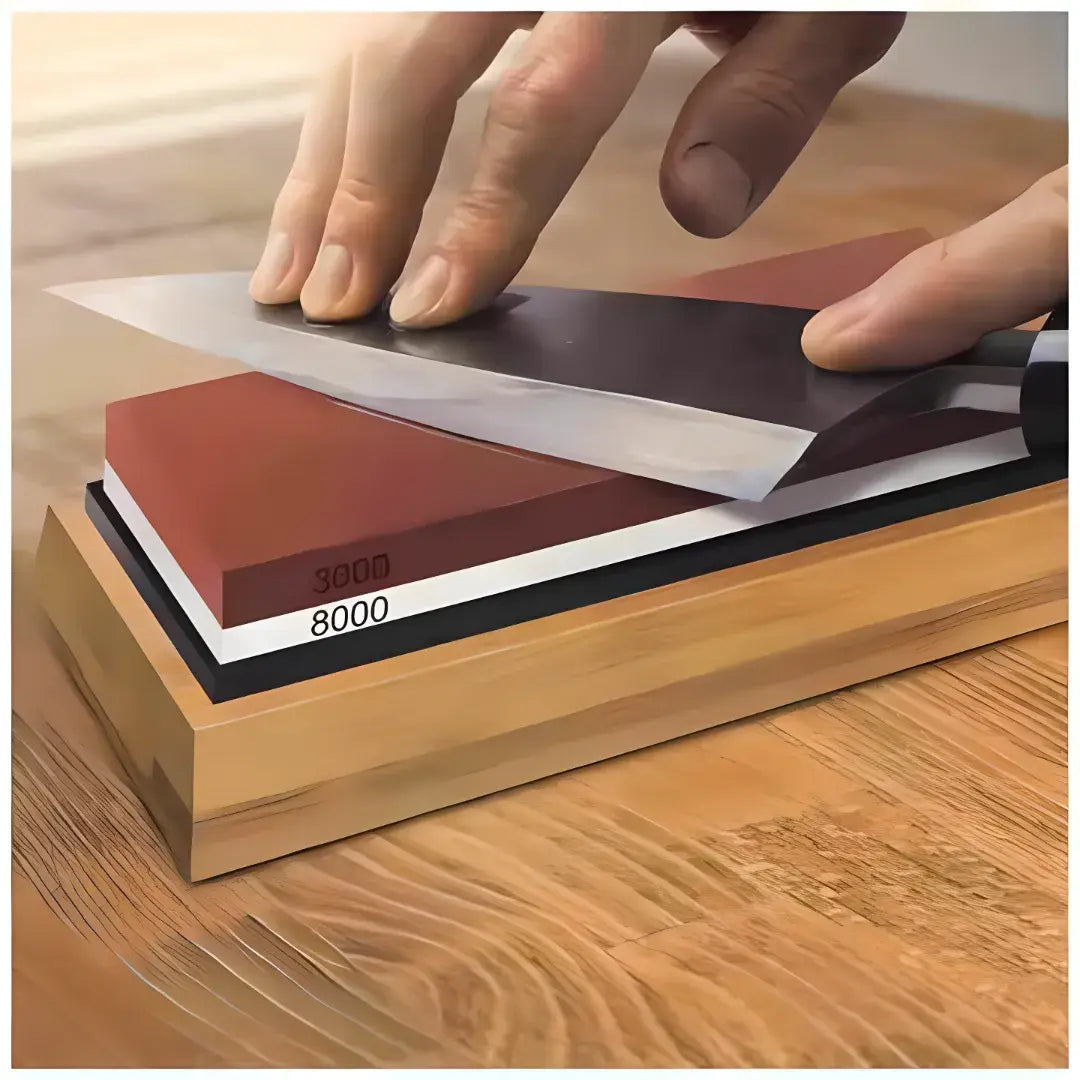
Who should choose a 3000/8000 whetstone?
The Yakushi dual-sided stone is designed to refine and polish kitchen knives that already have an established edge. Use the 3000-grit side to refresh and smooth the bevel, then use lighter passes on the 8000-grit side for a finer finish.
It is not intended to be the first step for major chips, extensive reshaping or a severely dull knife. Begin those jobs on an appropriate lower grit or consult an experienced sharpener.
What you need—and what you can skip.
A good setup keeps the stone secure, the blade path clear and the process repeatable. It does not need to be elaborate.
The correct stone
Match grit to edge condition and confirm that the abrasive suits your steel. Know whether the stone requires soaking, surface wetting or a different lubricant.
A secure base
Use a purpose-built holder or nonslip base on a flat counter. A clean, wrung-out damp towel can add stability where appropriate. The stone must not slide or rock.
Water and cleanup space
Keep clean water nearby when using a water stone, along with towels placed outside the blade path. Allow enough room to move from heel to tip without striking nearby objects.
Useful additions
- A flattening plate or compatible lapping stone.
- A pencil for marking the stone before flattening.
- A magnifier and bright light for inspecting the apex.
- An angle guide while learning, if it suits the blade.
- A rust eraser or dressing tool approved for the stone.
Things not to improvise
- Do not hold a loose stone in one hand while sharpening.
- Do not mix oil and water without manufacturer approval.
- Do not use a damaged, cracked or badly dished stone.
- Do not sharpen while distracted or with wet, slippery hands.
- Do not test the edge by sliding a finger along it.
Keep hands out of the edge path.
Sharpening exposes the edge for repeated passes. Secure the stone, keep fingers above and behind the edge and stop before wiping or repositioning anything. The CCOHS sharp-blade guidance emphasizes stable surfaces, appropriate tools and keeping body parts out of the path a blade could take if it slips.
How to sharpen on a whetstone.
This overview is for conventional double-bevel kitchen knives. Single-bevel blades and unusual geometries require blade-specific instruction.
Inspect the knife and stone
Look for cracks, large chips, loose handles and a visibly dished stone. Stop if the knife has structural damage or the repair lies beyond routine sharpening.
Prepare the stone correctly
Soak or wet the stone only as its instructions specify. Place it on a clean, secure base with the long axis positioned for a natural sharpening stroke.
Set the intended angle
Use the knife maker's recommendation when available. Keep the wrist stable and treat angle consistency as more important than chasing an unsupported universal number.
Work the complete edge
Use controlled passes that cover heel, middle and tip. Apply only the pressure needed for the stone to cut and keep fingers safely on the blade face, away from the edge.
Confirm progress and change sides
Inspect the scratch pattern and apex. If using burr formation as a cue, check cautiously from spine toward edge rather than along the edge. Work the opposite side according to the blade's geometry.
Refine and deburr
Reduce pressure as the edge develops. Move to a finer stone only after the lower-grit work is complete, then use controlled alternating passes or the deburring method appropriate to your stone and steel.
Clean and inspect
Rinse residue from the blade, dry it completely and inspect under bright light. Never run a thumb or finger along the sharpened edge.
Test without touching the edge
Use a careful paper-slicing test or a normal food-prep task after cleaning the knife. Keep the cutting path clear and stop if the blade behaves unpredictably.
Use the full tutorial before sharpening.
Follow our complete step-by-step Japanese knife sharpening guide, then use sharpening angles explained to match the edge geometry rather than guessing.
Flattening, cleaning, drying and storage.
Water stones wear as they release abrasive. Routine care keeps the surface useful and reduces the chance of transferring an unwanted curve to the bevel.
Check for dishing
Place a straightedge across the surface or mark a pencil grid. A hollow center, persistent high spots or disappearing marks during lapping indicate that flattening is needed.
Flatten compatibly
Use a flattening plate or lapping stone suitable for the whetstone. Work the full surface evenly with water until the reference marks disappear.
Rinse after use
Remove loose abrasive and metal residue with clean water unless the care instructions say otherwise. Avoid household detergent on the Yakushi stone.
Dry slowly and fully
Air-dry in a shaded, ventilated place. Do not use an oven, radiator or direct heat, and do not seal a damp stone in its base, box or drawer.
Protect the edge after sharpening.
Wash the knife by hand, dry it promptly and store it so the edge cannot strike loose utensils. Our Japanese knife care guide and safe knife-storage guide cover the complete routine.
What to compare before choosing a whetstone.
| Question | Why it matters | Practical decision |
|---|---|---|
| What condition is the edge in? | Repair, sharpening and polishing require different removal rates. | Buy for the lowest grit you genuinely need, then add refinement. |
| What steel and geometry do you own? | Wear resistance, hardness and bevel design influence abrasive choice and technique. | Check the knife's instructions and our Japanese knife steel guide. |
| Soak or splash-and-go? | Preparation and storage habits affect convenience and stone life. | Choose the routine you will follow and obey the maker's directions. |
| How will you flatten it? | A water stone may become dished through regular use. | Budget for a compatible flattening method instead of waiting for severe wear. |
| Is the stone large enough? | A useful working area makes angle control and full-length strokes easier. | Match stone dimensions to your longest regularly sharpened knife. |
| Do you need a combo stone? | A dual-grit stone saves space, while separate stones can be replaced independently. | Choose convenience for occasional use or modularity for frequent sharpening. |
Common questions about sharpening stones.
What is the best whetstone grit for Japanese knives?
There is no single best grit for every condition. Around 800–1200 grit is a useful primary-sharpening range for a normally dull double-bevel knife. Add a finer stone for refinement, and use coarse grits only when repair or reshaping is necessary.
Is a 3000/8000 stone enough by itself?
It can be enough for a maintained edge that needs refinement and polishing. It is generally too fine to be the efficient first step for a severely dull, chipped or misshapen edge.
Do all whetstones need to be soaked?
No. Some water stones require soaking, while others are designed to be wetted at the surface and used immediately. Follow the instructions for the exact stone; soaking a splash-and-go product can damage some binders.
Does “whetstone” mean “wet stone”?
No. “Whet” means to sharpen. Some whetstones use water, some use oil and some plates use little or no added lubricant according to their instructions.
Is a higher grit always better?
No. Higher grits create a finer scratch pattern, but edge performance depends on apex quality, deburring, steel, geometry and cutting task. A practical toothy edge may outperform a highly polished one for some slicing work.
How often should a whetstone be flattened?
Check it regularly and flatten when the surface is no longer acceptably level. Frequency depends on stone hardness, pressure, sharpening area and use. A pencil grid provides a simple visual check during lapping.
Can I repair a chipped Japanese knife myself?
Small chips may be repairable with an appropriate coarse-to-medium progression and enough experience. Deep chips, cracks, bent blades, expensive knives and single-bevel geometry should be assessed by a professional. Start with how to fix a chipped knife.
Can the same stone sharpen every Japanese knife?
Not necessarily. Steel wear resistance, bevel design, blade length and current condition all matter. Traditional single-bevel knives require a different technique from common double-bevel gyuto, santoku and nakiri knives.
Should beginners use an angle guide?
An angle guide can provide an initial reference, but it may not fit every blade or reproduce the intended geometry. Use it as a learning aid, not a substitute for checking the knife maker's recommendation and developing consistent control.
How do I know when to stop sharpening?
Stop when the complete edge is apexed, the unwanted burr is removed and the edge performs the intended cutting task. Extra strokes after the work is complete remove steel without a useful reason.
Further reading from trusted sources
Choose the stone your edge actually needs.
Browse Yakushi sharpening stones for fine-edge maintenance, then use our step-by-step guides to build consistency before chasing speed or polish.