
Gyuto vs Chef Knife: What’s the Difference and Which Should You Choose?
A Gyuto is a Japanese chef knife—not a completely different category. The practical comparison is between the typically thinner, lighter Japanese Gyuto pattern and the often heavier, more curved Western chef knife. Both can be excellent; the better choice depends on your cutting motion, board space, maintenance habits and preferred feel.
A Gyuto is a chef knife with Japanese design roots.
Choose a Gyuto when you want an agile all-purpose blade, a precise tip, efficient cutting geometry and a profile that supports push cuts, slices and controlled rocking. Choose a Western-style chef knife when you prefer more belly for sustained rocking, a more substantial feel or construction intended to be comparatively forgiving.
The lowest-regret starting point
For many home cooks, a double-bevel Gyuto around 200–210 mm—or roughly eight inches—offers the best blend of reach and control. But category labels never replace fit: the actual profile, grind, steel, handle and balance matter more than the country associated with the design.
Gyuto vs Western chef knife at a glance.
These are broad tendencies, not rigid rules. Individual knives vary significantly by maker, model, length and intended use.
| Feature | Gyuto | Western chef knife |
|---|---|---|
| Core role | Japanese multipurpose chef knife. | Western multipurpose chef knife. |
| Common profile | Pointed tip with a relatively flat heel and gradual rise. | Often a broader curve or more pronounced belly. |
| Common geometry | Frequently thinner through the blade and behind the edge. | Frequently more robust, though French-style patterns can be comparatively slim. |
| Natural motions | Push cuts, draw slices, chopping and controlled rocking. | Rocking, chopping, slicing and general board work. |
| Typical feel | Agile, precise and often blade-forward. | Often more substantial, neutral or handle-influenced. |
| Edge behavior | Often uses harder steel and a thinner edge for efficient cutting. | Often uses a tougher, more forgiving edge geometry. |
| Best fit | Cooks prioritizing clean cuts, tip precision and mixed motions. | Cooks prioritizing rocking comfort and a robust, familiar feel. |
| Main responsibility | Avoid twisting, prying, hard impact and unsuitable surfaces. | Still requires correct tasks, secure technique and edge-friendly boards. |
Do not buy a stereotype.
Some Gyutos are curved and substantial; some Western chef knives are thin and comparatively flat. Compare the finished knife’s profile, thickness, weight and balance rather than assuming every example follows the average.
Why they can feel so different in the same task.
The amount of steel behind the edge, the curve along the cutting edge and the blade’s taper often influence performance more immediately than the alloy name.
Gyuto: reach, precision and lower resistance
Many Gyutos combine a relatively flat rear section with a gradual rise toward a fine point. This supports efficient push cutting at the heel and middle, smooth slicing across the edge and deliberate detail work near the tip.
- Thin geometry can reduce wedging in dense produce.
- A fine point supports scoring, trimming and precision.
- A mixed profile accommodates several cutting motions.
- Lower mass often encourages control instead of force.
Western chef knife: curve, stability and familiarity
A typical German-influenced chef knife has more belly and may be thicker or heavier, supporting a pronounced rocking motion and a substantial feel. French-influenced chef knives can be flatter and slimmer, demonstrating why “Western” remains a broad family.
- More belly can make continuous rocking feel natural.
- Additional mass may assist selected chopping tasks.
- More robust geometry can tolerate modest technique errors.
- A familiar handle and balance may shorten adaptation time.
Sharpness is not a nationality.
Either knife can be sharpened well or poorly. Cutting feel reflects edge geometry, grind, heat treatment, steel, finish, maintenance and technique as a system—not one national label.
Which knife is better for each kitchen priority?
Both cover general preparation. The winner changes with the exact knife and the motion you use most.
Push cutting vegetables
Typical edge: Gyuto. A flatter rear section and thin grind can provide clean board contact and lower resistance through onions, carrots and potatoes.
Continuous rock chopping
Typical edge: Western chef knife. A pronounced belly often supports a larger rocking arc, especially for cooks already comfortable with that motion.
Fine tip work
Typical edge: Gyuto. Its narrower point can feel precise for trimming, scoring, shallots and controlled detail work. Never use that point for prying.
Boneless protein portions
Typical edge: Gyuto. Its long cutting edge and thin geometry often favor smooth slices, though either knife can portion suitable boneless meat and fish.
Robust everyday handling
Typical edge: Western chef knife. More substantial geometry may feel forgiving, but neither blade belongs on bones, frozen food, glass or stone.
One knife to develop with
Strong choice: Gyuto. Its mix of reach, flatter board contact, curvature and tip precision supports a broad technique range as your confidence grows.
Blade length changes the comparison.
A 180 mm Gyuto can feel completely different from a 240 mm model. For many homes, 200–210 mm balances useful reach with manageable board space. Read the Gyuto buying guide before choosing a size.
Choose for your hands, board and cutting motion.
Choose a Gyuto if…
- You want one agile knife for produce and boneless proteins.
- You favor push cuts, draw slices and controlled rocking.
- You value a fine point for trimming and detail work.
- You are comfortable protecting a thin, precise edge.
- You want useful reach without relying on heavy blade mass.
Choose a Western chef knife if…
- You use a pronounced rocking motion for much of your prep.
- You prefer a heavier, more substantial knife in hand.
- You want comparatively robust geometry and easy familiarity.
- You already know that its handle and balance suit your grip.
- You prioritize forgiveness over the thinnest cutting feel.
Which is better for a beginner?
Either can be an excellent first knife. A stainless double-bevel Gyuto around eight inches teaches efficient technique without being specialized. A Western chef knife may feel more familiar to a committed rock chopper. Comfort, control and appropriate use matter more than experience level.
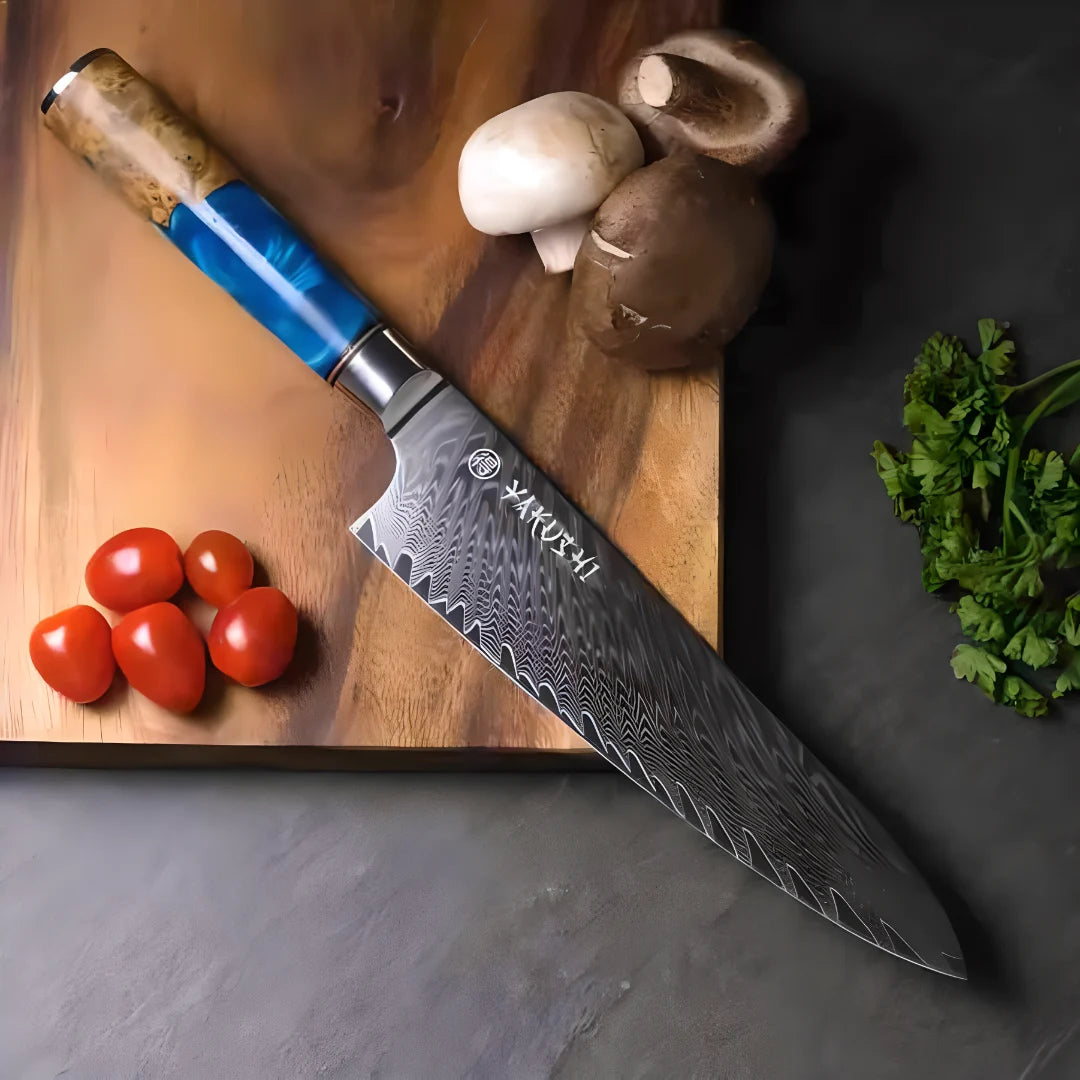
Yakushi 8-inch Damascus Chef Knife
This Japanese-style chef knife offers Gyuto-like versatility in a practical home-kitchen length. It combines an all-purpose pointed profile with a VG10 stainless cutting core, double-bevel edge, full-tang construction and solidified wood-and-blue-resin handle.
At 198g, it is designed for vegetables, fruit, herbs, aromatics, boneless proteins, gentle rocking and controlled draw cuts. Keep it away from bones, frozen food, hard pits, shells, twisting, prying and hard cutting surfaces.
Choose the performance level that fits your kitchen.
Both options use an approachable eight-inch, double-bevel, full-tang format. Their steel, finish, handle and price position differ.
Classic Japanese-style chef knife
The 192g Yakushi Classic uses a curved all-purpose profile, high-carbon stainless-steel blade and Pakka wood handle. It is a practical starting point for everyday chopping, slicing, dicing, mincing and suitable boneless-protein prep.
Damascus VG10 chef knife
The 198g Yakushi Damascus model adds a VG10 cutting core, flowing patterned finish and resin-and-wood handle while retaining the versatile double-bevel, full-tang, eight-inch format.
Compare by actual specifications.
Prices and availability can change. Use the product pages for the current details, then compare the wider Yakushi chef-knife collection.
What matters before you buy.
Profile and fit should lead the decision. Steel becomes useful only in the context of geometry, heat treatment and the maintenance you will actually perform.
Length and board fit
Choose the shortest blade that comfortably handles your largest recurring ingredients. Confirm that the full edge and tip fit safely on your board.
Profile and motion
More belly favors rocking; a flatter rear section favors push cutting and clean board contact. Match the real edge to the technique you intend to use.
Grind and thickness
Thin geometry lowers resistance, while more material can add stability. Neither extreme is universally superior; choose for your ingredients and habits.
Handle and balance
Check circumference, contour, grip security and total mass. A beautiful knife that creates pressure points is the wrong everyday tool.
Steel and heat treatment
Hardness, toughness, corrosion resistance and edge retention interact. Judge the complete treatment rather than assuming a steel name guarantees results.
Sharpening plan
Know the maker’s bevel guidance and whether you will use whetstones or a qualified professional. Maintainability is part of long-term value.
Go beyond marketing shorthand.
Use Yakushi’s guides to Japanese knife anatomy, knife steels, heat treatment and sharpening angles to compare complete specifications.
Safe use and care for either knife.
The profiles differ, but both deserve a stable surface, an appropriate task and deliberate handling.
Appropriate everyday work
- Slicing, dicing and chopping vegetables
- Preparing fruit, herbs and aromatics
- Slicing and trimming boneless meat
- Portioning suitable boneless fish fillets
- Controlled push cuts, draw cuts and profile-appropriate rocking
Tasks and surfaces to avoid
- Cutting bones, hard joints or frozen food
- Opening shells, cans or packaging
- Twisting the blade inside an ingredient
- Prying with the pointed tip
- Cutting on glass, stone, ceramic or metal
Stabilize and grip
Use a nonslip wood or suitable synthetic board, a relaxed pinch grip and a curled guide hand. Keep your cutting path visible.
Wash and store
Hand-wash promptly, dry completely and store the knife where its edge and tip cannot strike other utensils. Never leave it hidden in a sink.
Sharpen by condition
Refresh the edge when it slips, crushes food or needs extra pressure. Preserve the intended profile and follow maker-specific guidance.
Build technique around a stable setup.
The Canadian Centre for Occupational Health and Safety recommends using the correct tool and working on a stable surface. Continue with Yakushi’s guides to holding a chef knife, using a Japanese chef knife, sharpening and safe storage.
Gyuto vs chef knife FAQ.
Is a Gyuto the same as a chef knife?
A Gyuto is a Japanese multipurpose chef knife. “Chef knife” can describe the broad all-purpose category or specifically a Western pattern, so clarify which meaning a comparison uses.
Can a Gyuto replace a Western chef knife?
Yes for many cooks. Both handle general board work involving vegetables, fruit, herbs and suitable boneless proteins. Your preferred curve, thickness, weight and balance should decide.
Can you rock chop with a Gyuto?
Most Gyutos can make controlled rocking cuts because the edge rises toward the tip. The size of the arc must match the actual belly; flatter Gyutos are usually more natural for push cutting.
Which knife stays sharp longer?
No category always wins. Many Gyutos use harder steel and a thin edge that can retain cutting performance well, but heat treatment, edge geometry, board material, technique and sharpening determine the real outcome.
Is a Gyuto fragile?
A Gyuto is not inherently fragile, but thin, hard edges resist different forces than thick, tough ones. Avoid bones, frozen food, twisting, prying, impacts and hard cutting surfaces.
What Gyuto length is best for home cooks?
Approximately 200–210 mm is a versatile starting point for many kitchens. Choose 180 mm for compact control or 240 mm for more reach when your board and workspace comfortably support it.
Which is easier to sharpen?
Profile, abrasion resistance and edge condition matter more than the label. A gently curved double-bevel knife is approachable with correct instruction, while very hard or highly wear-resistant steel may require suitable abrasives.
Learn beyond the category labels.
Japan House London places the Gyuto within its overview of essential Japanese kitchen knives and documents blade craftsmanship in Tsubame-Sanjo. The Japan National Tourism Organization explains how Seki’s blade tradition evolved into modern knives and cutlery.
Editorial sources and product references
Choose the profile that makes your natural motion feel controlled.
Explore Yakushi’s Japanese-style chef knives for eight-inch reach, double-bevel versatility and a familiar full-tang handle format.