
How to Slice Vegetables Like a Chef
Professional-looking cuts begin with control, not speed. Learn how to stabilize your board and ingredients, protect your guide hand, choose the right motion and turn everyday vegetables into even pieces that cook consistently.
Build a stable setup, then repeat one controlled motion.
Use a sharp, sound knife on a secure cutting board. Create a flat base on round produce, hold the knife with a relaxed grip and curl the fingertips of your guide hand away from the cutting path. Make pieces uniform by establishing an even first slice and using it as your visual reference.
Chef-style slicing in one sentence
Set up safely, square or stabilize the vegetable, choose a cut size, guide the food deliberately and let the blade travel through it without forcing, twisting or racing.
Make the workspace predictable.
A stable board, dry hands and a clear landing area do more for control than trying to imitate restaurant speed.
Stabilize the board
Use a flat, undamaged cutting board. If it moves, place a clean nonslip mat or a clean, wrung-out damp towel underneath and confirm that the board cannot rock.
Wash and dry
Rinse produce under running water and dry it before cutting. Wash hands, board and tools, and keep raw proteins separate from ready-to-eat vegetables.
Clear the zone
Keep towels, utensils, cords and bowls outside the knife path. Reserve one nearby area for prepared food so you never reach across an exposed edge.
Check the knife
The blade should be clean, dry, sharp and free of looseness, cracks or serious edge damage. A dull edge demands more force and reduces control.
Sharp-blade safety is non-negotiable
Keep every body part out of the blade path, stop cutting if your attention is pulled away and never try to catch a falling knife. Do not leave a blade hidden in a sink, beneath a towel or among loose utensils. For more detail, review the CCOHS guidance for working with sharp blades.
Use a relaxed knife grip and a deliberate guide hand.
The knife hand steers. The other hand stabilizes the ingredient and controls how far it advances between cuts.
Secure the knife
A relaxed pinch grip is a useful starting point: place the thumb and bent index finger on opposite blade faces near the handle, then wrap the remaining fingers naturally around the handle.
Form the claw
Curl the guide-hand fingertips inward, tuck the thumb behind them and keep the leading knuckles forward. Leave comfortable clearance; your knuckles are a reference, not armor.
Advance in small steps
After each stroke, move the guide hand back by a small, deliberate amount. Slow down or stop when the remaining piece becomes too small to hold securely.
Need a closer look at finger placement?
Use our complete chef-knife grip guide, then connect the grip to your stance and stroke in how to use a Japanese chef knife.
Match the stroke to the blade and ingredient.
There is no single motion for every vegetable. The blade profile, food texture and desired cut determine whether you push, draw, rock or move primarily downward.
Push cut
Guide the edge forward and down through the food, then lift and reset. This controlled stroke suits many vegetables and works well with gyuto, santoku and nakiri profiles.
Draw slice
Use more of the blade's length in one smooth backward stroke. It is helpful for delicate produce such as ripe tomatoes and mushrooms when downward pressure would crush texture.
Straight stroke
Move primarily down and up, landing softly rather than hammering the board. A flatter nakiri can feel natural here, provided the edge is not twisted on contact.
Controlled rock
Use a small arc only when the blade has enough belly to support it. It can suit herbs and selected mincing tasks; do not force a flat-edged knife into aggressive rocking.
Technique cues that help
- Keep the wrist comfortably aligned and shoulders relaxed.
- Use the blade's length instead of pressing straight through resistant food.
- Withdraw the knife in the same plane if it begins to bind.
- Pause and realign the ingredient whenever the cut starts to wander.
- Transfer food with the blade face or spine, not the sharpened edge.
Movements to avoid
- Twisting the edge while it is embedded in food.
- Raising the blade higher than the task requires.
- Sawing rapidly with short, uncontrolled strokes.
- Forcing the knife through frozen food, bone or hard pits.
- Cutting on glass, stone, ceramic or metal surfaces.
Start with shape and consistency, then refine size.
Classical dimensions vary between culinary schools and kitchens. For home cooking, repeatable pieces suited to the recipe matter more than chasing a name or ruler-perfect measurement.
| Cut | How to form it | Useful for | Control cue |
|---|---|---|---|
| Rounds | Slice crosswise at a consistent interval. | Cucumber, zucchini, carrots and radishes. | Create a flat base first when a vegetable rolls. |
| Bias slices | Angle the vegetable or knife path to create longer oval pieces. | Carrots, scallions, celery and stir-fry vegetables. | Set the angle before the stroke and repeat it. |
| Half-moons | Split a cylindrical vegetable lengthwise, place it cut-side down and slice crosswise. | Cucumber, zucchini, eggplant and leek. | The flat face should stay planted on the board. |
| Planks | Square or stabilize the ingredient, then make parallel lengthwise slices. | The first stage of sticks and dice. | Make each plank the same thickness before stacking. |
| Sticks and julienne | Stack a few stable planks and cut them lengthwise into even strips. | Carrots, potatoes, peppers and garnishes. | Use small stacks that cannot slide or topple. |
| Dice | Turn even sticks crosswise and cut at matching intervals. | Soups, sauces, sautés and roasted vegetables. | Consistent planks create consistent cubes. |
| Chiffonade | Stack broad leaves, roll loosely and slice into narrow ribbons. | Basil, leafy greens, cabbage and herbs. | Use light slices to reduce bruising and tearing. |
Want the Japanese culinary vocabulary too?
Continue with our guide to Japanese cuisine knife cuts for technique names and culinary uses, or use vegetable breakdown techniques for larger produce.
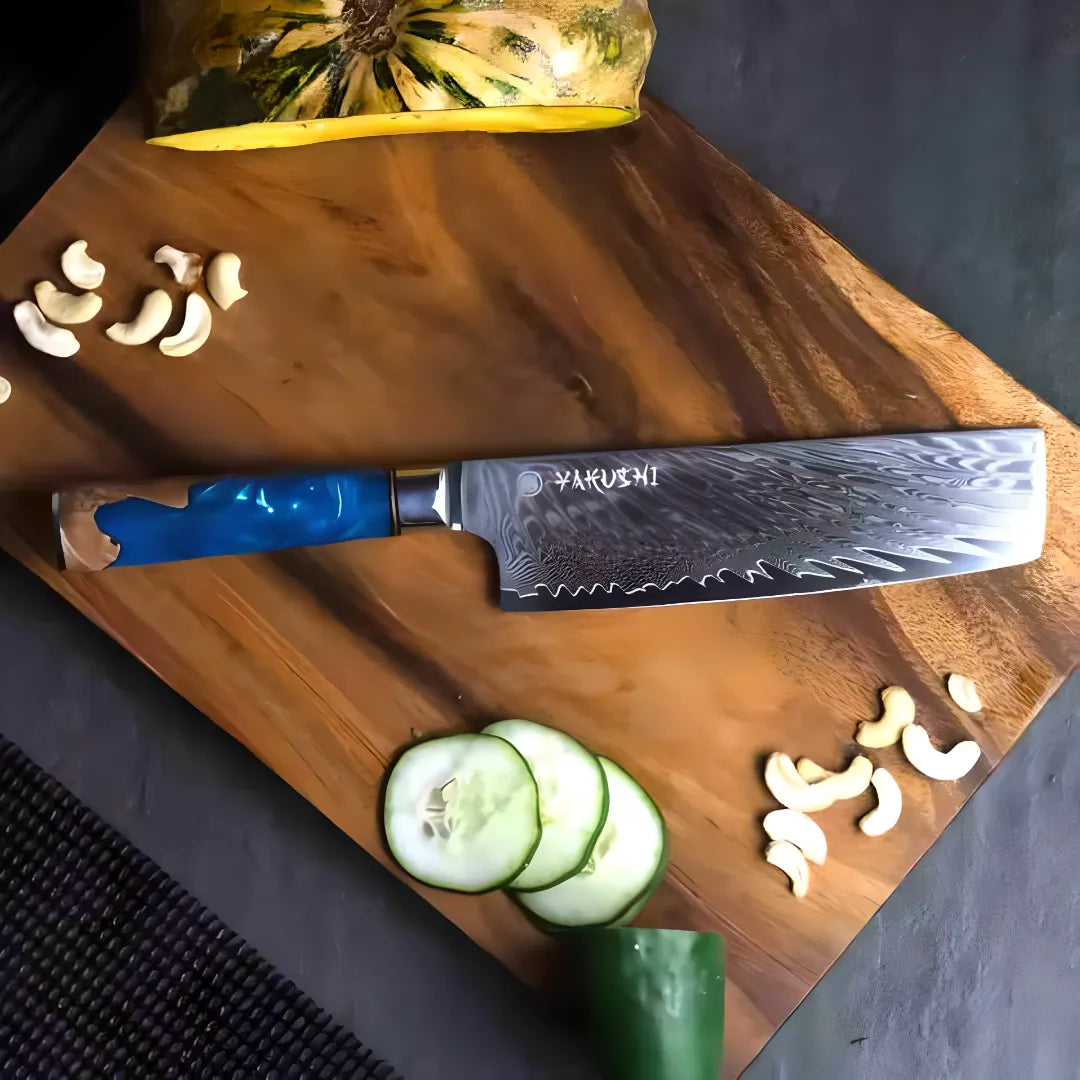
Why a nakiri feels natural on vegetables
A nakiri's broad blade provides knuckle clearance and makes moving prepared ingredients convenient. Its comparatively flat edge favors controlled push cuts and straight strokes across vegetables.
It is a vegetable specialist, not a cleaver: avoid bone, frozen food, prying and lateral force. Learn the profile in our Japanese nakiri guide.
Use the method that makes each ingredient stable.
Prep the exterior, establish a flat face when practical and keep the food in a shape you can control throughout the cut.
Onion: slices or dice
Trim the stem end, halve through the root and peel. Place the flat side down. For dice, make controlled vertical cuts toward the root without cutting through it, then cut crosswise. Keep the root only while it helps stability and discard it at the end.
Carrot: rounds, planks or sticks
If the carrot rolls, remove a thin lengthwise slice or split it to create a stable base. Cut rounds directly, or make even planks before turning those planks into sticks and dice. Work with shorter sections if the carrot bows.
Bell pepper: strips and dice
Remove the top and bottom, open one side and unroll the pepper. Trim the core, ribs and seeds, lay the panel skin-side down and slice into strips. Turn the strips crosswise for dice.
Cabbage: fine shreds
Quarter the cabbage through the core. Remove the tough core wedge, lay each quarter on a broad flat face and use long controlled slices. Keep the section compact; divide it again if your hand cannot control it comfortably.
Tomato: clean slices
Use a very sharp plain edge or a suitable serrated knife. Start with a light draw so the edge enters the skin, then continue through the flesh without crushing. Never add your free hand above the blade to force it downward.
Leafy greens: ribbons
Remove thick stems when the recipe calls for it. Stack a manageable number of leaves, roll them loosely and cut crosswise with light slices. Avoid compressing the roll so tightly that the leaves bruise.
Food safety belongs in the prep routine
The FDA's safe food handling guidance recommends washing hands and surfaces, rinsing fresh produce under running water and separating fresh produce from raw meat, poultry and seafood.
Which knife is best for slicing vegetables?
The best choice is a sharp knife you can control comfortably. Blade length, height and edge curve should match your board, hand and preferred stroke.
Gyuto
A versatile choice for vegetables and mixed prep. Its length helps with larger produce and long draw slices, while moderate belly can support selected rocking motions.
Santoku
Compact and approachable for everyday vegetables. Its moderate length and flatter profile often feel controlled in smaller kitchens and with forward-and-down cuts.
Nakiri
A dedicated vegetable shape with generous blade height and a relatively flat edge. It suits push cutting and straight strokes but is not intended for bones.
Petty or paring knife
Useful for trimming, coring and small detail work. Use an appropriate small knife for tasks that feel awkward with a full-size blade; avoid unsupported cutting toward your palm.
Choose fit before labels.
Enough knuckle clearance, a predictable balance point and a blade length that fits your board will improve control more than owning the most specialized profile. See our guide to the best Japanese knives for vegetables for a fuller comparison.
A simple practice plan for more even cuts.
Accuracy comes first. Speed is a possible result of repetition, not a target to force.
Choose one forgiving vegetable
Start with a cucumber half, zucchini half or short potato section that rests securely. Avoid very hard, tiny or slippery ingredients while building the motion.
Set one visible target
Choose rounds, planks or sticks and decide the thickness before cutting. Make the first piece carefully and place it nearby as a reference.
Cut slowly in small batches
Make five to ten deliberate strokes. Check the grip, fingertip position and board before each short sequence, then compare the pieces.
Correct one variable
If pieces taper, check the blade angle. If they vary in width, advance the guide hand more consistently. If the food moves, rebuild the flat base.
Use the result in a meal
Practice becomes sustainable when the vegetables go into soup, stir-fry, salad or roasting trays. Our knife skill-based recipes turn repetition into dinner.
Reset and care for the edge
Wash the knife by hand, dry it promptly and store it securely. Follow the Japanese knife care guide and sharpen when performance declines.
Common mistakes and practical corrections.
| What you notice | Likely cause | Adjustment to try |
|---|---|---|
| The vegetable rolls | It has no stable contact surface. | Stop and create a flat face, or divide it into a smaller section that rests securely. |
| The knife crushes instead of slices | The edge may be dull, the food delicate or the stroke too vertical. | Use a sharp appropriate knife and a longer draw slice with lighter pressure. |
| Pieces taper | The blade tilts during the stroke. | Slow down, keep the wrist quiet and watch the blade enter and leave in the same plane. |
| Pieces vary in width | The guide hand advances inconsistently. | Move the guide hand in smaller increments and use the previous piece as a visual reference. |
| Food sticks to the blade | Moisture, starch and a broad blade face create adhesion. | Pause safely, set the knife down and wipe it. Do not swipe food from the edge with your fingers. |
| Your hand tires quickly | The grip may be too tight or the board height uncomfortable. | Relax the pressure, bring the work closer and take a break before fatigue reduces control. |
Sharpening is maintenance, not a rescue during prep.
If the blade needs excess pressure or cannot make a clean controlled cut, stop and service it away from the active prep area. Use our Japanese knife sharpening guide and sharpening angle guide before working on the edge.
Common questions from home cooks.
How do chefs cut vegetables so evenly?
They stabilize the ingredient, choose the final size before cutting and repeat a controlled motion. Planks of equal thickness lead to even sticks, and even sticks lead to even dice.
What is the safest way to hold vegetables while slicing?
Create a stable base, curl the guide-hand fingertips inward, keep the thumb behind them and advance the hand in small increments. Leave comfortable clearance from the edge and stop when the remaining piece is too small to hold securely.
Should I push cut or rock chop vegetables?
Use the motion your knife profile and ingredient support. Push cuts work well with many Japanese chef knives. Controlled rocking can suit a blade with enough curve, but a flatter nakiri or santoku should not be forced into a large rocking arc.
How can I keep a carrot or cucumber from rolling?
Create a flat side by splitting the vegetable lengthwise or removing a thin slice. Place that face on the board before making smaller cuts.
Why does my knife squash tomatoes?
The edge may be dull or you may be applying too much downward force. Use a sharp suitable edge and a gentle draw slice. A serrated utility knife is also appropriate for very delicate skins.
Is a sharper knife safer?
A sharp knife can require less force and feel more predictable, but it can still cause a serious injury. Safe setup, attention, correct technique and secure storage remain essential.
How should I move chopped vegetables off the board?
Use a bench scraper when available, or turn the knife and use its spine or broad face carefully. Scraping sideways with the sharpened edge can dull or damage it.
How do I get faster with a knife?
Practice accuracy and rhythm in short sessions. Speed should come only after your board, grip, guide hand and stroke remain consistent without rushing.
What cutting board should I use?
Use a stable, clean board made for food preparation, large enough for the ingredient and knife. Avoid glass, stone, ceramic and metal cutting surfaces because they are hard on edges and may be slippery.
Further reading from trusted sources
Choose a blade that makes vegetable prep feel natural.
Compare Japanese steel knives, find a stable cutting surface and keep building skills one calm, useful meal at a time.